Who Fronts the Ad Spend, and Who Marks It Up?
Your paid social agency has sent its first invoice, and one line says ad spend. You have logins to the ad platforms, yet nothing you can open shows that number. You are being asked to pay it anyway.
The invoice line you cannot match
Picture a hypothetical retailer opening its first agency invoice. There are two lines: a fee, and “Media” with a single figure, no platform named, no dates. Nothing it can see in the ad dashboards adds up to that figure.
The question is not whether the ads are working. It is who pays the platform, and what gets added on the way to your invoice. This is separate from who owns the ad account and from how the fee is calculated, covered in the post on retainer, percentage of spend and performance fees.
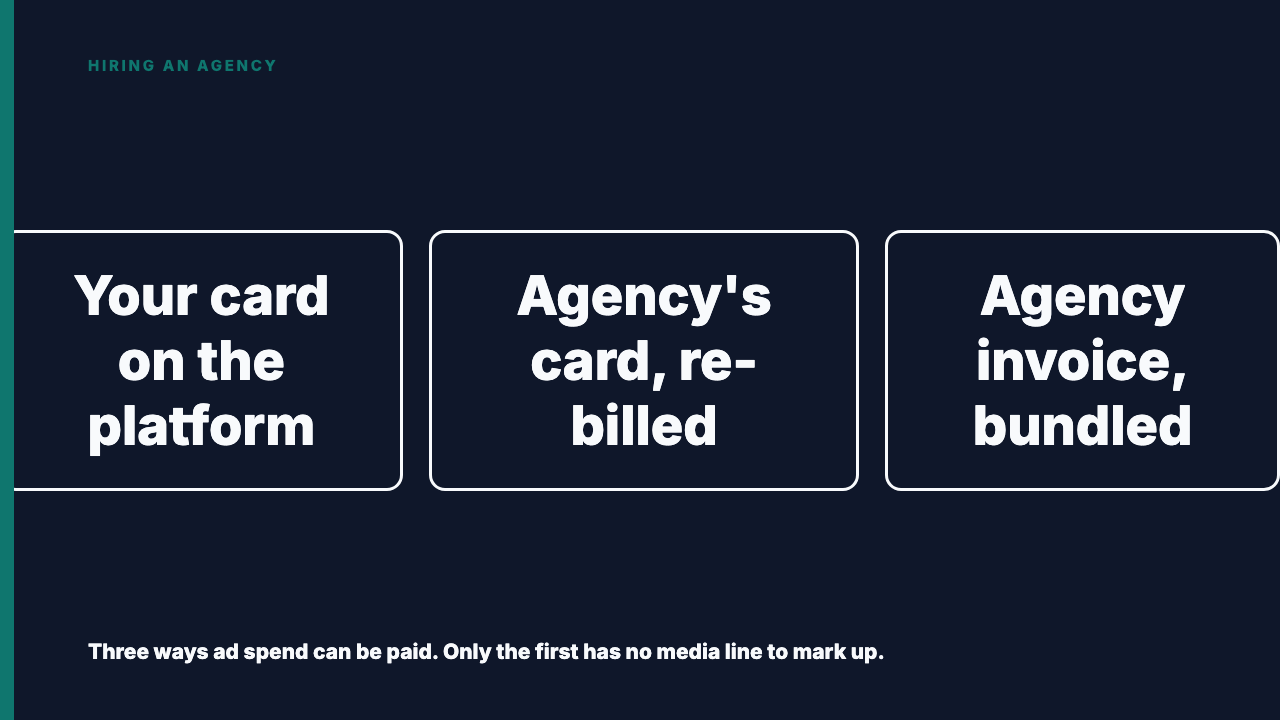
The three ways the money moves
| Flow | Who fronts the cash | Who sees platform charges | Where a markup could sit |
|---|---|---|---|
| Your card on the platform | You. The platform bills you directly. | You, in your own account. | Nowhere on the media. The agency has no line to mark up. |
| Agency’s card, re-billed | The agency, until you reimburse it. | The agency, and whatever it shows you. | In the re-billed amount, if it exceeds the platform charge. |
| Agency invoice, bundled | The agency. | The agency. You see one blended number. | Inside the bundle, inseparable from the fee. |
The brand-card flow removes the middleman. The other two put someone between you and the platform charge.
The agency-card flow has a cash-flow consequence: the agency is financing your media until you pay it. That is a reason some agencies want shorter payment terms or a deposit.
Where a markup hides, and where it does not
Here, a markup means the agency bills you more for media than the platform charged the agency. It is distinct from a management fee, which is the disclosed price of the agency’s work. A markup is not automatically improper. An undisclosed one is a transparency failure, because you cannot judge a price you cannot see.
A blended number hides it well. Illustrative, round invented figures, not typical ones: you agreed a fee of 2,000, and the invoice says “Media and management: 12,000”. You assume 10,000 of media. If the platform actually charged 9,000, the agency kept 1,000 beyond its fee and nothing on the page says so.
A hypothetical invoice, line by line
The good version
- Meta ad spend, 1 to 31 October, at cost: 10,000
- Google Ads spend, 1 to 31 October, at cost: 4,000
- Management fee, as agreed: 2,000
- Other pass-through costs, each on its own described line (see software costs billed on top of the retainer)
Each spend line names a platform and a period. You can subtract the platform’s own billing record for those dates from the invoice and check whether the remainder equals the agreed fee.
The bad version
One line reads “Media and management: 16,000”. Or “Ad spend: 14,000” with no period and no platform. Neither can be compared with anything.
How to reconcile the spend line against the platform
- Get view-only access to the billing or transactions area of each ad account. In Meta, ask for a role that can see billing and confirm which roles can.
- Pull the charges for the invoice period.
- Match the date range exactly, including the account’s time zone.
- Compare the platform total to the invoice’s spend line.
- Account for taxes and platform-side credits separately.
Small mismatches usually have innocent causes: billing period cut-offs, charges posted after the invoice date, currency conversion, taxes, credits. Treat each as a reason to ask, not an accusation. If the agency cannot explain a mismatch in writing within a reasonable window, invoke your contract’s billing dispute terms.
Google Ads documents adding a payment method, and describes monthly invoicing as typically used by large advertisers and agencies managing client accounts.
What to insist on in the contract
My position: insist on either spend billed at cost with the fee as a separate line, or a payment method on the platform in your own name, and preferably both.
Name the clauses. May the agency add anything to platform charges? Do you get billing-level visibility in the account? How far in advance will the agency tell you about budget changes? What happens to unspent budget at the end of the month or term?
An acceptable answer to pushback: the agency will not open platform billing, but states its media margin as a percentage in the contract. An unacceptable one: refusing any visibility while calling the line “at cost”. If the agency fronts the spend, it may reasonably ask for shorter payment terms. That is a negotiation, not a red flag. Billing transparency is one item in what to vet when hiring a paid social agency.
Finding agencies that will show you the numbers
The directory lists 11 agencies in the Paid Social niche, and says nothing about how any of them bill. Ask every shortlisted agency: “Is media billed at cost, and can I see platform-side spend myself?” A clear yes, or a specific no with a disclosed margin, is workable. Vagueness is not.
Browse vetted agencies, or list your agency free.
FAQ
Is it normal for an agency to add a markup to ad spend?
Some arrangements include one and some bill at cost. The issue is disclosure, so ask which model applies before you sign.
Should ad spend go through my card or the agency’s?
Preferably your own payment method on an account you control, so the platform bills you directly. If you accept the agency’s card, require spend at cost on its own line.
What if I cannot get access to the platform billing screen?
Require an itemised platform statement with each invoice, covering the same dates as the spend line. Access and control are covered in the post on who owns the ad account.
What is the difference between ad spend and the agency fee?
Ad spend is what the platform charges to run ads. The fee pays for the agency’s work. How the fee is calculated is covered in retainer, percentage of spend and performance fees.