Brand Safety and Ad Adjacency Belong in the Contract, Not the Platform
Most paid social scopes of work get argued over line by line on creative approval, reporting cadence, and spend. Almost none say a word about what the ad account is configured to avoid running next to. The setting exists already, chosen by whoever had account access at launch, and nobody with authority to negotiate it looked at it.
The assumption that goes unstated in most scopes of work
Brand safety and adjacency settings do not live in the creative brief or the reporting deck. They live inside the ad platform’s account configuration, in a menu a buyer reviewing creative and results has no reason to open. The client sees the ad and the numbers, not the suitability tier or exclusion list the account was set to at launch, and nobody ever asks.
That silence has a default outcome. These settings are chosen, actively or by inaction, by whoever holds account access, usually the agency. Whatever the agency’s standard setup happens to be becomes the client’s brand safety posture, discussed or not.
What brand safety and adjacency controls actually are
Two layers get talked about as one thing. The first is what the platform prohibits outright: content violating its own policies, which cannot carry ads at all. No configuration is required for that floor.
The second layer is what this post is about. Above that floor sits content the platform allows ads on, that an advertiser can still choose to avoid being placed near. Google’s documentation on content suitability describes this as additional filtering on top of the policy baseline, letting an advertiser set a suitability tier or exclude content categories. Google’s Display and Video documentation draws the line more directly: brand safety is automatic filtering that keeps ads off content nobody wants to run on, while suitability is the narrower, advertiser specific layer on top, already a subset of brand safe content by definition.
In practice this shows up as sensitivity tiers and category exclusions set at the account level. None of it configures itself. Someone with account access sets a tier, sets exclusions, or leaves the default in place.
Where this actually bites: hypothetical scenario
Picture a brand that hired a paid social agency for a product launch. The scope covers targeting, budget, and reporting, and says nothing about suitability settings. Now picture one of those ads landing next to unrelated contentious news content, or beside a flagged account the platform has not removed. Nothing about the ad is wrong. The problem is where it landed.
The answer turns out to be unremarkable: the account ran on the platform’s default, most permissive setting, because nobody had set it to anything else. Not carelessness with the media plan, not a platform policy failure, just a default nobody chose on purpose.
This is a hypothetical, not a real brand, agency, or incident. The setting that determined whether this could happen was never a negotiated choice.
Questions to ask before you sign, not after a placement goes wrong
- Does the agency apply a content suitability setting by default, or only when asked?
- Does the agency maintain a standing exclusion list of publishers or categories, and will it show the client that list?
- Who inside the agency can change these settings once live, and is a change logged the way a targeting or budget change would be?
- After a bad adjacency placement, is there a proactive review step, or does the client have to notice and flag it?
What belongs in the scope of work itself
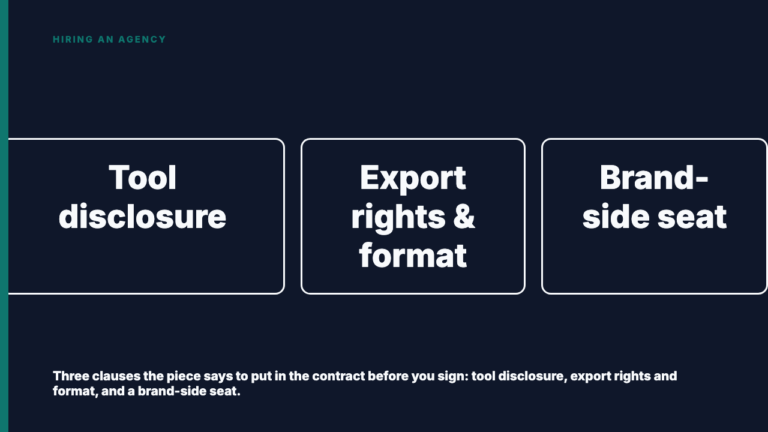
The answers are only useful in writing. A scope that promises “brand safety” as an unspecified feature has committed to nothing. It should name the specific suitability tier or exclusion approach the agency will apply as the account default.
The same goes for exclusion lists. If the client cares about excluding specific publishers, categories, or competitor adjacency, that belongs in the scope as something the agency configures and can prove, not something assumed already running. “We handle that” is not a clause. A named list, reviewable on request, is.
A change to these settings mid contract should require the same notice as a change to targeting or budget. It changes what the brand’s ads sit next to, without touching the approved media plan.
What this is not about
This is specifically about paid placement adjacency inside an ad platform’s own inventory, not the platform’s community guidelines, and not the agency’s organic content choices or creative quality. Those are decided elsewhere. Nor is this a request for a guarantee of zero risk, which no platform or agency can promise. The fix is contractual specificity: naming the setting, writing it into the scope, requiring notice when it changes.
Before you sign anything, read what to vet differently when hiring a paid social agency and how to read a scope of work before you sign it. Account access decides who controls these settings by default, so see who owns the ad account when an agency runs your paid social, and for the broader picture, what to check in a social media agency contract. Ready to compare agencies who put this in writing? Browse vetted agencies, or if you run one, list your agency free.
FAQ
Does the platform automatically keep my ads away from bad content?
Only up to a point. Platforms enforce their policies against prohibited material, and that floor applies without any setup. Suitability and adjacency exclusion beyond it is a separate, advertiser level choice, per Google’s own documentation. If nobody configured it, the account runs on whatever default the platform sets.
Is this the agency’s fault if it happens?
Treat it as a scope of work gap, not a question of blame. If the contract never named a suitability setting or exclusion list, neither side has anything on record to point to. The useful move is writing the setting into the scope going forward as an explicit, checkable deliverable, not assigning fault after the fact.
What is the difference between brand safety and brand suitability?
Per Google’s documentation, brand safety is the narrower, platform enforced floor filtering out content no advertiser may run against. Suitability sits above that floor as the advertiser’s own preferences, set through sensitivity tiers and exclusions. Suitability content is a subset of brand safe content, not a separate or looser standard.
Should I ask to see the exclusion list itself?
Yes. A verbal assurance is not something you can hold anyone to. Ask for the actual list or setting name, and put the right to review it into the scope of work rather than taking it on trust.