Your Agency Invoice Does Not Match the Retainer. Here Is the Process
You open the invoice, and the number is not the number you signed for. Some line items look unfamiliar. A rate has changed. The retainer on the contract and the total on the bill do not agree, and you have to decide what to do before you pay, refuse, or say anything to the agency.
The invoice is higher than the retainer. Start here.
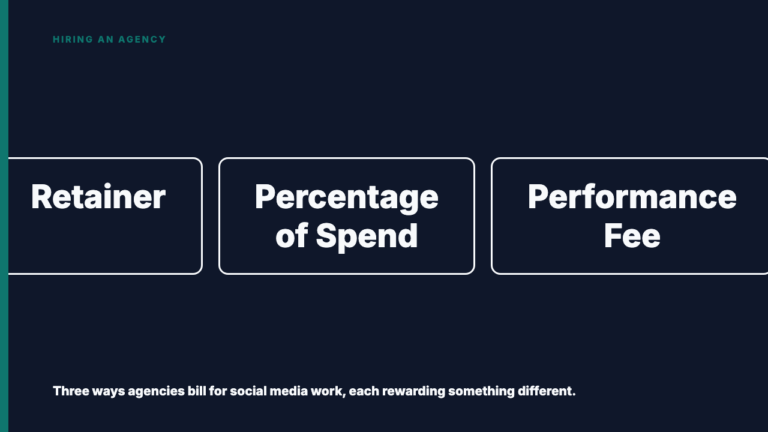
Most mismatches trace back to one of three causes: add ons approved informally over email or Slack and never folded into a written scope change, rush fees with no rate defined in the contract, or hours reclassified into a different bucket than what was scoped, billed under a new name at a new rate. That drift is easier to spot once you understand how agency fee structures actually work.
The instinct runs one of two ways: pay it because arguing feels awkward, or refuse to pay any of it because something looks wrong. Both are the wrong first move. The invoice is a document you check against another document, not a feeling you respond to. Open the scope of work and put it next to the invoice first.
Match the invoice to the scope document, line by line
This works best when the signed scope of work is specific enough to check anything against. If yours reads more like a pitch than a spec, how to read a scope of work before you sign it is worth fixing at your next renewal.
- Put the scope’s deliverables and hours in one column and the invoice’s line items in the other, side by side, not from memory.
- Mark every invoice line as covered by scope, an approved add on, or unexplained.
- The proof standard for an add on is a written approval, not a verbal go ahead on a call. No email or ticket means it goes in the unexplained column.
- Once every line is labeled, stop before contacting the agency. The unexplained column is the basis for the conversation ahead, and it needs to be complete first.
How rush fees and reclassified hours slip past you
Picture a brand that asks for a same week turnaround on a post originally scheduled two weeks out. The agency bills a premium rush rate, but the contract defines no rush rate, so the brand cannot check whether the premium is reasonable. The missing schedule turns a fair request into an unverifiable charge.
Now picture a recurring monthly call, same meeting, same people, same agenda. One invoice cycle logs the hours under strategy. The next logs the same call under account management. If those categories carry different rates, the price of an identical meeting changed without the meeting changing. A loose habit of categorizing time is enough to cause this, and it is exactly the drift a line by line reconciliation catches.
What to actually say when you dispute a line item
The strongest position is the most specific one. Point to the exact line, the exact clause it should map to, and the gap between them. That is a dispute. Telling the agency the bill feels high is a complaint, and complaints are easy to absorb or outlast because there is nothing concrete to resolve.
Before you reject anything, ask for the underlying detail: which deliverable, which date, whose hours. An agency operating in good faith should answer without friction, and a vague answer is itself useful information.
A dispute names a specific line and a document it conflicts with. A complaint just says the total feels wrong.
What a dispute window and process should say before you ever need it
A well written contract defines this in advance, before either side is annoyed about a specific invoice. It should set a response window, a fixed number of business days after the invoice arrives during which the brand can formally flag a line item as disputed, so “I meant to raise it” cannot become “too late.”
It should also say what happens to a disputed amount while unresolved, either withheld until resolved or paid in full and credited back later, and what happens if the dispute is not resolved before the next billing cycle starts. A contract silent on these questions defaults to the agency’s own payment terms, written for the agency’s protection.
When a billing dispute is actually a scope creep problem
There is a version of this that keeps recurring even when every invoice checks out: the add ons were genuinely approved, the rush fees have a defensible basis. If that is the pattern across several cycles, the problem was never the invoice. Scope keeps expanding in small increments a formal change order process never catches, so each invoice looks fine while the retainer quietly stops matching the work.
Re litigating each invoice treats the symptom. The fix is upstream, in what counts as a change order, so the next request gets priced and approved before it happens.
Talk to an agency that gets this right
A dispute process this clean only works with an agency willing to put it in writing. Browse vetted agencies if you are still choosing who to hire, or list your agency free if you run one and want to be found by brands who read posts like this first.
FAQ
Should I pay the invoice first and dispute it after, or withhold payment until it is resolved?
This should be answered by the contract’s dispute clause, not decided in the moment. If the contract is silent, the safer default is to pay the undisputed portion on time and formally flag the disputed lines in writing, rather than withholding the entire invoice.
What if the agency says the extra charges were verbally approved?
A verbal approval with no written follow up cannot be verified by either side after the fact. Ask for whatever record exists: an email, a message, a ticket. The absence of one is grounds for the dispute to stand, not proof of bad faith either way.
How long should a dispute window be?
There is no standard number to reach for. Set the window long enough to reconcile the scope document against the invoice, typically measured in business days, and put that number in the contract itself rather than relying on custom.
What happens if we cannot resolve the dispute before the next invoice is due?
This is exactly what the dispute clause should define in advance: whether the disputed amount is escalated, credited, or carried forward. Without that language, two invoice cycles of disagreement stack instead of closing out.
Sources
- How to read a scope of work before you sign it, checked 2026-09-09.
- How agency fee structures actually work, checked 2026-09-09.
- What counts as a change order, checked 2026-09-09.
- Browse vetted agencies, checked 2026-09-09.
- List your agency free, checked 2026-09-09.