What Your Agency Actually Owes You Outside Its Billed Hours
You send a message to your social media agency on a Saturday afternoon because something urgent came up. Nobody responds. Monday morning arrives before anyone does. You are left wondering whether you just witnessed a broken promise or an assumption you never checked.
The weekend message that never got answered
Picture a hypothetical brand, clearly illustrative and not a real client story. They pay a sizable monthly retainer and came to believe its size meant someone was always watching. Nothing in the contract said so. It was simply assumed, the way people assume a gym membership includes a locker even when nobody confirmed it.
On a Saturday, a post needs a quick edit before it goes out to a partner audience. The marketing lead messages their main agency contact, expecting a reply within the hour because that is how fast the agency moves on a weekday. Nothing comes back until Monday, and when the agency treats the delay as normal, the brand feels blindsided.
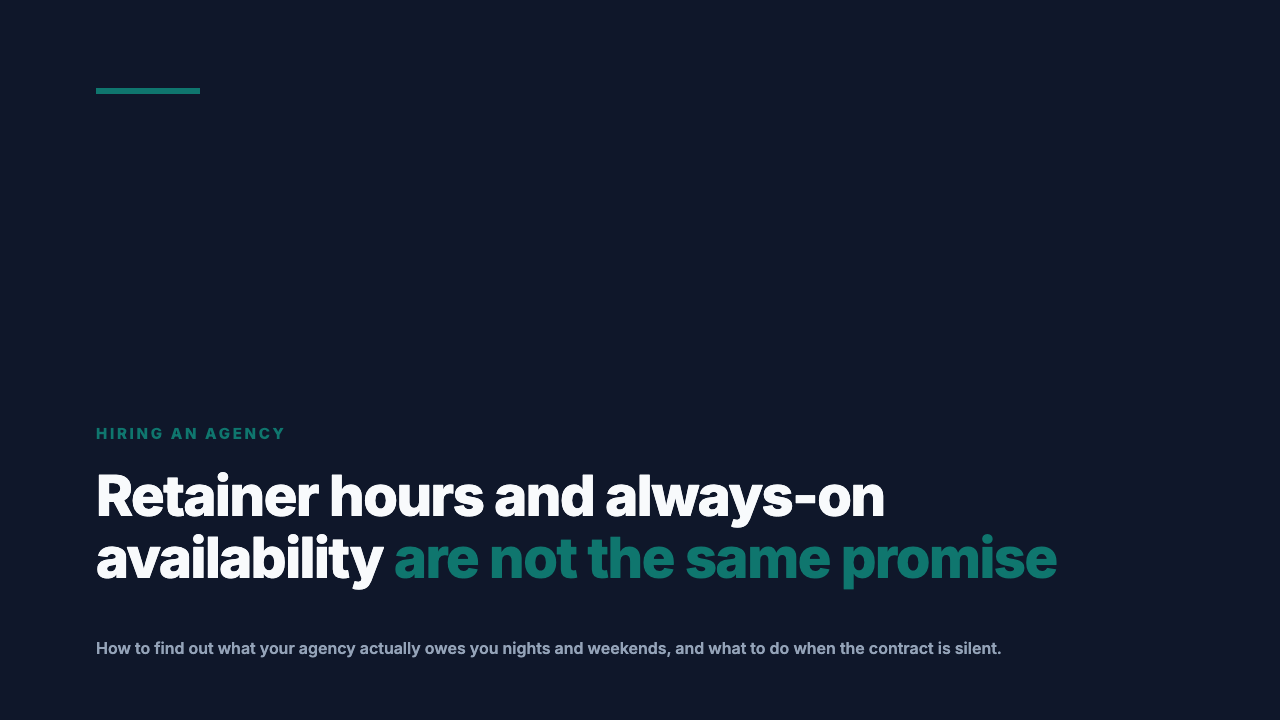
The confusion sits in one place: two different things were treated as one. Billed working hours are when the agency is doing the contracted work, planning posts, running campaigns, reporting on results. Availability is a separate promise about when someone will pick up an urgent message outside that window. A retainer buys the first. It does not automatically buy the second, no matter how the price tag feels.
Why the contract is usually silent on this
Most social media agency retainer contracts are written around deliverables and hours of billed work: how many posts get made, how many platforms get managed, how many hours of strategy time are included in a month. They rarely specify whether anyone is reachable at 9pm on a Tuesday, because standby time is a staffing cost agencies have no incentive to price in unless asked.
This differs from a true emergency escalation clause. Some contracts carry language for a genuine crisis, a hacked account, a reputational incident spreading in public. PartnerInSocial has covered what to check in a social media agency contract more broadly, and crisis escalation is its own separate topic here. That clause is not the same commitment as routine after-hours responsiveness, and treating the two as interchangeable is part of what causes the disappointment above.
Silence does not default to unlimited availability or to no availability. It defaults to undefined, and undefined terms tend to resolve in favor of whichever side asserts a norm first once something goes wrong.
What “billed hours” actually cover versus what after-hours availability would cost
A retainer covering a fixed number of monthly hours is a budget for planned work, not for someone sitting near a phone on a Saturday. Standby coverage, when offered, is almost always a separate line item, priced separately because it is staffed separately. Someone has to be on call, and that costs money whether or not the phone rings.
The good version looks concrete: a quoted add-on fee for defined after-hours monitoring, with a stated response window and a stated scope of what qualifies, an account security issue rather than a routine content question. The bad version is a sales conversation where “we’re always here for you” gets said warmly, but never becomes a number or a clause.
The specific language to look for in your contract
- Response time or SLA language, and whether it states the hours it applies to.
- A defined “business hours” clause. A response time commitment is meaningless without an anchor for when the clock is running.
- A separate emergency or crisis clause, and how it differs from a routine after-hours message. A genuine crisis clause covers account compromise or an active reputational incident, not a Friday-night question.
- An escalation path. Who gets contacted after hours, and by what channel? Without a name and a channel, there is no path.
What to do when the contract says nothing
If your contract addresses none of this, do not wait for the next dropped message to force the conversation. Raise it now, as a written clarification request rather than a general complaint about responsiveness.
Give the agency two outcomes to choose between. Either they state plainly, in writing, that messages sent outside defined business hours will be answered the next business day with no exceptions, or they offer a paid add-on defining actual after-hours coverage: what channel is monitored, what response time applies, and what messages qualify.
Either answer beats the silence you have now. Even “next business day, no exceptions” removes the guessing, because you know which one it is before the next Saturday arrives.
What a reasonable after-hours clause actually looks like
Excluding after-hours response: “Messages received outside defined business hours (Monday through Friday, 9am to 6pm local time) will be addressed on the next business day. No after-hours monitoring is included in this agreement.”
With a paid after-hours tier: “After-hours coverage includes monitoring of [named channel] for account security incidents and reputational emergencies only, with a response time of [stated window]. Routine content requests and general questions are addressed during standard business hours regardless of when they are sent.”
If your contract mentions billed hours without mentioning either of these, reading your agency scope of work before you sign it is the broader habit that would have caught this. If after-hours coverage gets added at renewal, that addition is itself a change order, and should be priced and documented like one.
Get vetted agencies who put this in writing
An agency willing to name its after-hours terms in a contract, not just in a sales call, is worth noticing before you sign. Browse vetted agencies, or if you run one that already does this well, list your agency free.
FAQ
Does a retainer automatically include weekend or evening availability?
No. A retainer is typically a budget for a defined amount of planned work during business hours. Availability outside those hours is a separate question the contract has to answer explicitly, and most do not.
If my agency doesn’t answer on a Saturday, is that a breach of contract?
Only if the contract specifies a response time covering weekends and the agency missed it. If the contract is silent, there is nothing written to have breached, and that silence is itself the problem worth fixing.
Sources
- What to Check in a Social Media Agency Contract, PartnerInSocial. Fetched 2026-09-09, HTTP 200.
- How to Read an Agency Scope of Work Before You Sign It, PartnerInSocial. Fetched 2026-09-09, HTTP 200.
- What Counts as a Change Order With Your Social Media Agency, PartnerInSocial. Fetched 2026-09-09, HTTP 200.
- Browse vetted agencies, PartnerInSocial. Fetched 2026-09-09, HTTP 200.
- List your agency free, PartnerInSocial. Fetched 2026-09-09, HTTP 200.