Who Keeps the Influencer Relationships When You Switch Agencies
You are weeks into replacing your social media agency when someone asks the question nobody asked at signing: who holds the influencer contracts? If the outgoing agency sourced the creators and signed the paperwork, it does.
Why the relationship sits with the agency and not the brand
The influencer agreement is commonly signed between the agency and the creator, or the creator’s management, with the brand named as the campaign client rather than as a contracting party. The agency sourced the creator, knows the rate that creator last accepted, and may run the same creator across several accounts. The FTC’s endorsement guides FAQ tells companies that recruit influencers for marketers, and pay and direct them, to run their own training and monitoring. That speaks to who pays and directs, not to who signs, but the paperwork follows the payment.
None of that is a law of nature, just a default, and defaults are negotiable. You can require that agreements name your brand as a signatory, and that the agency keep a record of every relationship built on your money. Most brands never ask.
What actually gets lost when you switch
Picture a regional skincare brand that ran eight influencer partnerships over a year through its agency, one of them close to an ambassador deal. Then it switched agencies, and the new team asked what it had been paying.
Nobody knew. The invoices showed a bundled influencer line item, the reports named creators but not terms, and the ambassador’s category exclusivity existed nowhere in writing. Every rate went back to open, and two creators quoted higher. Losing the contact was trivial, since all eight are publicly findable. Losing the leverage was not: the negotiated rate, the reasons behind it, the exclusivity, the record of which creator drove results.
The deliverable to require, not request
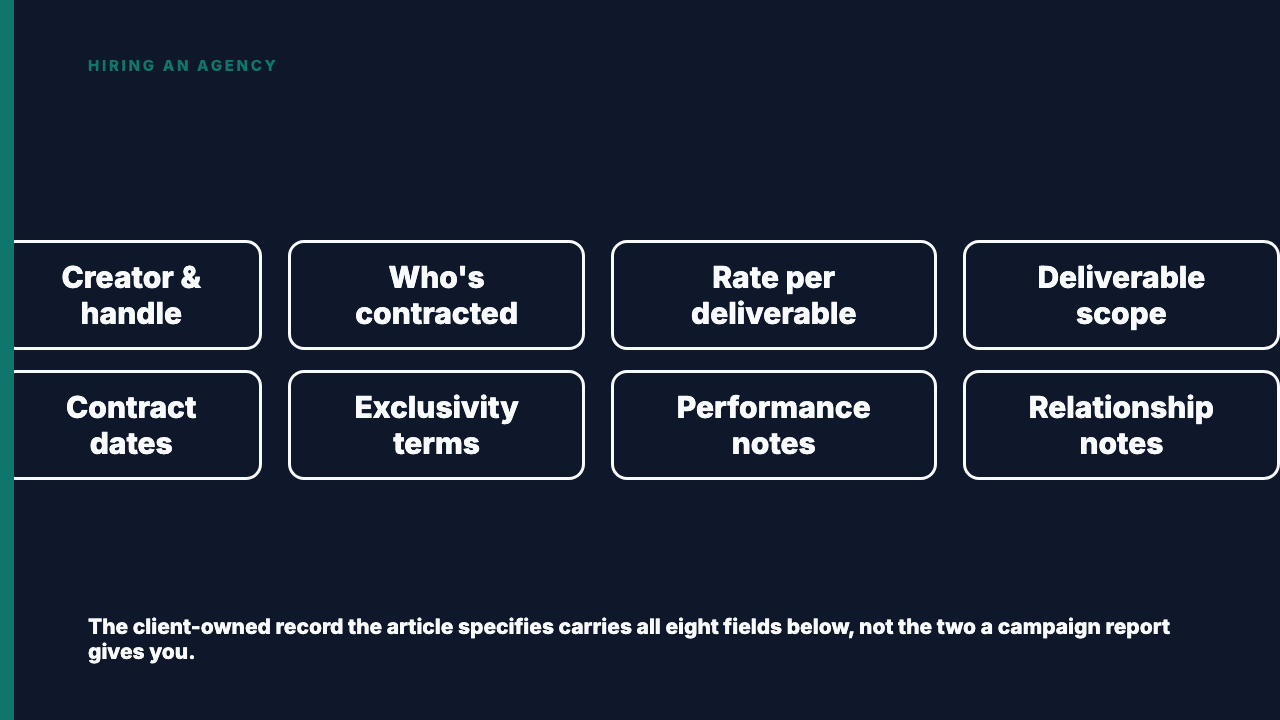
What you want is not a summary but a client-owned record you can sort and filter:
- Creator name and handle, plus the platforms covered.
- Who was contracted: the creator, their management, or a network.
- Contracted rate, per deliverable, not bundled into a campaign total.
- Deliverable scope: post counts, formats, usage rights, whitelisting, duration.
- Contract dates, including renewal or option terms.
- Exclusivity terms: any category lock or first refusal, and its expiry.
- Performance notes per creator, in your existing reporting metrics.
- Relationship notes: who introduced whom, what the rate was negotiated down from.
Make it a scheduled deliverable, quarterly or on request, not a document assembled at offboarding under time pressure. You pay for the relationship, so the record of it is work product, the same principle behind who owns your social accounts when an agency runs them.
Where this fits in the contract, not just the conversation
A nod in a kickoff call is not a deliverable, and neither is a slide in a quarterly review naming the creators. Unless the roster sits in the scope of work or a reporting clause, with a format and a cadence, it is not an obligation.
The clause has to reach into termination: handed over in full, in an editable format, within a defined number of days, not conditional on the account being in good standing, which is when it gets withheld. Have counsel check the wording against what to check in a social media agency contract. Raise it before signature: a prospect gets the clause written in, a client on the way out is asking a favour.
What to ask a prospective agency about influencer relationships before signing
- Will agreements be signed agency-to-creator or brand-to-creator, and what happens to them if we part ways? Either answer is fine if it is clear. Vagueness means agency-to-creator with no transfer plan.
- Will rate history and performance by creator come as raw data, or only inside a summary deck? Agencies that treat per-creator rates as proprietary say so when asked.
- If we negotiate exclusivity or first refusal, what happens if we move that creator in-house or to another agency? The answer reveals whether the exclusivity was bought for you or for them.
Ask them alongside everything else in what to vet differently when hiring an influencer marketing agency.
This is a subset of a bigger handover problem, but it needs its own line item
Agency transitions carry a long handover list: account access, content calendars, asset libraries, reporting history. Influencer relationships get lost inside it because everything else on that list exists between you and the agency alone. This one adds a third party with their own manager and preferences.
A folder of content files cannot decide it prefers your old agency. A creator can. If nobody memorialised who introduced whom, at what rate, on what terms, the relationship quietly re-attaches to the outgoing agency. Give it its own line in the exit plan, not a bullet inside how to leave a social media agency without losing the history.
Where to start
Ask the roster question on the first call. Partner in Social lists 14 agencies in the influencer marketing category, so you can browse vetted agencies to build a shortlist. Running an agency? You can list your agency free.
FAQ
Can I require influencer contracts to be signed directly between my brand and the influencer instead of through the agency?
Yes, and some brands insist on it so the relationship survives whichever agency manages it. Agencies often resist, because a direct contract removes their ability to carry a negotiated rate across other clients. You also absorb the contract administration.
Is a list of influencers used in a campaign the same thing as a roster and rate history deliverable?
No. A campaign report names the creators you used. It rarely carries the contracted rate per deliverable, the exclusivity terms or the negotiation history. What this post describes is closer to a client-owned database than a report.
What if my current agency refuses to hand over influencer rate history when I leave?
If the roster was never written into the scope of work, you have little standing to demand it, and refusal is predictable rather than bad faith. Ask anyway, in writing, naming the exact fields you want.
Does this apply if my agency only runs organic content and paid social, not influencer campaigns?
No. This applies only to agencies running influencer marketing inside their scope.
Sources
- Federal Trade Commission, The FTC’s Endorsement Guides: What People Are Asking. Fetched 2026-09-07.