Hiring a Social Media Agency for a Seasonal Business
Your business does most of its revenue inside one window: the weeks before the holidays, or the run up to a filing deadline. Then an agency quotes one flat monthly fee for all twelve months.
The retainer was built for a business that works the same in March and November
A monthly retainer is a capacity reservation. You buy a fixed allocation of named people, some share of a strategist, a community manager, a designer, held for you whether or not you use it, producing deliverables at a cadence that does not change month to month. For a seasonal business the need is a spike, and a flat retainer prices the spike and the flat line at the same rate. Background: how retainer, percentage of spend, and performance fees actually work.
Two ways this costs a seasonal business money
- You overpay through the quiet months. With nothing to launch, you pay a full fee for capacity you are not consuming, and the agency fills the gap with work you would not have bought.
- You get understaffed at peak. An agency sized around a flat average has staffed to that average. When a short, intense peak multiplies the workload, that allocation is still all you have, and adding people takes lead time nobody committed to.
- These are one problem, not two. Overpaying in February and being underserved in November are opposite symptoms of one flat structure. Fix the shape of the fee and both go.
What a season shaped contract actually looks like
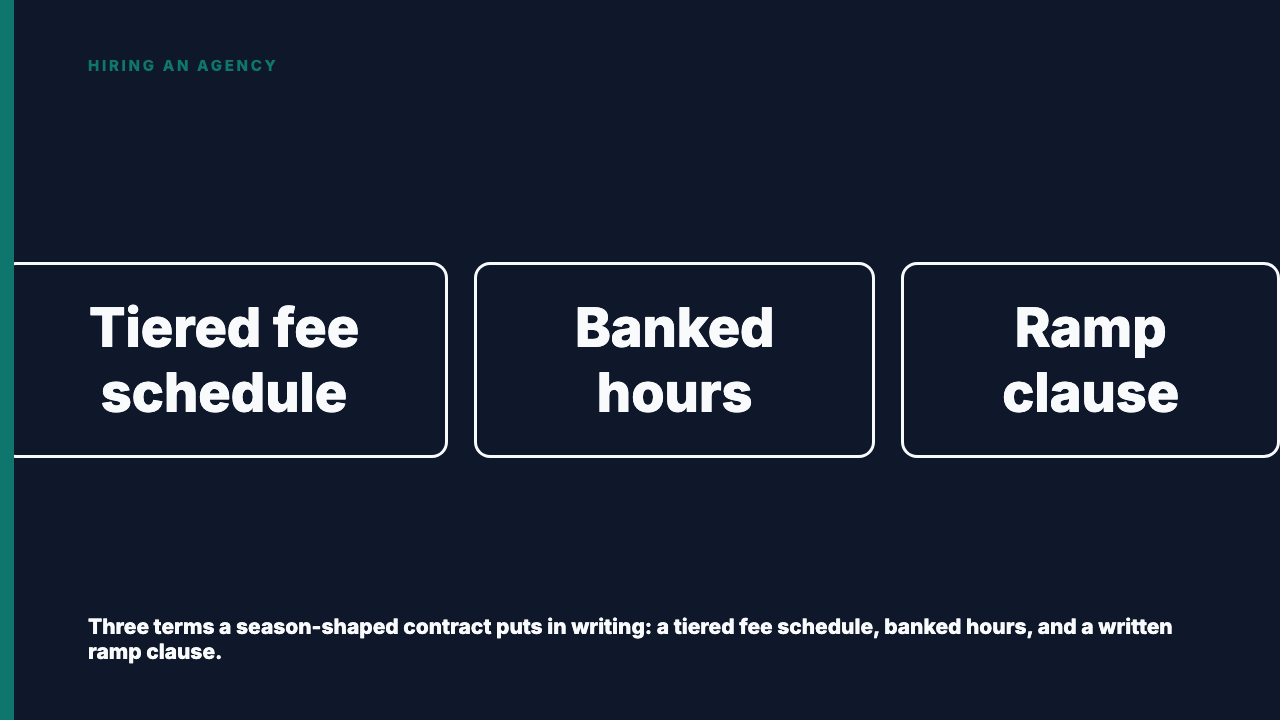
- A tiered fee schedule, agreed up front. One baseline fee for off season months, a higher fee for named ramp and peak months, each with its own deliverable list. Agree the uplift at signing, while the negotiation is calm, not under deadline pressure. Check the budget bands most agencies price into first.
- Banked hours or rolling scope. An alternative or complement to tiered fees: buy a pool of hours for the year and draw them unevenly. Ask about expiry, because banked hours with a monthly use it or lose it rule is a flat retainer wearing a different label.
- A written ramp clause. A stated lead time the agency commits to for adding staff before peak, with the trigger on paper: you give notice by a named date, they confirm the ramp team by a named date. That is a term with a consequence, not a verbal assurance from the pitch.
Why agencies resist this, and which resistance is legitimate
The constraint is real: staffing a short, intense peak means hiring people who then sit thinly utilised, or pulling people off other accounts. Short peaks are usually covered by reallocated staff or contractors rather than permanent hires, which is why flat retainers exist: a smooth monthly number smooths the agency’s own revenue. An agency naming a real capacity limit, a notice window it can meet, and a premium on peak rates is being straight. The one that will not put any seasonal term in writing is stalling, because flexibility that never reaches the document is a feeling, not a deal.
A hypothetical: the tax preparer and the four month year
An illustration written for this article, not a real client, agency, or case study.
Picture a tax preparation firm whose marketing need concentrates into the run up to the filing deadline: awareness ahead of it, heavy paid social through the crunch, almost nothing after. Four active months, eight quiet ones.
Its off season fee might buy a countable list: one strategy call a month, a set number of evergreen posts, community management with a stated response window, a quarterly report. The peak clause names the months, the added deliverables, the extra roles, and the uplift. Then the staffing notice: the firm confirms peak scope by a date set at signing, the agency confirms the team by an agreed date.
Questions to put to an agency before you sign
- What does the off season fee buy, deliverable by deliverable? Push past maintenance and always on support to a countable list with named outputs and response times.
- What lead time will you commit to in writing before our peak, and what happens if it is missed? A ramp clause with no remedy is a preference, so ask whether a miss triggers a fee credit, a scope adjustment, or an early exit right.
- Who joins the account at peak, and are they current staff, reallocated staff, or contractors? All three are acceptable answers. Not knowing is not.
- Have you structured a contract this way before? You are asking about process, not for a client name. One that has done it describes the mechanics unprompted.
The term length is part of the seasonal negotiation too
A long lock-in makes the mismatch worse, fixing the wrong shaped fee across several off seasons before either side can change it. A shorter initial term lets you test the agency through one full cycle, the logic behind why a paid pilot beats jumping straight into a twelve month commitment. Where the term is longer, tie renewal to your season’s calendar rather than the signing date, so the review lands just after peak. Then check what else to check in the contract itself.
Where to start looking
Building a shortlist? Browse vetted agencies and raise the seasonal question on the first call, not the third. If you run an agency that works this way, list your agency free.
FAQ
Should a seasonal business avoid a twelve month retainer entirely?
No. The problem is a flat twelve month fee, not a twelve month term. A year long agreement with a tiered, season shaped fee schedule inside it works fine. Avoid the version that charges the same amount every month regardless of what that month asks.
How much notice does an agency need to staff up for a peak season?
It varies by agency, by the roles involved, and by how much of your peak team is new hires rather than people reallocated from other accounts. A community manager and a senior media buyer are not sourced on the same timeline. Put the question to the agency and get its own commitment, with the notice and confirmation dates, written into the contract.
Is it cheaper to hire a new agency each season instead of keeping one year round?
It trades a lower off season cost for a re-onboarding cycle every year. Each new agency relearns your product, your approval chain, and your audience during the season you cannot afford to get wrong. Price those weeks against the fee you would save.