The Exclusivity Clause That Blocks a Second Agency Later
The contract arrives and you read the fee schedule, the term, and the notice period. Further down, under a heading like Exclusivity or Engagement of Third Parties, sits a sentence that decides whether you can hire anyone else to touch social for the next twelve months.
Why exclusivity language hides in plain sight
Buyers spend their negotiating energy on numbers, because numbers are comparable across proposals. Exclusivity language has no column, so it reads as boilerplate, and boilerplate gets skimmed.
It also does not present itself as a restriction on you. It is framed as what the agency needs to do the job: avoiding conflicting strategies, protecting a process they consider proprietary. Nobody negotiates hard against quality control, and the framing is fair: an agency accountable for a channel has an interest in not being contradicted on it. The failure is not agreeing to exclusivity. It is agreeing without knowing what you just foreclosed. For the surrounding terms, see what to check in a social media agency contract.
What an exclusivity clause actually says, in the versions that matter
Wording varies by agency and jurisdiction, but the versions you meet fall into a few recognisable shapes.
- Channel or discipline level. They run paid social, so you cannot appoint a second provider for paid social. Everything else is yours to allocate. The narrow version, and usually the fair one.
- Broadly defined social media services. One umbrella covering paid, organic, community management, influencer work and content production. You bought one. You are restricted on all of them.
- Exclusivity plus a non-compete style restriction. A separate provision bars you from retaining any other agency in the same broad category during the term, whether or not its work overlaps with the incumbent’s.
- The phrase pattern to watch. The tell is not the word “exclusive”. It is a definition of “Services” or “Scope” broad enough that a second agency writing organic captions is a breach, though the agency you signed only builds ad campaigns.
- How long it lasts. Some exclusivity is time-boxed to the term. Others survive termination for a stated period. Post-term restrictive covenants exist in service agreements generally, so check rather than assume there is none.
A hypothetical: the brand that wanted to split paid and organic
Picture a mid-sized furniture retailer that signs a twelve-month retainer with a full-service agency. Organic is why they hired. Paid is in the deal too, a smaller line nobody scrutinised during the pitch.
Six months in, organic is working and paid is flat. The retailer finds a specialist paid social shop. The plan is sensible: incumbent keeps organic, specialist takes paid. Then someone reads the contract. Exclusivity is scoped to “social media services”, defined in section 1 as including advertising, content, community management and reporting. Bringing in the specialist is a breach.
Two paths out, neither good. Reopen the deal mid-term, while the incumbent knows your alternative waits six months. Or sit on the plan until renewal and keep running paid you have already written off.
Why this matters even if you don’t plan to split anytime soon
You may have no intention of splitting anything. But twelve months is long enough for the intention to change without anything going wrong. Budget shifts from organic to paid, or the reverse. A platform you were not on becomes the one that matters. Neither is a failure of the relationship, and both are easier if the option was never closed.
This is not an argument for fighting every restriction; over-negotiating a first contract is its own way to start badly. The ask is narrow: not “remove the exclusivity clause”, but “scope it to what you are actually doing for us”. It sits beside whether your agency can also work with your competitor, the same clause family pointed the other way.
What to ask for instead
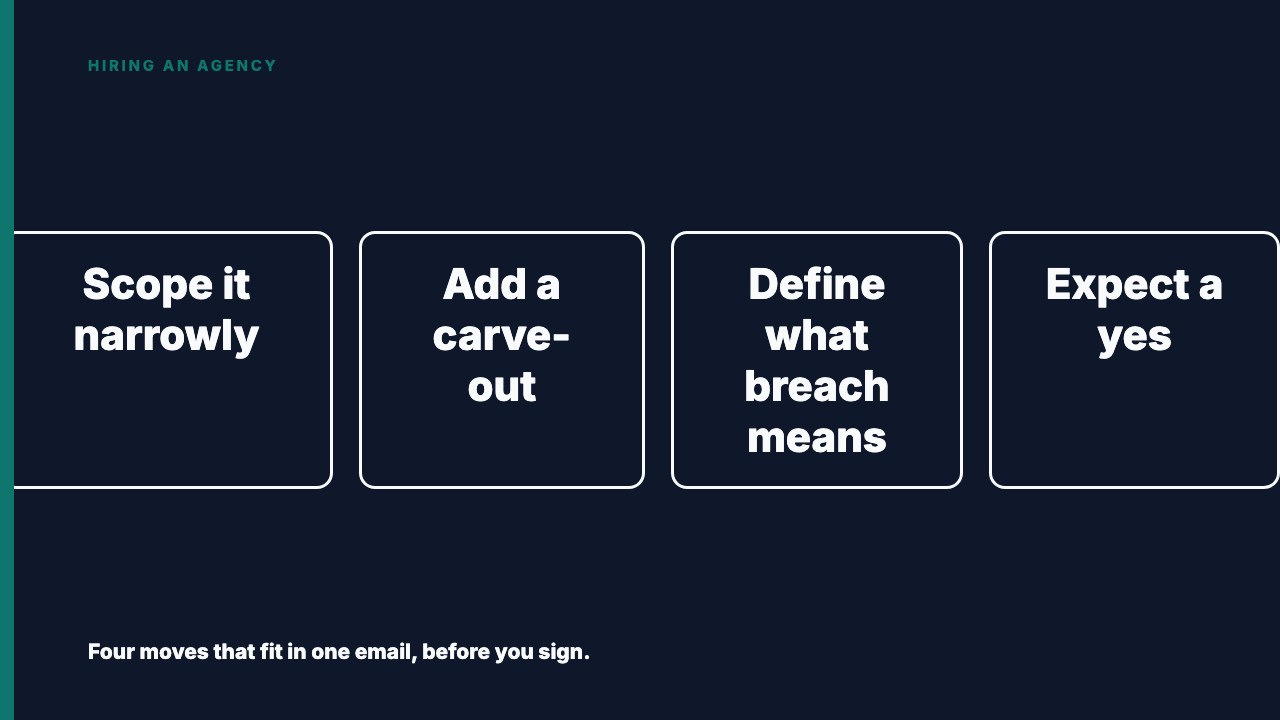
Four moves, all of which fit in one email before signature.
- Scope the exclusivity to the discipline you are buying. Ask for “paid social advertising services” or “organic content production and community management” in place of “social media services”.
- Ask for an explicit carve-out sentence: that the client may engage other providers for services outside the defined Scope of Services without that constituting a breach. Stated positively, so nobody reasons backwards from a definition later.
- Ask what actually happens if you do it. If we appoint a second agency during the term, is that a breach with remedies attached, a trigger to renegotiate, or simply outside scope?
- Expect it to be easy. Narrowing scope is a low-friction ask, and a well-run agency usually takes it, because an explicit boundary protects them too.
Reading the clause like a lawyer would, without being one
Go to the definitions section first, not the exclusivity clause. Whatever “Services”, “Scope of Services” or “Deliverables” means there is what the exclusivity binds to. The deck says “we run your Instagram and TikTok content”. The definition says “all social media marketing services, including paid media”. Only one of those binds you. The same discipline applies to how to read an agency scope of work before you sign it.
Then bring one question to whoever reviews the contract: does this definition of scope include categories of work I am not currently buying from this agency? A generic “please review this” never surfaces it. Nothing here is legal advice, and whether a given provision holds up is for your own reviewer in your jurisdiction.
Before you sign
If you are still choosing who to send that contract to, browse vetted agencies by discipline, which makes narrow scoping easier from the start. If you run an agency, list your agency free.
FAQ
Is an exclusivity clause in an agency contract normal?
Seeing one is not a red flag. An agency asking for protection on the channel it is accountable for is being reasonable. The question is whether its scope covers only the work it is contracted to do. A clause that matches the engagement is fine. One that reaches across every category of social work you might buy is worth renegotiating.
What is the difference between exclusivity and a non-compete in this context?
Exclusivity restricts who else you can hire while the agreement runs, within whatever scope the contract defines. A non-compete style provision goes further: it extends the restriction past the end of the term, or reaches into categories of work you are not buying at all. Check for both separately; they can sit in different sections. Neither is presented here as standard practice, and what either means for you is a question for your legal review.