How to Fire a Social Media Agency Without a Surprise Kill Fee
You have decided the relationship is over. What it costs to leave was fixed at signing, in a section you skimmed once and never reopened.
The exit was negotiated before the relationship went bad
By the time a brand wants out, the exit terms are fixed. Notice period, cure window, fee formula, all agreed on signature day, before anyone pictured a bad ending. You cannot renegotiate them now. The clause that read like boilerplate at kickoff governs the exit. Start with what to check in a social media agency contract.
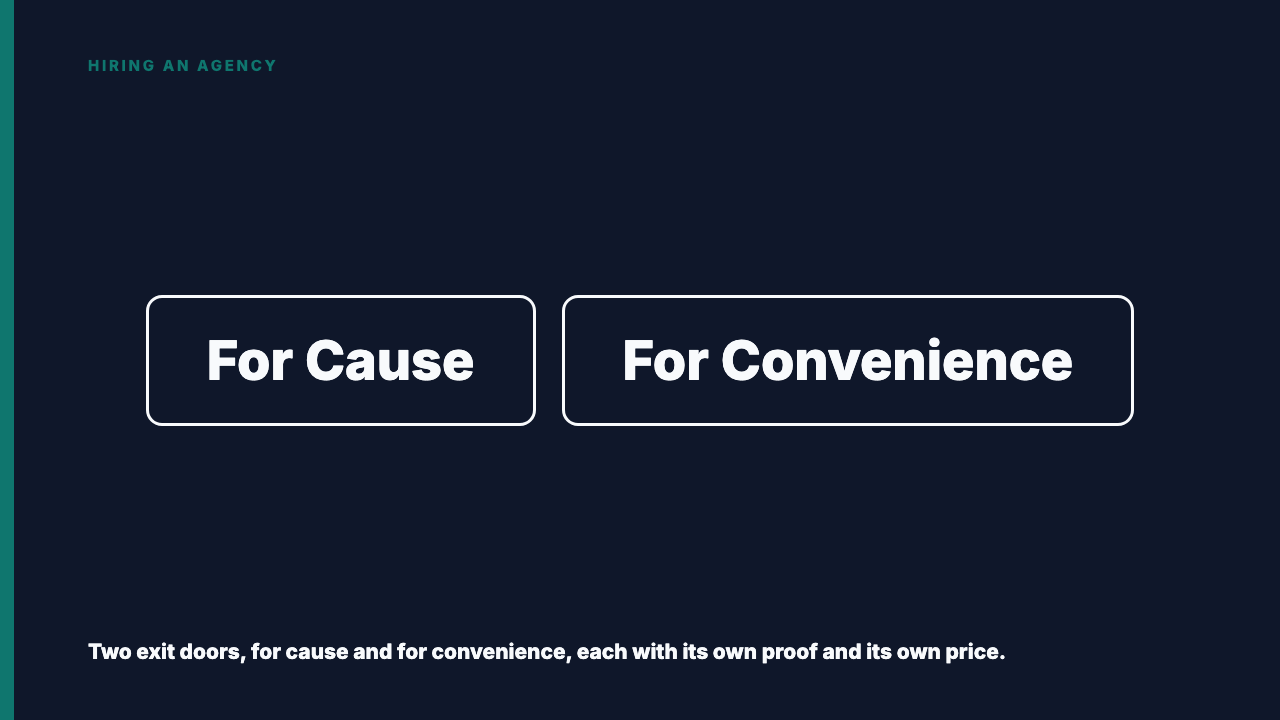
For cause vs for convenience: the two doors out
| For cause | For convenience | |
|---|---|---|
| What you must show | Deliverables missed against the agreed schedule, the account not staffed with the named roles, or breach of a numbered clause. | Nothing. No fault alleged. |
| What you owe | Work already delivered. Fee clauses usually attach to convenience exits, so check yours. | Full notice, invoiced as normal, plus an early termination fee in many contracts, because no fault is alleged. |
| Where it goes wrong | Evidence and procedure. Written notice and a cure window are conditions of validity, not courtesies. | Nothing procedural. Just cost. |
Most brands who feel wronged still take the convenience door, because cause is harder to prove than it sounds. Contract law recognizes substantial performance: immaterial variation still satisfies the agreement. Posts a day late, a thin deck, a slow account manager, that is what an agency will call immaterial. Cause needs a failure going to the purpose of the deal, documented as it happened.
Notice periods: what you actually owe before you can leave
The notice period is the runway between written notice and the contract ending. Invoices usually continue through it, and so does the scope of work. Agencies defend long ones for a reason: retainers fund named people booked months ahead, and an account lost with no runway is salaries paid against vanished revenue.
There is no universal length, and the trigger matters more than the number. Check whether notice can be given at any time, or only inside a window before a renewal date, since missing that window can roll the term forward.
The cure period nobody mentions until it matters
To cure means to correct a defect that would otherwise be a breach. A cure period is the window your agreement gives the agency to fix a problem you formally cited, before a for cause termination is valid.
Skipping it is the trap. If notice and a cure window are conditions of a valid for cause termination and you ignore them, you may not have terminated for cause at all, only stopped performing your own obligations, exposing you to the fee you were avoiding.
Illustratively: an agency misses a restaurant group’s posting schedule three months running. The group sends written notice citing the clause and the dated misses. Corrected inside the window, there is no cause. Window closed, misses continuing, the exit is clean.
What a kill fee actually is, and isn’t
A kill fee, or early termination fee, is compensation for ending the relationship before its minimum term or without serving full notice. It is not a penalty for disliking the work. It has legal weight: a pre-agreed sum payable on breach holds up as liquidated damages where the loss is real but hard to prove, not where it is punitive.
It is also not your unpaid balance. Work already delivered is owed however you leave, and treating both as one number is how brands argue about the wrong invoice. See how agency fee structures actually work.
As an example only, not a norm: a twelve month minimum term with a fee of half the remaining retainers. Exit in month ten and exposure is small; exit in month three and it is most of a year’s spend. Structures are not standardized, and no percentage is typical. Only your signed document says what you owe.
Read your contract like you are already leaving
- Read Termination or Term and Termination in full, including every cross-reference.
- Identify the notice period, how days are counted, and whether the clock starts on sending or receipt.
- Check whether a cure period exists and how many days it grants.
- Find the exact early termination fee formula, or confirm none exists.
- Read the handoff language governing passwords, ad accounts and content libraries, since it decides who owns your social accounts.
- Check for an auto-renewal clause and its own separate notice deadline.
This is contract literacy, not legal advice. If the money is material, have a lawyer read it.
The leverage you still have in a bad contract
Documented underperformance that falls short of the contract’s definition of cause is still leverage. An agency reading a dated log of missed deliverables can see how it would look if the dispute escalated, and would rather settle than defend it.
Propose a mutual termination: both sides agree in writing to end on terms other than the default clause, waiving a fee neither wants to litigate. Agencies live on references, so a contentious exit costs more than the disputed fee is worth. Then the handover, without losing the history.
What to put in the next contract instead
- A notice period both sides can live with, triggerable at any time, not only inside a renewal window.
- Symmetrical cure language: if the agency gets a window to fix a cited failure, you get one too.
- A fee that declines across the term. One identical in month two and month eleven compensates for nothing.
- The auto-renewal deadline and the termination notice as two separately dated triggers, not one clause doing double duty.
Before you sign the next one
The best protection against a punishing exit is choosing better next time. Browse vetted agencies on Partner in Social, and if you run an agency, list your agency free.
FAQ
What is a kill fee?
Money owed for ending a contract before its minimum term or without serving full notice. It pays for the exit itself, not your satisfaction with the work, and is separate from the balance owed for work already delivered.
Can I terminate for cause just because I am not happy with the results?
Generally no. Dissatisfaction is not the documented failure most contracts require, and minor deviations still count as performance. For convenience is the realistic exit for most brands who feel wronged.
Sources
- Cure, Legal Information Institute, Cornell Law School, fetched 6 September 2026.
- Breach of contract, Legal Information Institute, Cornell Law School, fetched 6 September 2026.
- Substantial performance, Legal Information Institute, Cornell Law School, fetched 6 September 2026.
- Liquidated damages, Legal Information Institute, Cornell Law School, fetched 6 September 2026.