What Happens to Your Contract When Your Agency Gets Acquired
The email is short and upbeat. Your agency has been acquired, nothing changes for you, and a name you do not recognise signs it. Can they do that, and can you leave?
The notice arrives after the deal is already signed
By the time you hear about an acquisition, the legal question has been settled, by assignment language near the end of the agreement you signed. The notice is a communications exercise, not a negotiation. And here is the answer it will not spell out: an acquisition does not by itself end your contract. It transfers to the new owner intact, on the same terms, unless you hold a termination right and use it.
The sequence is predictable: a letter about continuity and capabilities, sometimes a call from the incoming account lead, rarely an offer to reopen terms. Agency consolidation is ongoing trade press subject matter, a risk worth pricing in.
What an assignment clause actually says
An assignment clause governs whether a party can hand its side of the contract to somebody else. Cornell’s Legal Information Institute defines assignment as a transfer of rights, property, or other benefits from an assignor to an assignee, and notes that assigning a contract delegates duties as well as transferring rights.
The common default lets either party assign to a successor entity, including in a merger or sale, without the other’s consent. Consent is required only if the clause says so, and agencies draft it that way because a client book that transfers without per-client sign-off sells more cleanly.
Novation is different. The same source describes it as an agreement substituting a new party for an existing one, which excuses the replaced party and requires both original parties to agree. An assignment can happen without you, a novation cannot.
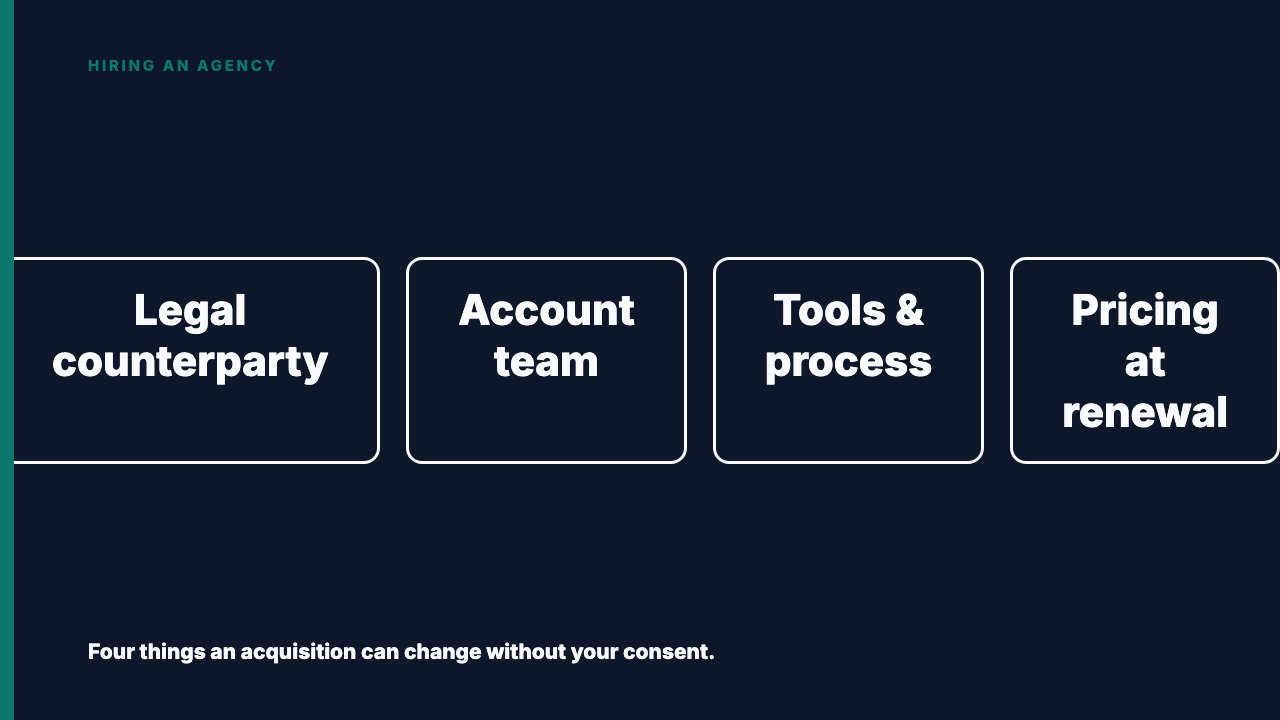
The four things an acquisition can change without your consent
- The legal counterparty. The entity behind your invoice, indemnity, liability cap, and data terms is not the company you chose.
- The account team. Acquirers fold teams into their own structure, so your strategist, community manager, and buyer can change at once: the account manager turnover problem, times every seat.
- Tools, reporting, and process. Migration onto the acquirer’s systems is standard: new reporting template, different approval flow, history stranded in the old one.
- Pricing at renewal. The current term’s rates normally hold. Renewal is a fresh negotiation against the acquirer’s rate card.
Access lists get rebuilt during a transition, so reconfirm who owns your social accounts.
What good assignment language looks like versus what leaves you exposed
The bad version is one sentence: either party may assign this agreement to any successor in interest. No notice, no consent right, so the agency can transfer your account and tell you afterwards.
The acceptable version adds notice: written notice of an assignment a defined number of days before it takes effect, thirty being a common illustrative figure rather than a universal standard. Notice buys preparation, not an exit.
The strong version splits the two. Assignment to an affiliate is administrative. Change of control, the agency itself being acquired, is not, and for that event the clause gives you a consent right or, better, a termination for convenience right exercisable for a window after notice. Have counsel check the wording, conventions vary by jurisdiction.
Termination rights are the leverage that actually matters
Clients fight the assignment. That is the wrong fight. A client who cannot stop an assignment but holds a short notice exit right has all the leverage they need, while one locked into nine more months behind an early termination fee has none. A long notice period is a fair concession to a partner you chose and a liability with one you inherited.
A termination for convenience right cannot be added retroactively without the other side agreeing, and an acquirer that just paid for your contract has no reason to grant one. Check it before you sign, alongside the rest of what to check in a social media agency contract.
What to actually do when the notice arrives
- Read the contract, not the letter. Your rights live in the assignment, change of control, and termination clauses, read together.
- Call the new ownership before the transition completes. Ask which named people are staying and on what timeline.
- Treat the next 60 to 90 days as a new relationship. Watch responsiveness, reporting quality, and whether the work is done by the people promised.
- If you have no clean exit, say so internally. Your leverage is negotiation, not contract right. Set a hard review date, and if you leave, run a real handover.
What to ask before you sign the next contract
Ask during negotiation whether the agency has taken outside investment or discussed a sale. No agency must disclose an unannounced deal, but how they answer is informative: a flat no reads differently from a pivot to growth plans.
Then ask for the language, not just the general assignment paragraph: a change of control notice requirement, separate from routine affiliate assignment, plus a termination trigger or consent right tied to that event.
Finding an agency worth signing with
Back in the market? Browse vetted agencies by specialty and location, or list your agency free.
FAQ
Can my social media agency sell my account to another company without asking me?
Usually yes, if your contract carries a standard assignment clause with no consent requirement. Read your own assignment paragraph rather than assuming.
Does an agency acquisition automatically end my contract?
No. The contract normally survives and transfers to the new owner on its existing terms, scope, rates, and remaining term included. It ends early only if you hold a termination right and use it.
Is a change of control clause different from an assignment clause?
They overlap but are not the same. An assignment clause covers any transfer, including routine moves to an affiliate. A change of control clause addresses the agency itself being bought, and can attach rights such as consent or a termination window.
What should I do if my agency just told me it was acquired?
Read the contract’s assignment, change of control, and termination sections before reacting to the letter, then ask the new ownership which named people stay on your account and when.
Sources
- Cornell LII, Wex entry on assignment, fetched 6 September 2026.
- Cornell LII, Wex entry on novation, fetched 6 September 2026.
- Marketing Dive, agencies coverage, fetched 6 September 2026.