What to Vet Differently When Hiring a Paid Social Agency
You have shortlisted a paid social specialist. The work looked competent, the references checked out. None of that tells you what happens the first time an account manager raises a daily budget in an account you cannot log into.
An organic engagement and a paid engagement are not the same risk
Organic work has a checkpoint built in: a post gets drafted, you see it, it goes out. Even if the agency publishes without sign off, a bad week means content you can delete. Nothing left your bank account.
Paid social is different for structural reasons, not trust reasons. Bids, budgets and creative change inside the platform, not in a shared document, so a campaign can be live and spending before you have seen the final targeting. A portfolio answers whether an agency does good work, not what happens to your money meanwhile.
Who owns the ad account, and who owns the account inside it
Two structures will be offered: your business owns the ad account and the agency is added at a defined access level, or the agency owns it and runs your spend inside. The first preserves your leverage.
Google Ads uses a manager account, still called an MCC, which Google describes as an umbrella account letting an agency manage multiple client accounts from one sign in. Google adds that a manager account can also be given ownership of a client account, which then controls user access on it. Look under Admin, then Access and security, at “Managers”, to see who is Owner.
Meta’s paperwork uses different words for a similar shape: business portfolio, or Business Manager in older material, plus ad account and partner access. Those are the terms your onboarding form will use, and Meta’s own Business Help Center sets out what each role can do.
The byproducts of paid social are not files. The pixel is created inside one ad account, campaign history accumulates there, and audiences are built from that pixel in that same account. Access to all of it follows access to the account, which is why ownership is worth settling before you sign.
The access questions to ask before you sign, and what a bad answer sounds like
- “Will the ad account live under my business with you added as a partner, or under yours?” A good answer names the brand-owned model as the default, unprompted. A bad answer calls it a formality.
- “What access level do you need, and can it be revoked without breaking live campaigns?” A good answer names roles. Google Ads publishes levels of email-only, billing, read-only, standard and admin, where standard edits campaigns and admin also grants access. Google documents granting, editing and removing access on the Access and security page as account administration, and is silent on live campaigns, so make the agency answer that part in writing. A bad answer wants full ownership, or says access cannot be changed later.
- “Whose card is on file?” A good answer defaults to your payment method on your own account, so the billing screen and your invoice show the same number. A bad answer routes spend through the agency’s card at a marked-up media fee, with no view of spent versus charged. See how retainer, percentage of spend, and performance fees work.
- “If we part ways, what do I keep?” A good answer is short: the ad account, the pixel, the audiences, the campaign history, because they were built in your account from day one. A bad answer involves a data export request, a transition fee, or a shrug.
Why this rarely comes up when vetting an organic-content specialist
Settle who owns your social accounts before any agency touches them. But it is a different failure mode. A locked organic account has a fixed cost: you recover it or you rebuild. A misconfigured paid engagement has a live dollar figure attached, spending while you argue. A paid specialist therefore deserves a different first conversation than a content shop.
A hypothetical: two agencies, two account setups
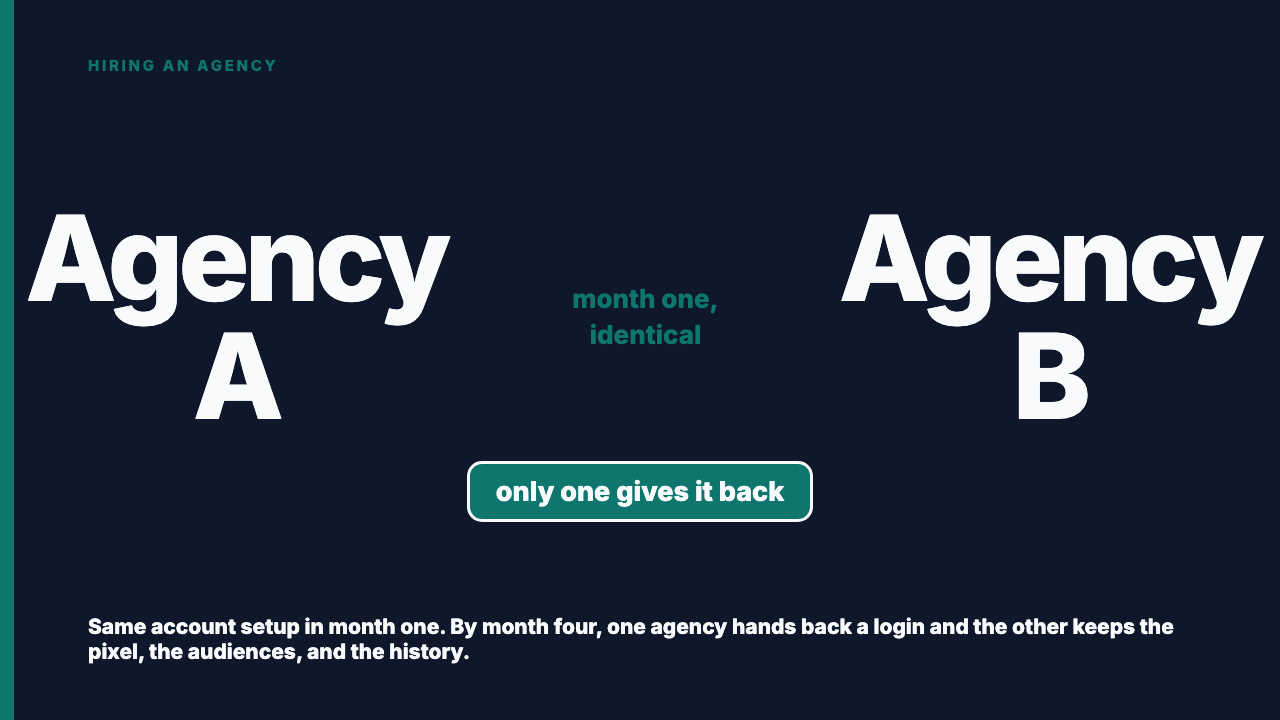
An illustration, not a case study. A home services brand is choosing between two paid social agencies. Agency A runs spend inside the brand’s own account at a defined partner role. Agency B proposes its own account for efficiency, at a marked-up media fee.
Month one is identical, which is why structure gets skipped. Month four separates them. Leaving Agency A is a permissions change: remove the partner, keep everything built inside the account. Leaving Agency B means all of it sits in an account the brand never held. Agency B did nothing wrong; agency-owned accounts do not always end badly. The structure decided it.
What to put in the contract, not just ask out loud
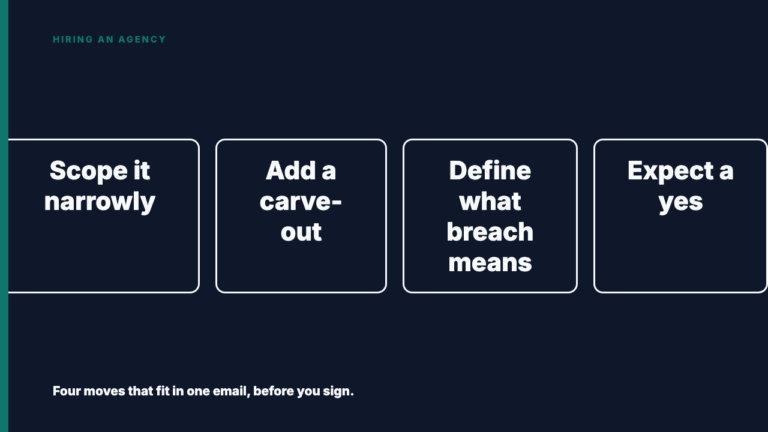
A salesperson saying “of course it will be your account” means nothing if the paperwork does not say so. The scope of work has to name the account structure, the access level, and the offboarding handover, item by item, not as “all relevant assets”. See reading a scope of work before you sign it and what to check in a social media agency contract.
Where to start
Paid Social is a listed specialty on Partner in Social, with 11 vetted agencies. Browse vetted agencies, and take the four questions to the first call, not the third. If you run an agency, list your agency free.
FAQ
Should the ad account be in my name or the agency’s name?
In your name, with the agency added as a partner or user at a defined access level. The pixel, the audiences and the campaign history are built inside whichever account runs the spend, so making that account yours keeps them with you.
Is it normal for an agency to ask to run ads through their own ad account?
It happens, usually framed as an efficiency: faster setup, or the agency’s credit line so you are not fronting cash. Those are real benefits. What goes unsaid is that the account, its history and its audiences stay with the agency. Ask what offboarding looks like.
Does this apply to organic social agencies too?
Not in the same way. Organic account ownership is a separate question we cover elsewhere. The difference is live spend: a disputed organic account costs you access and rebuild time, a disputed ad account is spending money while you argue.
Sources
- Google Ads Help, “About Google Ads manager accounts”, fetched 2026-09-02.
- Google Ads Help, “Manage access to your Google Ads account”, fetched 2026-09-02.
- Google Ads Help, “About access levels in your Google Ads account”, fetched 2026-09-02.