Moving Social In-House: Document the Agency’s Last Two Months
You have approved the first in-house social hire and told your agency you are leaving. The notice clock is running, and the people who know why your account looks the way it does are about to stop being paid to care. Do nothing and your new hire inherits an archive and a folder of exports. If you are still weighing the decision itself, read how to decide between in-house, agency or hybrid first.
The notice period is the only leverage you have left, and it is shrinking
An agency that has been told it is losing the account has no commercial reason to over-deliver on a handover unless you ask for it as a deliverable. That is incentives, not bad faith. Nobody earns credit for documentation on a departing client.
The bad version is a farewell call and a folder of exported files in the final week. The good version is handover work scheduled and scoped from day one of notice, with dates, owners and outputs.
Read your own contract for the notice length and what it says about transition help. Both are set by that document, not by a general norm. Then treat the notice length as the budget for everything that follows.
What lives only in the agency’s heads
This four part split is our own framework, not an industry standard, and the examples are hypothetical.
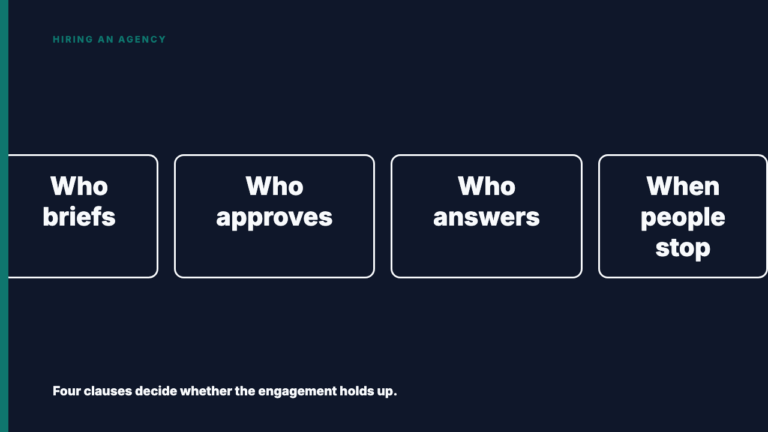
- Rationale. Why the content strategy is shaped as it is. Ask: “If you had to explain this mix to a new owner in five minutes, what would you say?”
- History of failures. What was tried and quietly dropped. Ask: “What did you stop doing, and why?”
- Approval politics. The informal rules about who approves what and who gets nervous about what. Ask: “Which stakeholder always asks for changes late?”
- Operational location. Where assets, logins, templates and recurring vendors actually live. Ask: “What is kept on a personal device or personal account?”
A posting archive and an analytics export contain none of these four. A brand with eighteen months of history can still know nothing about why it works.
A staged handover timeline, set against the notice period
This is an illustrative timeline for a notice period of about two months, not a norm.
| Stage | Agency task | Brand task | Output that proves it is done |
|---|---|---|---|
| 1. Access audit (first days) | List every account, login and asset they hold | Confirm the company holds admin on each | Written list naming the brand as owner |
| 2. Interviews (weeks one to three) | Account lead and the person who writes the posts sit for structured interviews | Run them, recorded with permission or written up the same day | Write-ups covering the four categories |
| 3. Shadow, then drive (weeks three to six) | Run live work with the new hire watching, then review the hire’s work | New hire shadows, then produces | A run of posts shipped by the hire with review notes |
| 4. Review only (final stretch) | Answer questions, review on request | Brand publishes everything | Agency touched no post in the final days |
Audit access first, because nothing else matters if the handles are not under company control. See agency account access permission levels for how roles decide that.
Interview both the account lead and the person who writes the posts, since they know different things. Collect analytics history as well, but the exports are the easy part; analytics after an agency exit covers portability.
If the contract does not already cover this work, offer to pay for it as scoped work. Asking politely is better than assuming it is owed. For clauses, see our post on the transition plan you negotiate at hire. For the overlap when the incoming party is another agency, see the overlap window. Here it is one employee, so the overlap is lighter but depends on that person’s time.
What to ask the agency to write down
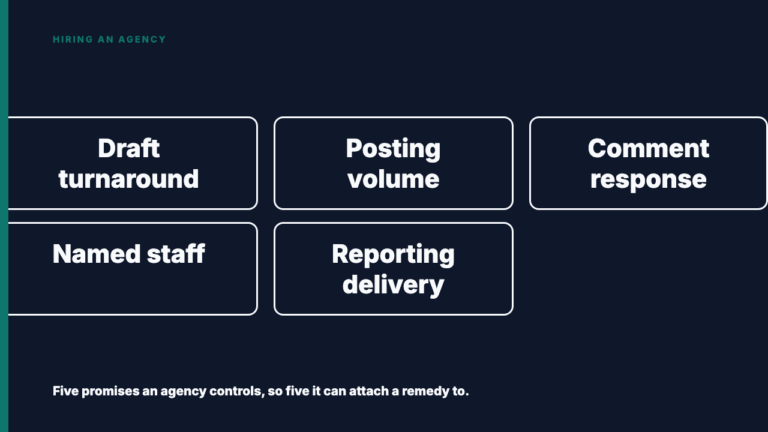
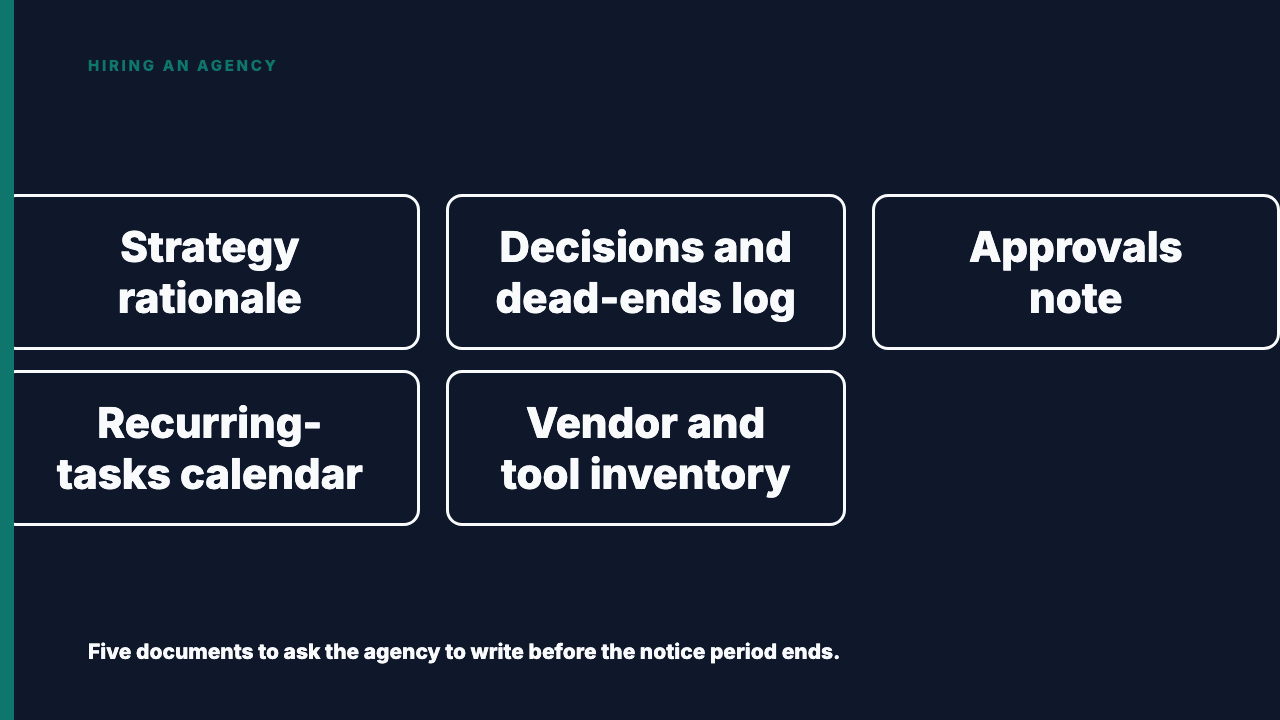
Request five documents: a one-page rationale for the current strategy, a decisions and dead-ends log, an approvals and stakeholder note, a recurring-tasks calendar, and a vendor and tool inventory.
A useful decisions log entry says what was tried, what happened as the agency read it, and why it was stopped. Picture: “We ran a weekly behind-the-scenes series for a quarter. Comments were warm, but the sales team said it never came up in calls. We stopped.” A useless entry is a list of past post topics, which the archive already shows.
The new hire should read each document and mark what they could not act on. The reader of a handover is the only valid test of it. For how to judge one, see our account handoff notes quality check post.
What to hire for first
Hire someone who can own the relationship with the business and the judgment calls, not simply the fastest producer of posts. The agency’s production capacity disappears on day one, but its judgment is what the notice period is trying to preserve.
In the interview, brief the candidate and have them explain the strategy back to you. See whether they ask what was tried before. Give them a slow, nervous approver and watch how they cope. Avoid the candidate who proposes to restart from a blank page, because they are discarding the history you just documented.
One person replaces a team, and a single hire will not match an agency’s staffing breadth. Decide before the agency leaves what you will drop, what you will buy in as freelance help, and what stays outsourced. The reasoning is in how to decide between in-house, agency or hybrid.
The first month after the agency leaves
Before the end date, ask in writing for a short, bounded window in which the agency answers questions. It should cover clarifying the documents and locating things. It should not cover new work, and it should have an end date.
Hypothetically, these three are most likely to turn up missing in week one:
- A login that has expired or sits on a former agency employee’s personal account.
- A recurring task nobody knew about.
- A stakeholder whose approval habits were never written down.
The brands that handle this well treat the last two months as a project with an owner and deliverables.
Next step
If the transition shows you want outside help for part of the work, Browse vetted agencies. If you run an agency, you can list your agency free.
FAQ
Should we keep paying the agency during the handover?
Yes, for the notice period and for scoped handover work if the contract does not cover it. Withholding goodwill does not buy a better transfer, so read the contract for transition obligations rather than assuming them.
What if the agency is unhelpful during the notice period?
Do the access audit first, ask for interviews in writing, and accept that some knowledge will be reconstructed from the archive. See how to leave an agency without losing the account history.
Sources
- In-house vs agency vs hybrid, fetched 2026-10-13
- Agency account access permission levels, fetched 2026-10-13
- Switching agencies: the overlap period, fetched 2026-10-13
- Leaving a social media agency: handover, fetched 2026-10-13
- Historical analytics data portability, fetched 2026-10-13