Hiring an Agency to Run Employee Content You Can’t Compel
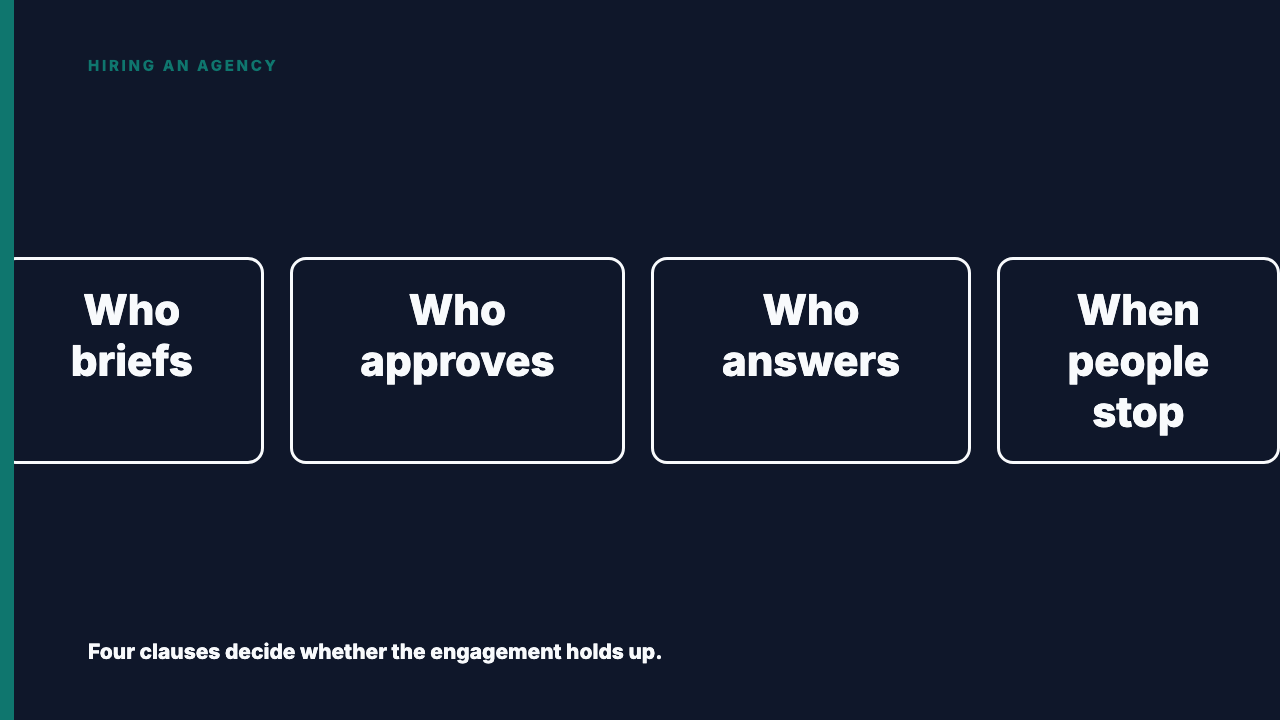
You want your sales and support staff sharing company news, and you are briefing agencies to make it happen. A standard retainer assumes the agency produces the work. Here the producers are staff the agency does not employ and you cannot fully compel. Four clauses decide whether the engagement holds up: who briefs, who approves, who answers for a bad post, and what happens when people stop.
The agency is coaching people it does not employ
In a normal retainer the agency makes the thing and you approve it. Here the raw material is other people’s time and willingness, and neither party controls it. The agency can own program design, training, drafts and content kits, reminders and reporting. It cannot own whether a given employee shows up.
The bad version is a quote for a set number of employee posts per month, which prices an outcome the agency cannot deliver. The good version is a fee for the parts the agency controls, with participation written into the scope as a brand-side dependency. This is not paid creator work. Participants are staff, so creator contract mechanics do not apply.
Who briefs the employees, and who sends the invitation
Picture two kickoffs at a mid-sized brand. In the weak one, the agency emails staff cold and is ignored. In the strong one, a named person inside the brand sends the invitation. The agency runs the training, and its scope lists how many enablement sessions and office-hours slots it provides.
The agency writes the program brief, the do and don’t guidance, and the training. The brand owns the invitation, the manager conversations, and anything that touches HR or an individual’s job. That needs one internal program owner: the role you need to fill before an agency can work.
Write down what the agency does not do. It will not:
- chase employees who go quiet,
- hold anyone’s personal account logins, or
- handle staff complaints about the program.
Its brief must also carry the disclosure instruction, worded exactly as the brand wants it.
Who approves an employee’s post, and how fast
Employee posts go out from personal accounts, so the agency controls no queue. Pre-approving every post kills the program because staff will not wait. Approving nothing leaves the brand exposed. Pick a model on purpose.
Two models work. The agency drafts content employees post as written, or employees write their own within published guardrails, with review after the fact. Review after the fact suits a low-risk brand. Pre-drafted content suits a brand with claims to substantiate.
The right to ask an employee to edit or take down a post belongs to your program owner, not the agency, which has no authority over another company’s staff. For the wider question, see how your approval process is shaping the work. A regulated brand needs its compliance team to sign off on the guardrails, and the agency should hear that before pricing.
Who is liable when an employee posts something wrong
The FTC’s Endorsement Guides Q&A says an employee who mentions the company’s products on social media should disclose the relationship, and that listing an employer on a profile page is not enough. It also says a company that actively encouraged employees to write reviews of its products is responsible for monitoring them, for disclosure and problematic claims, despite any difficulty. A program you launch is a program you answer for, whatever the contract says.
| Failure case | Trains against it | Watches for it | Acts |
|---|---|---|---|
| Posts about the company without saying they work there | Agency, with your exact wording | Agency | Program owner |
| Makes a claim the brand cannot substantiate | Agency, on your claims guidance | Agency flags, brand compliance reviews | Program owner with compliance |
| Shares something confidential | Brand defines it, agency repeats it | Brand | Program owner with HR or counsel |
| Posts something off-brand or offensive | Agency | Agency flags, within the agreed time | Program owner, HR for job matters |
The same page says advertisers need reasonable programs to train and monitor members of their social media network, including what to say and how to disclose. Your contract can assign that work to the agency, along with escalation and a response time. It cannot move your own responsibility onto it. The page separately covers an ad agency asking its own staff to post, a different situation from yours.
Whether staff can be required to take part, or disciplined for how they post, is a question for your employment counsel and outside this piece.
What happens when participation drops
It will drop. A silent contract produces a fight: the brand blames the agency, the agency blames staff, and the retainer keeps billing.
Treat participation as a brand-side dependency in the scope, like approval turnaround. Define the agency’s duties by what it does (sessions run, kits delivered, reports sent), not by employee output. Then write the trigger: a participation level below which a review is automatic, picked together in the scope. The review must end in a reduced scope, a relaunch plan with brand-side actions, or a stated decision to pause.
The acceptable version lets the brand downshift or pause on notice. The unacceptable version keeps the full fee while the agency’s own reporting shows no active participants. A downshift or relaunch is a scope change with its own paperwork; see what counts as a change order.
Questions to put to agencies before you sign
- How would you brief employees without our staff hearing from you first? Worrying: cold outreach, or no internal owner.
- What do you need from us that you cannot do yourselves? Worrying: “nothing”.
- What will you not do if an employee stops responding? Worrying: a promise to keep chasing individuals.
- How do you price this, and what happens to the fee if participation falls? Disqualifying: a fee tied to a promised number of employee posts.
- Who answers when a post goes wrong, and how quickly? Worrying: no named person, no committed response time.
Check every answer against the written scope, and read the scope of work before you sign.
Your next step
Shortlist agencies and put these questions in your RFP. Browse vetted agencies to build the list. If you run an agency, you can list your agency free.
FAQ
Can an agency make my employees post?
No. It can design, train, draft and remind, but participation is a brand-side matter. Whether staff can be required to take part is a question for your employment counsel.
Who is liable if an employee posts something false or undisclosed?
Under the FTC’s Q&A on employee endorsements, a company that actively encourages employees to post is responsible for monitoring them for disclosure and problematic claims. The contract can assign the work, not the responsibility.
Sources
- FTC, The FTC’s Endorsement Guides: What People Are Asking, fetched 2026-09-21.