Get the Agency Rate Card Before You Sign, Not After
You have signed a social media retainer. Then you ask for one small thing it does not cover, and the quote that comes back makes you wonder what the retainer was buying. The fix is a document to request before signing: the agency rate card.
The extra request is where the real price gets set
Picture a hypothetical brand, three months into a retainer. The marketing lead asks for a one-off video cut-down and an extra reporting deck. Neither is in scope. The agency replies with a single line total, well above expectation. No roles, no hours.
That is structural. Before signature the agency is competing and the brand can compare. Afterwards the brand has sunk onboarding time and faces switching costs, and the agency prices each extra with no alternative on the table. Buyers spend their energy on the retainer, priced once. The extras are priced every month. The rate card is the instrument of cost control for everything the retainer does not cover. See how agency fee structures differ.
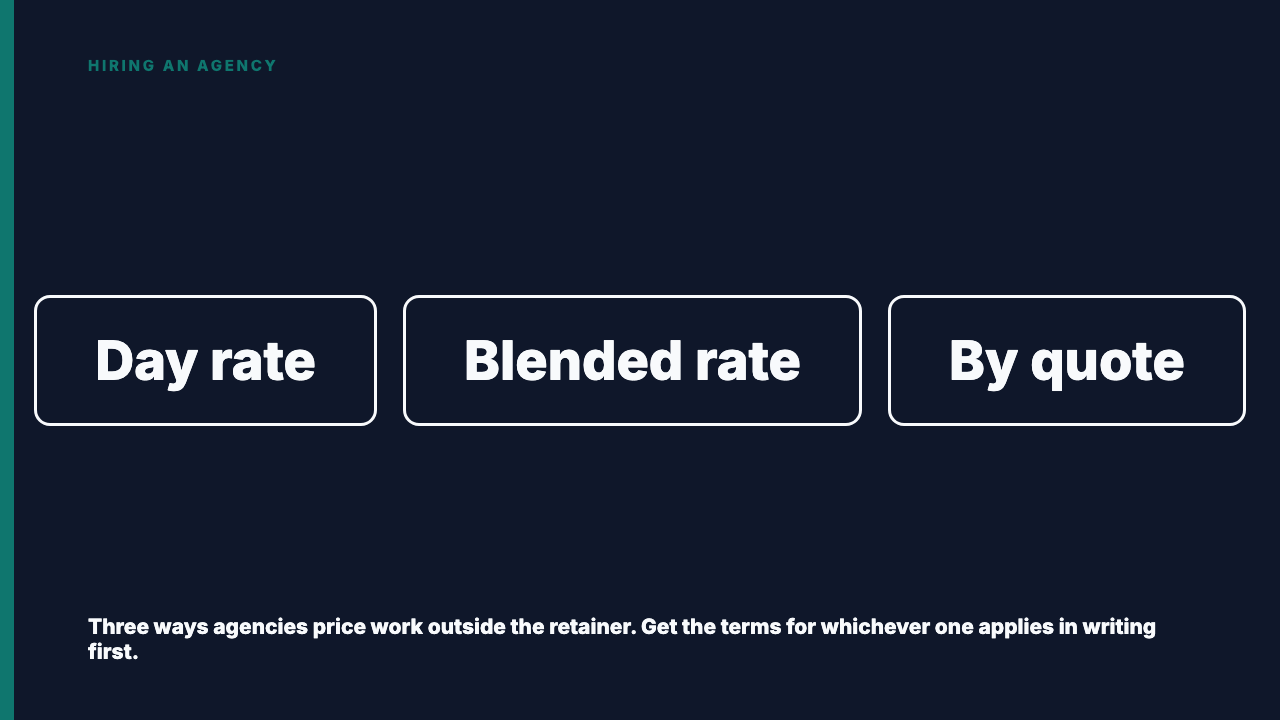
Three ways agencies price work outside the retainer
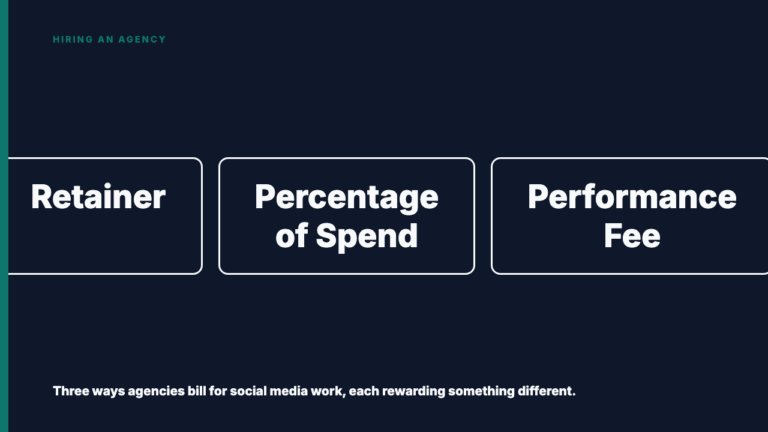
Usually it is a day rate, a blended rate, or “by quote”. This is practitioner description of common practice, not a cited survey.
A day rate multiplies a defined working day by role. Ask how many hours a “day” is. A rate quoted per role is only as good as the role used, and work can drift onto the most senior, most expensive person.
A blended rate is one rate across all staff levels. It is simple to read and hides the staffing mix. Ask which roles it blends and whether the mix is fixed.
By quote is a blank cheque with a signature line. The acceptable version: a written quote before work starts, itemised by role and hours or by deliverable, valid for a stated period, with no work billed without acceptance. The weak version says “additional work will be quoted”.
| Model | Predictability | Ease of audit | Estimating risk sits with |
|---|---|---|---|
| Day rate by role | Medium | High if roles are named | Shared |
| Blended rate | Medium to high | Low unless the mix is fixed | Mostly the brand |
| By quote, loose | Low | Low | The brand |
| By quote, itemised and capped | High | High | The agency |
Ratings are hypothetical, not market data.
What a usable rate card actually contains
A rate card is a structured list of prices that lets a buyer compare options (general definition). It is usually a ceiling to negotiate from, which is another reason to ask before signing. Can you budget from it without phoning anyone?
The good version gives rates by role or named unit of work, states the unit (hour, day, deliverable), sets minimum billing increments, shows rush multipliers as a stated factor rather than “subject to availability”, and carries a review date. The bad version is one line, an “hourly rate”, with no roles, no minimums, no rush terms and “rates subject to change”.
The best cards also pre-price common extras as units, not hours: an extra revision round, an additional deliverable, a report variant, an ad hoc strategy session. Ask which are pre-priced. A made-up card, every figure invented:
- Strategist, per hour: 100 (made up), 30 minute minimum
- Designer, per hour: 70 (made up), 30 minute minimum
- Extra revision round: 150 (made up)
- Report variant: 200 (made up)
- Rush under two working days: 1.5 times (made up)
- Valid to a stated review date, locked for the term
Ask for it before you sign, and why timing matters
Ask during negotiation. Before signature the agency is competing; afterwards it is not. Request in writing: rates for out-of-scope work, by role, with unit and minimums, attached to the proposal as a schedule.
Read the answer. An agency that produces a card quickly has thought about scope. One that says “we will quote as needed” has chosen to keep pricing discretion. That is a signal, not proof of bad faith. If the agency will not publish rates, fall back to a not-to-exceed on any single quote and a right to decline an extra without penalty.
The clauses that keep a small extra from becoming a surprise invoice
Five clauses make the card a working control. These are recommendations, not legal advice; have your own counsel review the wording.
- Rate card as a binding schedule, fixed for the term, not a webpage the agency can edit.
- Written approval before billing, from a named approver on the brand side.
- Rate lock or capped increase, so the card cannot be repriced mid-term.
- Quote format and validity: itemised, with a stated not-to-exceed.
- A small-request threshold: below it, requests are absorbed or pre-approved; above it, a formal quote.
Approval protects the agency too, with a clean record of what was asked. The contract should also say that work started on a verbal ask and not approved is not billable. Another cost outside the headline number: software costs billed on top of the retainer. For what qualifies as a change, see what counts as a change order, and attach the card to the scope after reading the scope of work before you sign.
Using the card once the relationship is running
Log every out-of-scope request: date, ask, card line, quote. Renewal then starts from data you hold. Test each quote by multiplying units, checking roles and minimums, and asking for the staffing breakdown when the total does not reconcile. With the made-up card above, a strategist at 4 hours plus a designer at 3 hours should total 610 (made up); a quote of 900 needs explaining.
If the same extra appears every month, you are paying card prices for a predictable need. Raise moving it into the retainer at renewal.
When a quote still lands far above the card, ask in order: which roles are on the job, how many hours or units per role, which card line each uses, whether a rush factor applies, and whether there is a not-to-exceed.
Next step
Browse vetted agencies and send each shortlist the same written request. If you run an agency with a clear card, list your agency free.
FAQ
Is a rate card the same as a price list?
Not quite. A price list prices finished products, while a rate card prices inputs by role or unit, so any unscoped request can be priced from it. A good card can include both.
Can I negotiate the rate card after signing?
You can ask, but the leverage is gone. That is why the schedule belongs in the contract, with a rate lock.
Sources
- Wikipedia, Rate card, fetched 2026-10-12