What Your Social Media Agency Needs From You in Writing
Your agency has asked you to “send over a brief,” and you are about to attach a goals paragraph and a logo pack. That is the most common way a retainer starts badly. The agency does competent work against what you wrote, then spends the first month learning, through rejection, everything you did not.
The agency asked for a brief. What it is actually asking for.
Illustrative scenario: kickoff is booked for Monday. The buyer sends three sentences about wanting visibility with younger customers, plus a folder of brand assets. By week three the account team has learned that legal must see any post mentioning pricing, that the founder dislikes exclamation marks, and that a campaign two years ago went badly and nobody mentions it. None of it was secret. It just was not written down.
An agency can work out platform norms, competitor activity and audience habits on its own. It cannot work out your legal limits, internal politics, past mistakes or tone lines. That is your contribution, and the brief is where you make it.
A creative brief is, in general, a document that gives a creative team what it needs to produce the work, and Wikipedia’s entry describes it as usually developed by the requestor. Most templates online, such as Mailchimp’s guide to writing one, are written for campaign planning. This post covers the buyer’s side of the same document.
Failure one: goals without constraints
A goal tells the agency where to aim. A constraint tells it what is off the table. Write down these categories: legal or compliance limits and claims that cannot be made, topics and dates to avoid, the approval turnaround you can really deliver, budget for anything outside the retainer, and tools or platforms already decided.
Vague (illustrative): Grow awareness among young professionals.
Rewritten (illustrative): Grow awareness among young professionals. We cannot make savings claims without legal review. Nothing posts during quarter-end reporting week. Approvals come back within two working days, and no sooner.
From the first line the account team can only guess. From the second it can build a calendar that avoids the blackout week, draft early enough for legal, and drop any idea that leans on a savings claim. An unstated constraint gets paid for twice: once in the rejected work, once in the revision round. That is reasoning, not a measurement, but anyone who has watched a first batch bounce back will recognise it.
Failure two: audiences listed, vetoes not
Briefs name the customer audience and forget the internal one. The target audience is who the work is for. The approval audience is who decides whether it ships: the founder, legal, a regional head, a product owner. The brief needs both. For each veto holder, write three lines:
- Their name or role
- What they care about and what they have blocked before
- Whether their approval is required or only advisory
The bad version: the agency learns in week three that the CEO reads every caption, and a calendar built on two-day approvals collapses. The good version: page one says the CEO reads every caption, has agreed to a 24 hour turnaround, and has blocked anything that sounds like a promotion. The contract side of approvals is covered in our existing posts on approval workflows and decision rights. Keep the brief to what the day-to-day team needs.
Failure three: the brief never says what you will not accept
Buyers write what they want and assume the rest is obvious. An illustrative “will not accept” list, in several registers: no sarcasm aimed at customers, because a past reply thread got screenshotted. No stock imagery of people at laptops, because our audience reads it as generic. Nothing posts without written sign-off, because an unapproved post once went live in a sensitive week. No engaging with competitors’ posts from our account. No vanity metrics presented without the number we agreed at kickoff.
Note the reason after each rule. An agency follows a rule it understands and tests a rule it does not. This section is also not a substitute for contract terms. The brief is not a contract, and this is not legal advice. Anything that must be enforceable belongs in the scope of work. The brief is how the daily team learns it.
The one-page version that survives an account team
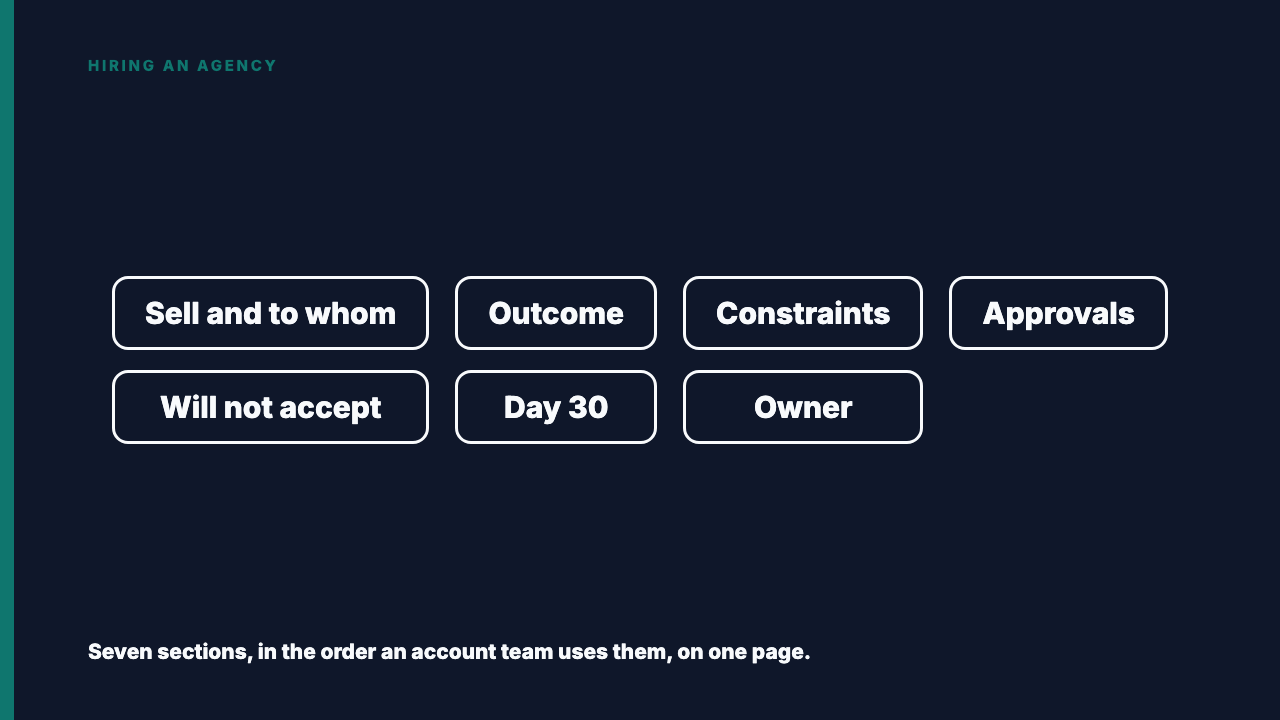
Order the page the way an account team uses it: what you sell and to whom, the one outcome that matters this quarter, constraints, who approves what and how fast, the will-not-accept list, what good looks like at day 30, and the one person who owns the brief. Here is an invented regional cycle repair chain, written two ways.
| Section | Vague (illustrative) | Filled in (illustrative) |
|---|---|---|
| Sell, and to whom | Bike services for everyone | Repairs for commuters near our three shops |
| Outcome this quarter | More engagement | More booked services before winter |
| Constraints | Keep it on brand | No price promises, no bank holiday posts, no new platforms |
| Approvals | We will review | Shop owner, 48 hours; partner advises on tone only |
| Will not accept | Nothing offensive | No rider safety jokes, no stock cyclists, no unsigned posts |
| Day 30 | Good momentum | Calendar agreed, four weeks published without a rejected batch |
| Owner | The team | One named person who settles disputes |
If it runs past one page, you have not decided what matters, and the agency will read the first half. Brand guidelines and past reports go in appendices. Access and assets are a separate job, covered in what to have ready before you sign.
What to do after you send it
At kickoff, ask the agency to play the brief back in its own words, and write down what it got wrong. A misreading found in week one costs a conversation. Found in week five, it costs a month of content. The first 30 days with a new agency is where the brief gets tested.
Revise it when a veto holder changes, a constraint appears, or a first batch is rejected for a reason the brief did not cover. One person holds the pen: the internal owner of the agency relationship. Binding changes go through the contract; see reading the scope of work.
Finding an agency that will push back on a thin brief
A good agency interrogates a vague brief. It asks who approves, what has been rejected before, what you cannot say, and how fast you can respond. An agency that says “great, we’ll take it from here” is telling you it will find out the hard way, at your expense. Treat the difference as a vetting signal.
Next step
Browse vetted agencies: the directory lists 83 published agencies, 47 in Social Media Management. If you run an agency, list your agency free.
FAQ
How long should a brief to a social media agency be?
One page. The limit forces decisions, which is the point. Anything longer belongs in appendices, such as brand guidelines and past reports, that the brief points to.
What is the difference between the brief and the scope of work?
The scope of work is the contractual list of what the agency delivers and what it costs. The brief tells the account team how to do that work well for you. Enforceable terms belong in the scope of work.
Sources
- Mailchimp, How to Write a Creative Brief, fetched 2026-10-10
- Wikipedia, Creative brief, fetched 2026-10-10