Your Agency Doesn’t Know Who to Report To During a Reorg
Your marketing team is being merged, split or moved under someone new, and your social media agency is still sending drafts every Tuesday. The person who used to answer them may no longer own the answer. Nobody has told the agency, so it is guessing.
The two ways an agency fails during your reorg
The first failure is the stall. Posts sit in draft because the approver changed. Questions go to a person who no longer owns the answer. The agency is polite about it, so you never get a complaint. You just notice, weeks later, gaps in the content calendar.
The second is the drift. The agency keeps executing the last approved strategy on schedule because nobody told it to stop. The account publishes against a plan the new structure may not endorse. Nothing looks broken. The brief is simply out of date.
A diligent agency is more likely to drift, because it hates missing a slot. A cautious one is more likely to stall, because it would rather wait than publish something the wrong person objects to. You cannot tell which you have until something goes wrong. This applies to any structural change, such as marketing and comms merging, a reporting line moving or a team consolidating. It may involve no new leader at all, which is exactly why nobody thinks to brief the agency.
A hypothetical month: marketing and comms merge
This is a hypothetical, not a real company. Picture a mid-sized consumer brand merging its marketing and communications teams.
Week one. The agency’s day-to-day contact is told their role is changing, but not into what. They keep approving posts out of habit, with less confidence each day.
Week two. The comms lead inherits a say over social copy and edits a draft the original contact already approved. The agency now holds two sets of feedback that disagree.
Week three. The agency publishes the version it received first. It touches a topic the comms lead would have blocked. Nobody is angry yet, just quietly annoyed.
Week four. The monthly report arrives. The old contact is buried in the merger and the comms lead does not know the report exists. It goes unread, and the agency reads that silence as permission to carry on unchanged.
One page of written direction on day one would have changed most of this: a single named approver, a note that new campaigns wait, and a date for the next update. The agency would have had one voice to listen to and a reason to expect a reply.
Name one interim decision owner, in writing
The fix that matters most is one named person with authority to approve, redirect and say no, for a stated period.
The good version reads: “Until the end of the quarter, or until we introduce the permanent owner, Priya approves all content and answers all questions. Please take direction only from her.” It has one name, an end date or trigger, and an exclusivity rule. The bad version is “check with both of us” or “we’ll let you know.” Those phrases hand the agency a coordination problem it cannot solve.
The interim owner does not need to be the future owner, but they need real approval authority, meaning they can say yes without escalating. If the best person is the one whose job is being cut or changed, ask them anyway and have someone senior state their authority so the agency believes it.
Send this as a short written message the agency can reply to and file, not a verbal heads-up on a call. See our post on the internal owner for the agency relationship for how to choose well.
Decide what freezes, what continues and what pauses
Do not treat the retainer as one lump. Sort the work into three buckets.
| Bucket | Test | Illustrative work types |
|---|---|---|
| Continue | Evergreen, already approved, low brand risk | Approved evergreen posts, community replies within agreed guidelines |
| Freeze scope | Commits budget or positioning | New campaign concepts, a new channel, a new content series |
| Pause | Message depends on the unresolved structure | Announcements about the new team, leadership voice content |
The work types are illustrative. Your own list will differ.
Freezing scope is not the same as freezing the fee. Check what your contract says about paused or reduced work before assuming the retainer flexes, and take specific questions to counsel. Our post on how to pause a social media agency without firing it covers the contract mechanics.
Fix the approval path before the content queue backs up
A reorg tends to break approvals in three ways:
- Two approvers send conflicting edits on the same post.
- An approver has left the thread but still holds the permissions.
- Nobody is authorised to approve anything time-sensitive, so a reactive post dies.
The acceptable version is short: one approver, one named backup, a turnaround window the agency can rely on, and a default for silence. That default is either hold the post, or publish only pre-approved evergreen items. Pick one and write it down.
Also check whose access and roles the agency’s tools still reflect once people change jobs. Shared logins and notification routing can point at someone who has moved on. Our post on the approval process goes deeper.
What to tell the agency, and what to keep to yourself
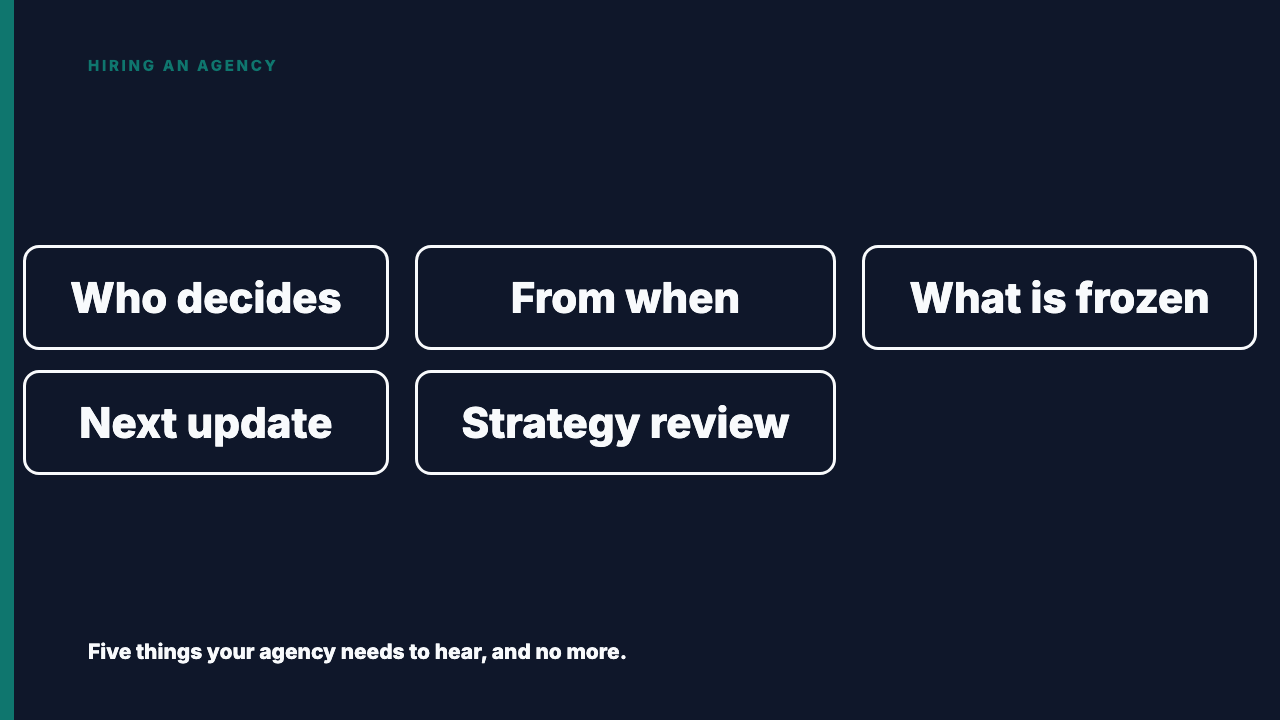
The agency needs five things: who decides, from when, what is frozen, when the next update comes, and whether a strategy review is coming. It does not need to know who is being let go, the internal politics, or unconfirmed rumours.
Vagueness reads to an agency as risk. Guard against the possibility that an agency, sensing a client gone quiet, quietly staffs down or moves its strongest people to steadier accounts. That is a risk to manage, not a certainty, and a clear message is the cheapest way to manage it.
Template, adapt freely:
We are restructuring our marketing team. From Monday, [Name] is your single point of approval and direction until [date or trigger]. Please continue the approved evergreen calendar and hold new campaigns and any content about our team or leadership. We will update you by [date] and expect to discuss strategy once the structure settles. Please reply to confirm who you are taking direction from.
That last sentence matters. It proves the message landed and gives you a file copy.
Set the date when the real owner takes over
An interim arrangement without an end becomes permanent by neglect. Book a handover meeting where the permanent owner is introduced and every frozen item is either released or cancelled.
The new structure may want a different strategy. Rather than silently continuing or abruptly overhauling, propose a short checkpoint review a few weeks after handover. Also check whether the original statement of work still describes what the new structure needs. If not, start a change conversation rather than stretching the old document. If the reorg also brings a new leader, the situation differs again, and our post on inheriting an agency covers it.
Next step
If the reorg has you rethinking the agency relationship itself, Browse vetted agencies on Partner in Social. If you run an agency yourself, you can list your agency free.
FAQ
Should I pause my social media agency during a reorg?
Usually no. Pause only the work that depends on unresolved decisions and let evergreen, pre-approved work continue. Check your contract before assuming the fee will flex.
Who should my agency take direction from while roles are changing?
One named interim owner with real approval authority, confirmed in writing, with an end date or trigger. Never two people in parallel.
Sources
- How to Pause a Social Media Agency Without Firing It, fetched 2026-10-09