How Much of Your Influencer Budget Reaches the Creator?
You are reviewing an influencer proposal and one line carries most of the budget: “Creator package, all-in, per creator.” There is no breakdown beneath it, and you cannot tell whether the creator receives most of that figure or a small slice. You are not sure whether asking is allowed. It is, and a good agency will not find the question strange.
The single number that hides two payments
Picture a proposal for six creators, each at one round figure. Nothing says what the creator is paid, what the agency keeps, or whether usage rights are included.
The brand is buying two things in that number. One is the creator’s licence to publish and perform the work for their audience. The other is the agency’s labour: sourcing, briefing, contracting, approvals and reporting. Both are legitimate costs. The problem is only that a blended price blurs them, so you cannot judge either. My position: ask for them as separate lines.
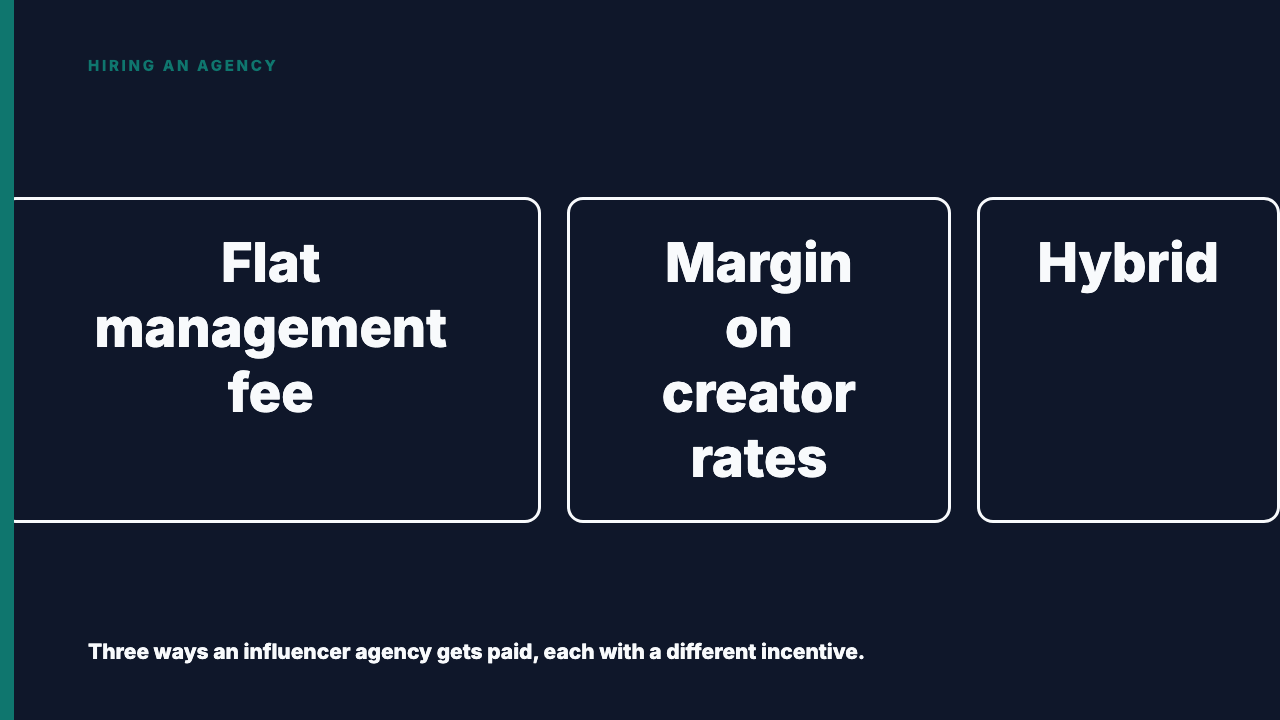
Three structures agencies use to get paid
These are conceptual models, not market statistics. I will not say which is most common or what any costs. What matters is what each makes the agency want to do.
| Structure | How the agency is paid | What it rewards | Weakness |
|---|---|---|---|
| Flat management fee | A set fee for running the campaign. Creator fees pass through at the rate the creator agreed. | Finding the right creators, not the priciest ones. | Less reason to negotiate a creator’s rate down. Scope creep gets argued over. |
| Margin on creator rates | A percentage or markup added to whatever the creator is paid. | Growth with creator spend, which is a quiet pull toward bigger names and bigger deals. | Perfectly fair when disclosed and capped. Hidden, you cannot see the pull. |
| Hybrid | A smaller management fee plus a smaller margin, or margin only above a creator spend threshold. | A blend of both incentives. | Not a red flag by itself, but the most room for confusion, so it most needs separate lines. |
The same question applies to other pass-through costs, such as whether software costs are bundled or billed extra.
What the incentive does to the creators you get shortlisted
An illustrative, hypothetical contrast. Give the same brief to two agencies, one paid a flat fee and one paid a margin on creator rates. The flat-fee agency has no financial reason to prefer an expensive creator, so its shortlist may lean toward fit and include modest price points. The margin agency earns more from each extra unit of creator spend, so its shortlist might skew toward fewer, larger deals, or a longer list that uses the whole budget.
This is an incentive to be aware of, not an accusation. Plenty of margin-based agencies recommend sensible shortlists, and plenty of flat-fee agencies under-negotiate.
Does the shortlist span a range of price points? Does the agency explain why it rejected a cheaper creator? Has it ever recommended fewer creators than you asked for? An agency that never advises spending less is telling you something.
How to ask for the split without souring the pitch
Put the ask in writing. This is wording you can paste into an email:
Could you restate the quote with each of these on its own line: creator fees (per creator, per deliverable), any usage or licensing fees, and your agency fee? We want to see where the budget goes.
- A good answer gives a clear breakdown, names the structure, explains what the agency fee covers, and is willing to show the creator’s fee line as agreed with the creator.
- A bad answer is “our rates are confidential,” “it’s a package, we don’t break it out,” or an offer to break out only the total you already have.
An agency’s internal costs are its own business. What a creator is paid on a campaign you are funding is different, and a brand can reasonably treat a refusal as a deal breaker.
One fair counterpoint: some agencies bundle because creators will not agree to have their rate shared, or because the agency carries risk such as non-delivery and replacement. You can accept that and still require a category-level split, creator fees in total and agency fee in total.
What the agency fee should be buying
Whatever the number, the agency’s share should map to work you can name: sourcing and vetting creators, briefing, contracting, content approval rounds, posting coordination and reporting. Match each item to a named person or a block of hours.
Keep paid amplification and usage rights beyond the campaign on their own lines, separate from both fees. And a lower agency fee is not automatically better. A cheap quote usually cuts something, so check what was removed, not just what was charged. See what a lower agency quote usually cuts.
Where payments, disclosure and responsibility get murky
Routing creator money through an agency raises questions to settle in the contract, not assume. Who pays the creator, and when? You should know whether you pay the agency before or after the creator is paid, and what happens to the creator’s fee if the campaign is cancelled. If a creator drops out, is the unspent budget returned to you or kept by the agency? Put the answer in writing.
Disclosure is the third. The FTC’s Disclosures 101 for Social Media Influencers says an endorsement should make it obvious when there is a material connection to the brand, including the brand paying the creator, and points to the Endorsement Guides for how advertisers and endorsers should behave. This is not legal advice. Do confirm in the scope of work who checks that disclosures are present, and name that person.
A quick check before you sign
- Are creator fees shown separately, per creator and per deliverable?
- Is the agency fee on its own line?
- Is the structure named: flat, margin or hybrid?
- Does the contract say what happens to unspent creator budget?
- Does it say who pays the creator, and when relative to your payment?
- Does the scope of work say who verifies sponsored-content disclosure?
The decision rule: if you cannot tell which part of the number the creator receives, ask. If the agency will not tell you, that is information about the agency.
Compare agencies on the terms that matter
Browse vetted agencies, including the 14 influencer marketing agencies in the directory, and bring the line-item request to each conversation. Run an agency yourself? List your agency free.
FAQ
Is it normal for an influencer agency to take a margin on creator fees?
It is one common way agencies get paid, alongside flat management fees and hybrids, and it is not wrong in itself. The question is whether it is disclosed. I will not quote a typical percentage, because any figure offered as standard would be a guess.
Can I ask an influencer agency what the creator is actually being paid?
Yes, it is a reasonable request for a campaign you fund. If the agency will not name individual rates, ask for creator fees in total and agency fee in total.
Sources
- FTC, Disclosures 101 for Social Media Influencers, fetched 2026-10-01 (HTTP 200)