Should Your Agency Submit Your Account for an Award?
Your account manager has emailed. They would love to put your account forward for an industry award, the deadline is Friday, and could you just reply with a quick yes? It is friendly, it is flattering, and it arrives with a clock attached.
The email arrives, and you have no policy
Picture the message. It says the campaign was a highlight of their year and they only need a go-ahead by end of week. Nothing in it tells you what will actually leave the building, and most brands answer from instinct, in the reply thread.
An award entry is a business exposure decision. Treat it like any other decision about releasing company information. This post is not about whether your work deserves to win. It is only about who decides what leaves the building.
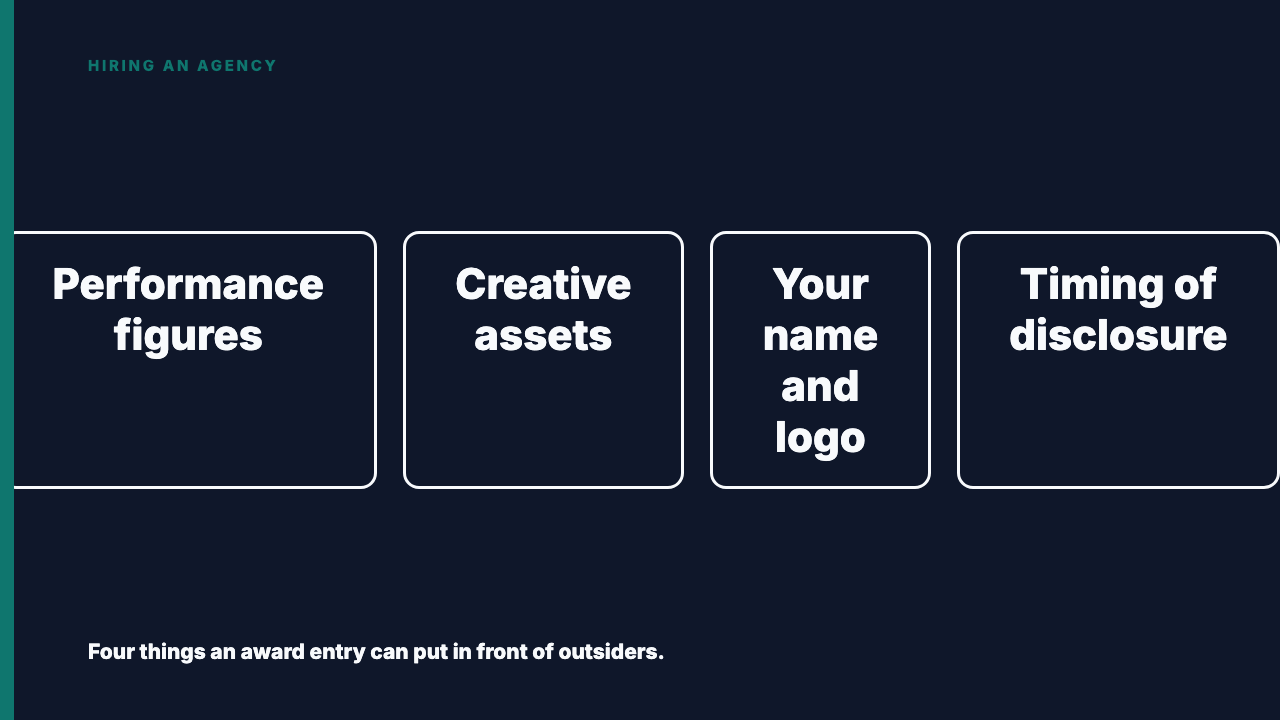
What an entry actually puts in front of outside people
- Performance figures. A number that is fine internally can look awkward beside a competitor’s.
- Creative and content assets. The entry may include a campaign you have not finished running, or content whose rights you have not cleared for this use.
- Your name and identity. Your logo attached to an entry publicly associates you with whatever the agency writes about you.
- The timing of disclosure. Something harmless in March can be sensitive in June, ahead of a launch or a change in strategy.
Entry requirements differ by program, and you cannot tell from the agency’s email which parts are visible to judges only and which are published afterward. That uncertainty is the reason to ask.
Also watch for screenshots of comments, DMs or customer replies. They can carry personal information about third parties, and that is your problem as much as the agency’s. The FTC’s guide to protecting personal information for business is a sound general reference, though not specific to award entries.
Why the agency asking is not the problem, and why silence is
Agencies want to enter because recognition helps them win new clients and keep good staff. That is a normal motive, not a red flag.
The good version: the agency asks early, names the program, and says what it plans to submit. The bad version: the agency submits first and mentions it on the monthly call, or a line buried in the boilerplate grants blanket permission to use work in “promotional and award submissions.” Either way the brand never decided anything. A default did.
This is a sibling of the clause in Can Your Agency Call You a Client in Their Own Pitch Deck?. Award entries sit beside that publicity clause and are often not covered by it, so check your own wording rather than assuming.
The consent and review step to write into the contract
Add a short clause to your master services agreement or statement of work, alongside the rest of what to check in a social media agency contract. In plain language: no submission of the brand’s account, data or creative to any awards program, competition or publication without written approval for that specific entry. Have counsel review the actual wording. This is not legal advice.
These are our suggested practice, not an industry standard. Each request should state:
- The program.
- The entry category.
- The exact figures and assets to be included.
- Whether the entry becomes public, and when.
- The deadline.
Reserve a review window. We suggest asking for requests at least ten working days before the entry deadline. Silence must never count as approval.
You can also require redaction of specific metrics, indexed or relative figures in place of absolute ones, removal of third-party screenshots, and the right to see the final entry as submitted. Rights to creative are covered in who owns the content your agency made, and how figures are defined in KPI language that belongs in your agency contract.
Three ways to answer: yes, no, yes with conditions
| Answer | When it fits | What to say back |
|---|---|---|
| Yes | You have seen the entry, the campaign is finished, and you would happily publish the figures. | “Approved for this program and category, as drafted on [date].” |
| No | Picture a brand in a regulated setting, or one with a product launch pending. | “We are passing on this one. Please do not submit our account, data or creative.” |
| Yes with conditions | You are open to it but want control over what is shown and when. | Use the reply below. |
Conditional reply: “We are open to this, subject to written approval. Please send the program, category, exact figures and assets, whether the entry will be public and when, and the deadline, at least ten working days before it closes. We would also like to see the final entry.”
A no is legitimate and should not damage the relationship. You can also say not now, and revisit once a campaign has ended.
What to do if the agency has already submitted
Get a copy of exactly what was submitted. Find out whether it is public and whether it can be withdrawn, which depends on the program’s rules, so ask the agency to check them rather than assuming. Read your contract for a publicity or confidentiality clause. Then raise it as a process gap, not an accusation: there was no approval step, so add one.
Put the policy in one paragraph
Adopt this as your standing policy: “Our agency may not submit our account, data, creative or name to any awards program, competition or publication without our written approval for that specific entry. Each request must name the program and category, list the exact figures and assets, say whether and when the entry becomes public, and state the deadline, with enough notice for review. We may require redaction and removal of third-party content, and we will see the final entry as submitted. Silence is never approval.”
Still choosing an agency? Browse vetted agencies from our directory of 80 published agencies. If you run one, list your agency free.
FAQ
Can I say no to an award submission without hurting the agency relationship?
Yes. A well-run agency expects a conditional or negative answer to be possible. Offer not now, or yes with redactions, so the agency has a path forward.
Does a standard agency contract already cover award submissions?
Sometimes indirectly, through a clause allowing use of work for the agency’s own promotion or portfolio. Check for that wording and for confidentiality terms, and do not assume either way. See our post on agencies using your brand in their own marketing.
Sources
- FTC, Protecting Personal Information: A Guide for Business, fetched 2026-09-25.