Ask an Agency When It Can Start, Not Just Whether It Can
You are holding three proposals. Each accepts the scope, each is priced within reach of the others, and you have run out of ways to tell them apart. Ask each agency when its named people can start, and what they are finishing first.
Every proposal says yes because yes is free
A proposal says whether the agency can do the work, and stays silent on when it has room to. Capability is what an agency sells. Capacity is what it has to deliver. A proposal documents only the first, and saying yes costs nothing until the contract is signed.
In buyer terms, capacity means the named people have enough unbooked hours to give your account real attention in the first weeks. Firms that bill for time track a utilization rate, which Wikipedia defines as billable hours divided by hours recorded or by a fixed number of hours, and notes can be gamed.
The point is a vetting signal, not a scheduling nicety: a confident, specific answer about availability beats an enthusiastic one about capability.
What a full agency does after it says yes
Hypothetical: a small outdoor gear brand signs with an agency already at full load. The contract is signed on the first of the month and the kickoff call lands three weeks later. The first month is staffed from whoever is free: a junior strategist and a contractor build the audit. The named account lead splits their week across other clients, and questions wait days.
Those are three distinct failure modes: a slipped kickoff, bench staffing in the ramp period, and a lead who is assigned but practically absent. You rarely see them because the first weeks are onboarding and audit work with little public output, so a slow start looks like a normal ramp.
This piece covers the timing axis only. For the staffing swap, read the team that pitches you is not the team that runs your account. For headcount per account, see how many people are actually working on your account.
Four questions that surface capacity
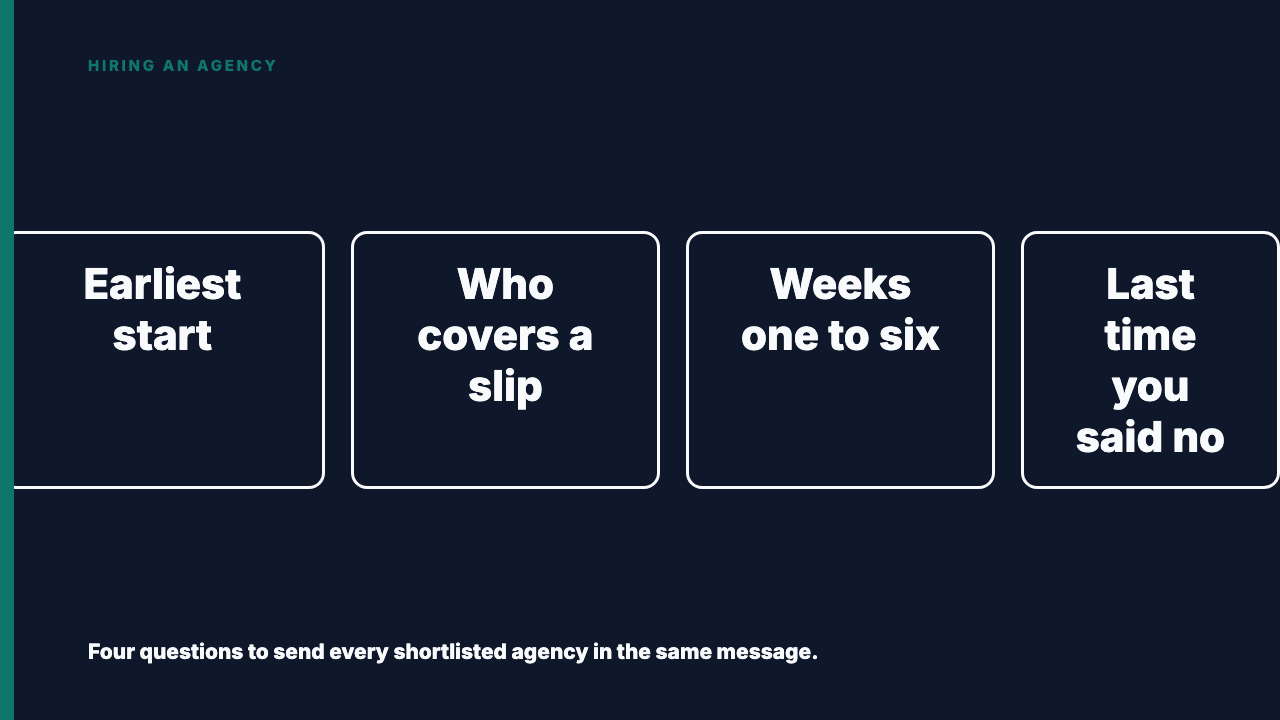
Put these in writing to every shortlisted agency.
- What is the earliest date the people named in this proposal can start on our account, and what are they finishing before then? This tests whether it has looked at its calendar. A date plus a named prior commitment is good. “Right away” with no detail is not.
- If that date slips, who does the work in the meantime, and will you name them and their seniority? This tests whether a fallback exists.
- Walk me through weeks one to six. What happens, who does it, and what do you need from us? This tests for a ramp plan, not just a kickoff meeting. The good version has dated milestones and a list of what it needs from you, such as account access and approvals.
- When did you last delay or turn away a client because you were full? This tests honesty about limits. An agency that has never said no is lucky or not counting.
Send all four in the same message so the answers compare side by side. A vague reply is an answer too. If the proposals also cover different work, compare proposals with different scopes first.
What a confident answer sounds like next to an enthusiastic one
| Question | Strong answer | Weak answer |
|---|---|---|
| Earliest start | A specific week, and the named work the team finishes first. | “We would love to get going immediately.” |
| Who covers a slip | A named person, their seniority, and what they would handle. | “We will make it work.” |
| Weeks one to six | Dated milestones, an owner for each, and what it needs from you. | A kickoff call, then “we will take it from there.” |
| Last time you said no | A specific start pushed back to protect existing work. | “We always find a way to fit everyone in.” |
| Your readiness | Says which access and approvals it needs from you to hit the date. | Never mentions what you must do. |
The tell is specificity and willingness to state a constraint, not speed. A fast start is fine if it arrives with names and dates.
When the best agency says not until next quarter
A later start with a reason attached is often a good sign. It usually means the agency protects its existing accounts and will protect yours the same way. It is a signal to read, not a guarantee.
Waiting costs a quarter of momentum and perhaps a launch that falls in the gap. Starting now costs the attention that justified choosing this agency. A rule of thumb: a fixed launch date the agency cannot support is a reason to look elsewhere, while a flexible timeline is a reason to wait.
A middle option, not to be oversold: ask whether the agency will take a smaller, clearly scoped piece of work in the gap, or keep your current arrangement running until the date.
A start date depends on you too. Delays from your own approvals and account access are not the agency’s fault, so work through what to have ready before you sign.
Put the start date and the named team in the contract
Three terms are worth requesting: a stated kickoff date, the named people working the account from it, and what happens if it slips. Treat them as terms to negotiate, not market standard.
Two remedies you can propose for a slipped start: retainer billing begins at actual kickoff rather than at signature, or you receive a fee credit for each week of delay. The poor version says the work starts “on or about” a period with no anchor date, and describes the team only as “a dedicated team.” Have a lawyer review the wording.
An agency unwilling to write down a date it just stated aloud has told you something.
Browse the directory
Browse vetted agencies among the 80 in the directory. Agency owners can list your agency free.
FAQ
How long should it take a social media agency to start?
There is no universal number. The useful answer is a specific date, the names of the people starting on it, and what they are finishing first. Judge the specificity, not the speed.
Is a later start date a red flag?
Not by itself. A later date with a reason and a named fallback is often a good sign. The red flags are an instant start with no detail about who does the work, or a date that moves after signature.
Sources
- Utilization rate, Wikipedia. Cited for the definition only.