Agency, Freelancer, or Fractional Lead: Which One Your Risk Picks
You have a modest budget and three vendors in your inbox, all promising to run your social: a freelancer, a fractional lead, and an agency. They read as interchangeable, they compete on price, and the cheapest one wins. Then a week arrives when the one person who knew your account is not there, and you learn what you bought. This choice is about which failure you can survive, not budget.
The fork most comparisons get wrong
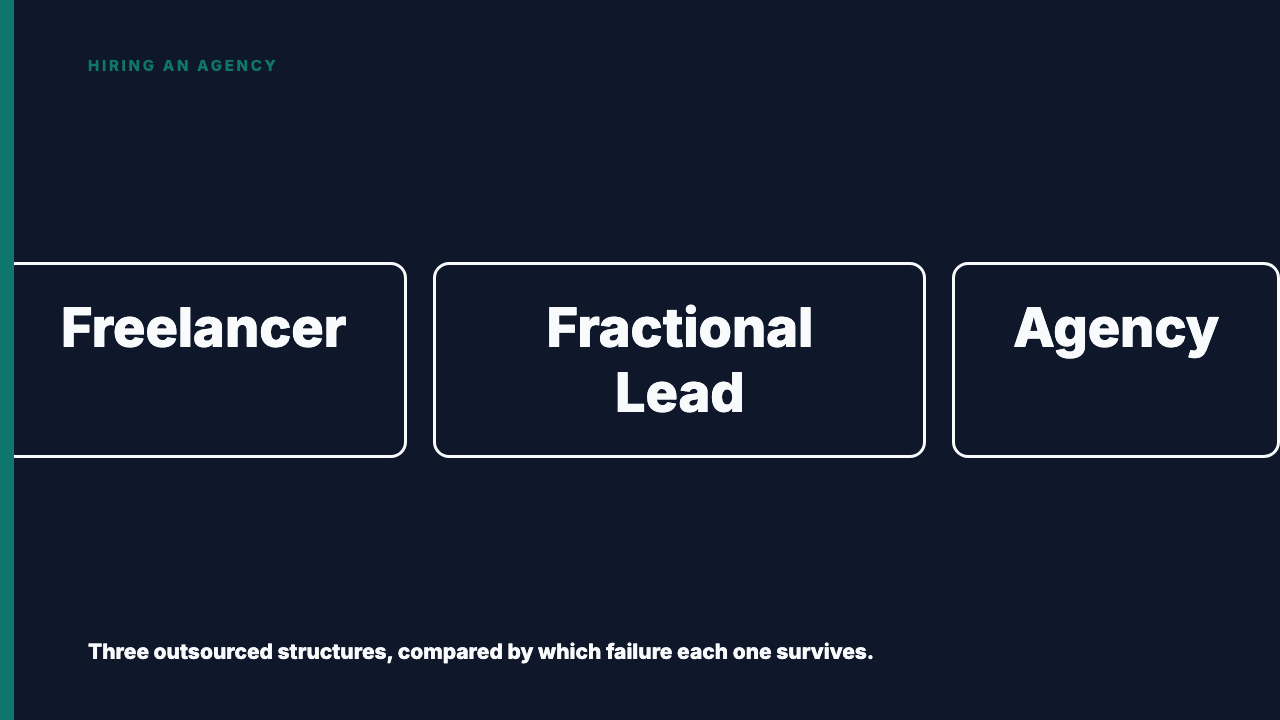
Most write-ups frame this as agency versus in-house. For a smaller brand on a modest budget that is the wrong fork, because in-house is not the live option. The live choice is which of three outsourced shapes to buy: a freelancer, a fractional social lead, or an agency.
The variable it turns on is not price. It is coverage risk and coordination load: what happens to your social when the person doing it disappears for a week, and how much managing the arrangement costs you. Price is the loudest number in the pitch, which is why it crowds out the two that actually decide whether it holds.
A fractional social lead, a term most readers have not seen defined, is a part-time senior operator who sets direction and directs contractors rather than doing the day-to-day alone.
One freelancer: cheapest until the week they are gone
The good version is genuinely good. You get one skilled person who learns your brand quickly, moves fast because there is no handoff, and costs the least of the three. When your social is steady and low-stakes, that can be right.
The bad version is structural. Picture the week your seasonal launch lands and your freelancer is on holiday, ill, or has just signed a better-paying client. A solo freelancer is the whole bench, so when they are unavailable, so is your social. A freelancer removes coordination load only because there is nobody to coordinate, the same reason there is no redundancy.
Fractional lead: strategy without hands
A fractional lead buys senior judgment: someone who has run social at the level you are reaching for and can build a plan worth following, at a fraction of a full-time salary. If your posts are fine in isolation but going nowhere as a whole, that is a direction problem, and this is the structure built for it. But the gap is direct: they buy strategy and oversight, not execution capacity. Someone still has to make the posts, whether your team, contractors the lead manages, or you.
So this option adds coordination load rather than removing it. Underneath the lead sits a small pool of contractors, where redundancy lives or fails to: a lead directing three interchangeable contractors has cover when one drops out, while a lead directing a single freelancer has only recreated that freelancer’s exposure with an extra fee.
Agency: redundancy you pay a margin for
What an agency sells, stripped of the language, is redundancy. It buys coverage that survives one person being absent, and you pay a margin on raw labour for it, whether or not a given month tests it. That margin funds a bench that can cover the account, an account manager who holds the relationship, and a process that continues when any one person does not.
Agencies carry their own failure mode. The team that pitches you is often not the team that runs the account, so the account you were sold is not always the one you get. Confirm whether the agency subcontracts the work before assuming the bench exists.
Match the structure to your failure mode
Map it to your risk, not your price: a one-week gap you could absorb makes a freelancer defensible, a direction shortage points to a fractional lead, and a campaign week you cannot miss means an agency. Coverage risk is not the only variable, but it is the one buyers most often ignore.
| Structure | Failure mode it survives | Cost basis | Coordination load |
|---|---|---|---|
| Freelancer | Nothing when they are unavailable; no bench | Lowest; pure labour, no margin | Lowest; one person to brief |
| Fractional lead | A direction gap, not an execution gap; cover depends on the pool | Judgment at a fraction of a salary; execution billed separately | Higher; you manage the lead and often the pool |
| Agency | One person’s absence, by design | Labour plus a margin for the bench | Lower day to day, if pitch team is run team |
Browse the options before you decide
Once you know which structure your risk points to, compare providers against it. Browse vetted agencies, and if you run one, list your agency free. For the adjacent decisions, read the in-house versus agency versus hybrid decision, how agency fees are actually structured, and why agency size is its own selection criterion.
Two questions to ask yourself before you post the job
- What happens to our social if the one person doing it is unavailable for a week during our busiest month? That sorts the freelancer from the other two.
- Is our real shortage direction and strategy, or hands and volume? That sorts the fractional lead from the agency.
- Then decide against your worst plausible week, not your average calm one.
FAQ
What is a fractional social media lead?
A part-time senior operator who owns your social strategy and direction, often managing a small pool of contractors who do the hands-on posting rather than executing it alone. You buy their judgment for a fraction of a full-time senior salary, not a full-time pair of hands.
Is a freelancer always cheaper than an agency?
On the headline number, in most cases yes. But that lower price is also the absence of redundancy: a freelancer has no bench, so when they are unavailable your social stops, whereas an agency’s margin pays for coverage that survives one person’s absence. The saving is real, and so is the coverage risk.
When does an agency actually earn its margin?
When a one-person gap would genuinely cost you, such as during a launch or a real season. In those weeks the margin buys coverage that survives someone’s absence, which is exactly what a freelancer cannot offer.
Can a fractional lead and a freelancer be combined?
Yes, and it is common: the fractional lead sets direction and manages one or more freelancers who execute. This recreates coordination load, and the redundancy depends on the size of the contractor pool, since a lead directing one freelancer carries the same exposure as hiring that freelancer alone.
Sources
- U.S. Small Business Administration, Manage your business, which frames hiring and managing help as a structured business decision. Fetched 2026-09-15.