When Your Agency Tells You Not to Spend More
Your agency just told you to hold your budget where it is, or to trim it. After months of hearing that more spend would move the number, the advice has reversed, and you are left wondering what to make of it. The recommendation is not the answer. What surrounds it is.
Why almost every agency pushes the number up
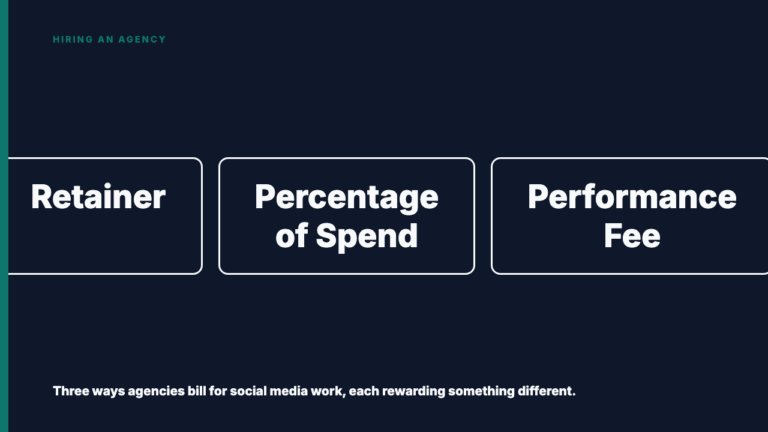
Start with the incentive. Two common fee structures reward a bigger budget directly. On a percentage of ad spend, the agency takes a cut of what you put into the platforms, so a larger media budget is a larger fee with no extra work to justify it. On a retainer, the pressure shows up as scope: another channel or a second deliverable, billed as an upsized retainer at renewal. In both models, more spend means the agency earns more. If you want the full breakdown, see how your agency is actually paid.
When the incentive and the advice point the same direction, the advice tells you nothing about the agency’s judgment. The good version explains why more spend would not clear the bar the agency set with you, pointing at your results. The bad version reaches for a bigger number at every review by reflex, because that is the number that pays it. “Spend more” is the default, so the message worth reading is the one that breaks it.
What a real hold recommendation sounds like
A recommendation to hold has a shape when it is real. Picture a quarterly business review where the agency shows the current budget is not fully worked yet, so more now would mean paying for audience the campaigns have not learned to convert. Or the opposite: a channel where each added dollar returns less than the last, the shape of diminishing returns. Either way it arrives with a condition: hold until the creative refresh ships, until the funnel below the ad is fixed, or until the audience justifies a new one.
That condition is the tell. A real hold comes with a reason tied to your results and a specific thing that, if it changed, would reverse the call. A lazy hold is a shrug: no reading of your numbers, no path forward, just “let’s keep it steady for now.” A hold can also mask an agency that has quietly deprioritised your account and would rather coast than do the work an increase demands. The question that separates the two: what is the agency working on this quarter to improve your results at the current spend? A genuine hold has a plan; a disengaged account has an excuse. If you are unsure whether the quiet is normal, see how often you should actually hear from your agency.
The questions that pressure-test the recommendation
You do not have to take the signal on faith. A few questions, asked while it is fresh, turn it into something you can verify.
- What would have to be true for you to recommend spending more? A real hold has a specific answer, because the condition that justifies holding is the same one that, reversed, would justify spending. If the agency cannot name it, the hold has no reasoning behind it.
- What are we leaving on the table by holding? This forces the agency to admit the cost of its own advice. A thoughtful answer names the upside you are forgoing and why it is not worth chasing yet; silence means it was never weighed.
- What happens to your fee if we hold? An agency on a flat retainer loses nothing by advising a hold. An agency on a percentage of spend is advising against its own revenue. Both are worth saying out loud, because naming the incentive changes the room.
The answer that should worry you is vague reassurance with no numbers and no condition. “Trust us, now is not the time” is not an answer.
How the fee structure changes what the signal is worth
Not every hold weighs the same, and the difference is how the agency gets paid. When an agency that earns a percentage of your ad spend tells you to hold, it argues against its own take, and every dollar it talks you out of spending is a dollar off its fee. A costly recommendation is a credible one, close to the strongest trust signal the relationship offers.
On a flat retainer the same words cost almost nothing. The retainer holds whether you spend more or less, so the advice is neither sacrifice nor risk. That does not make it wrong; it makes it weaker evidence of character, judged on its reasoning rather than any sacrifice behind it. The retainer test shows up at renewal: declining to upsell a service you do not need is the retainer-side version of the signal.
What to do with the signal after the meeting
A signal you do not record is a signal you lose. Before the memory fades, write down the recommendation, its reasoning, and the condition the agency said would reverse it, so the next review can check whether the forecast held. Hold that record against what happened: an agency whose holds turn out right, whose conditions arrived roughly on schedule, has earned latitude at renewal; one whose holds were really disengagement is caught by the same record, because the condition never came. Before reading too much into a single hold, see what normal performance looks like after the ramp, so you can tell an expected plateau from a problem. Treat this as part of the renewal conversation you should already be running.
Find your next agency
If this has you reconsidering the relationship, browse vetted agencies on Partner in Social. Run an agency that earns its retainer by advising honestly? You can list your agency free.
FAQ
Is an agency recommending against more spend always a good sign?
No. It is a trust signal only when it comes with reasoning tied to your actual results and a condition that would change it. The same words can hide a disengaged account. The distinguishing question is what the agency is doing this quarter to improve your results at the current spend: a genuine hold has a plan, a disengaged one has an excuse.
Why does my agency’s fee structure matter here?
Because it sets the price of the recommendation. A hold costs a percentage-of-spend agency real revenue, which makes it strong evidence. On a flat retainer it costs almost nothing, so it is weaker evidence, judged on the quality of its reasoning.
Sources
- Partner in Social, how agency fee structures work, fetched 2026-09-11.