Ask Who Keeps the Content Calendar and Approval History When the Contract Ends
A brand offboards its agency, gets the post library and the ad account keys, and calls the handover done. Then the new team, whether an incoming agency or an in house hire, opens the calendar to plan next quarter and finds nothing behind it. No record of why a launch moved by three weeks, no trail of what the brief said before it was revised twice. The finished posts are all there. The reasoning behind them is not, and nobody named it as missing until it was gone.
The handover that looks complete but isn’t
Picture a mid sized retailer ending a two year retainer. The offboarding checklist covers the obvious: transfer the content library, hand back the ad account, confirm brand assets sit in a shared drive. Everything gets ticked off cleanly. Three weeks later, the new agency asks why the brand’s tone shifted around month fourteen, or why a strong performing content pillar was dropped. Nobody remembers, and there is no document to check. The calendar, the approval threads, and the brief history lived inside systems whose access ended with the contract. The handover looked complete because it covered every asset anyone thought to list, not the reasoning behind the work.
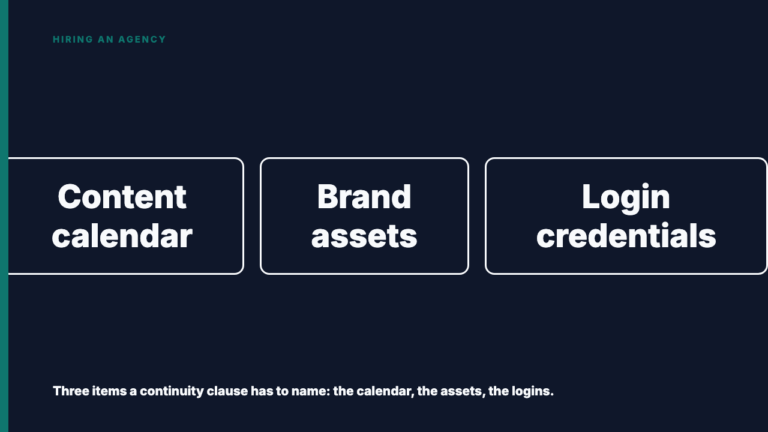
Three things that go missing and are not the finished asset
- The content calendar or scheduling tool. Distinct from the posts it scheduled, it shows what was planned, when, and how far ahead the agency worked.
- The approval comment threads. The back and forth explaining why a version was rejected or changed. A rejected draft with no reasoning attached is just a discarded file, a history how your approval process shapes the work covers from the client side.
- Brief revisions. The sequence of edits to the creative brief, showing what the agency was told to do and how that changed. A final brief shows the last instruction, not what was tried first or who pushed for a change.
Why losing this costs more than it looks like
None of this shows up as a line item anyone budgets to protect, because it is not a deliverable the way a logo file is. Losing a logo file is obvious, someone notices within a day. Losing eighteen months of reasoning is quieter, and the new team simply starts deciding without the context that would have told them an idea was already tried and rejected.
Consider a hypothetical: a new in house hire proposes reviving a content series that disappeared early in the previous agency’s tenure because it underperformed and stakeholders asked for it to stop, a decision settled in an approval thread that no longer exists. The idea gets rebuilt and re-killed months later, because nobody named that memory as worth preserving.
Where this history actually lives
This disappears by default for reasons that have nothing to do with bad faith. Calendar and approval tools are, in most cases, licensed to the agency, not the client, unlike a shared drive of finished files, where the client usually holds its own copy from day one. When the contract ends, that license ends too, a tooling and access problem, not deliberate withholding. Most agencies hand over what they are asked for if the request comes while access still exists, so the failure usually happens earlier: nobody asked.
What to name explicitly in the offboarding clause
- A requirement to export the content calendar in a usable format, not a screenshot or PDF of the current month.
- A requirement to preserve the approval comment threads, or at minimum a written summary of key decisions and their rationale, covering rejections and pivots, not just approvals.
- A requirement to hand over the creative brief with its full revision history, not only the final version.
- A stated deadline for the handover, tied to the offboarding period. An open ended promise to send files “soon” rarely survives once the relationship has formally ended.
What the acceptable version looks like versus the bad version
A good handover contains three things: an exported calendar history covering the engagement, not just the upcoming schedule; a document summarizing the major approval decisions and why they were made; and the complete brief revision trail showing what changed and why.
A bad handover looks different: a login credential revoked before anyone can export from it, a single current state snapshot with no history, or a verbal promise to send files over that quietly never arrives.
When to ask for this
Timing matters more than wording. This has to be negotiated before the exit is confirmed, not after. Once an agency knows the relationship is ending, its incentive to accommodate a non standard request drops sharply, and a request that would take an afternoon during a normal relationship becomes low priority.
The stronger move is to raise this at contract signing, as a forward looking clause, rather than waiting until departure is on the table. It was never unusual if it was agreed from the start. If you are early in a relationship, what to check in a social media agency contract covers where a clause like this fits. If the relationship is already ending, how to leave a social media agency without losing the history covers the broader handover.
Talk to agencies that already build this in
Browse vetted agencies to compare how they handle offboarding before you sign, or list your agency free if handover is already how you operate.
FAQ
Is the content calendar itself something I can legally ask for?
Yes, if it is named in the contract or offboarding clause. Without that, what you receive defaults to whatever the agency’s tool allows, often nothing once access ends. Treat the calendar as a negotiated deliverable, not an assumed right.
What if the agency uses a tool that cannot export history at all?
Ask this during vetting, not during offboarding. If the tool cannot produce a usable export, the workaround is a manual handover document the agency compiles before departure, made a named deliverable with its own deadline.
Does this apply if I am staying with the same agency but changing the account team?
Yes in spirit. The same memory risk shows up internally when a team changes. The fix differs: ask for an internal handover document between account teams rather than a contractual export, since no license or access boundary is crossed.
Should this be a one time request at offboarding or a standing clause?
It works best as a standing clause written into the contract at signing, so no negotiation is needed at the moment of highest friction, when leverage is lowest.
Sources
- https://partnerinsocial.com/blog/leaving-a-social-media-agency-handover/, verified 2026-09-09
- https://partnerinsocial.com/blog/who-owns-your-social-accounts-agency/, verified 2026-09-09
- https://partnerinsocial.com/blog/social-media-agency-contracts/, verified 2026-09-09
- https://partnerinsocial.com/blog/client-side-content-approval-workflow/, verified 2026-09-09
- https://partnerinsocial.com/agencies/, verified 2026-09-09
- https://partnerinsocial.com/list-your-agency/, verified 2026-09-09