How to Compare Agency Proposals With Different Scopes
Three proposals, one decision due this week, and they look nothing alike. One is a two-page PDF with a single number at the bottom. One is a deck with pricing on slide seven. One is an email with a fee and a list. None of them is quoting the same thing, so the numbers are not comparable.
Why the bottom-line number is the wrong first comparison
Agencies do not scope from a shared template. One bundles strategy hours into the retainer without breaking them out. Another bills strategy hourly as it comes up. A third folds paid social management into its flat fee. A fourth does not offer paid management at all and never says so.
Picture three travel quotes: one all-inclusive, one flights only, one quietly including a rental car. The lowest wins and tells you nothing. A total is the output of a scope, so normalize scope first or you are choosing on formatting.
The five line items every proposal is hiding somewhere
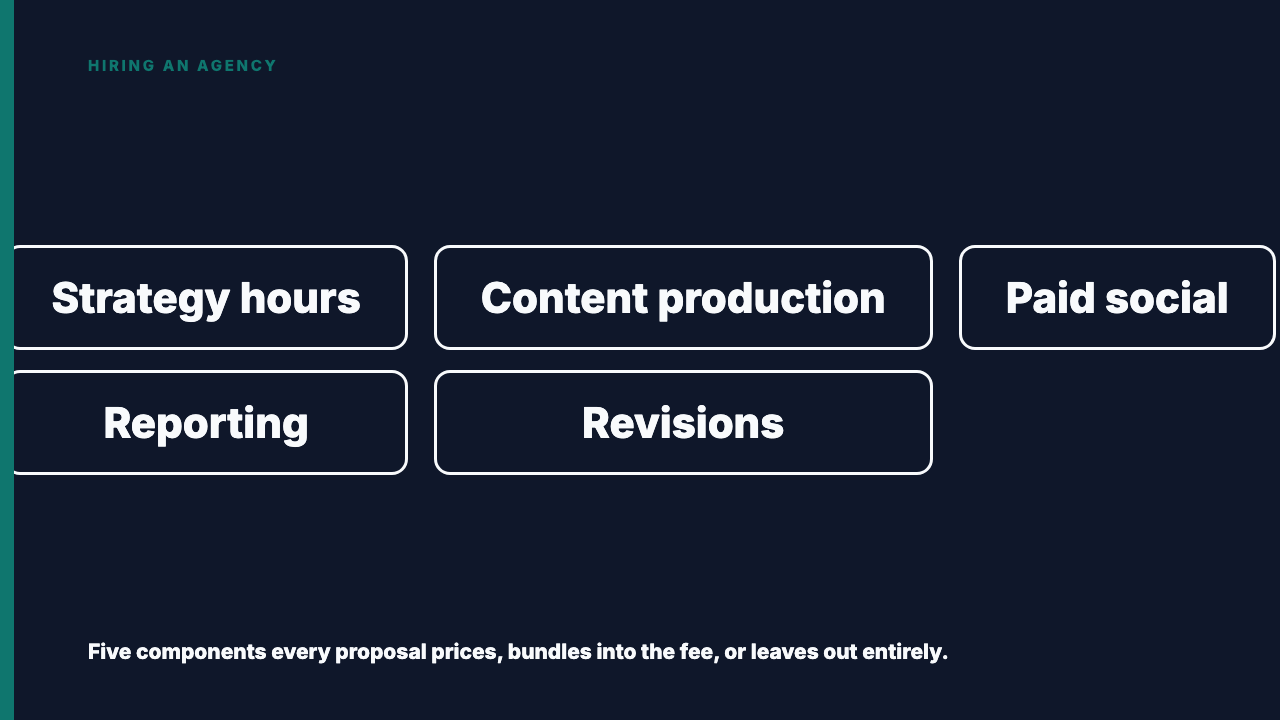
Nearly any proposal decomposes into the same five components, each itemized, bundled into a flat number, or absent entirely. Find out which before comparing figures.
- Strategy and planning hours. A stated monthly allocation, absorbed into the retainer, or never quantified. No hour count means nobody has agreed what strategy means.
- Content production. Volume and format mix, not just “content”. Twelve statics is a different product from six statics and six videos.
- Paid social management. A flat fee, a percentage of the media budget the agency manages, or not offered. The models diverge as spend grows: retainer, percentage of spend, and performance fee models.
- Reporting and analytics. A written monthly report and a review call have hours behind them. Dashboard access does not, and is often where the base fee stops.
- Revisions and scope changes. Rounds per asset, and what happens when you ask for something outside the plan.
Build a normalization table before you build an opinion
One row per line item, one column per agency, recording what each proposal says. “Not mentioned” is a finding, not a blank.
| Line item | Agency A | Agency B | Agency C |
|---|---|---|---|
| Strategy hours | 4 hrs/mo, itemized | Not in base fee, billed hourly | “Included”, no hours stated |
| Content production | 12 statics + 2 short videos | 10 statics, video quoted per project | 8 statics + 4 short videos |
| Paid social management | Included in flat fee | Percentage of spend, billed on top | Not mentioned anywhere |
| Reporting | Monthly written report + call | Dashboard login, report is an add-on | Quarterly report |
| Revisions | 2 rounds per asset | “Unlimited revisions” | Not stated |
| Headline monthly fee | $6,000 | $4,200 | $5,400 |
Every cell above is invented for this walkthrough, not a benchmark and not any real rate. Agency A carries the highest fee and is the only column where all five items are present and priced. Agency B is the cheapest and leaves two of them outside its base fee.
Reading what a proposal doesn’t say
Bundled and missing are different states. A bundled item is named and priced inside the total: “monthly reporting included”. You can see it and ask what it covers. A missing item is never mentioned at all. It has no price because nobody decided it was part of the job, and it surfaces in month two as a change order. Missing is the dangerous one, because there is nothing on the page to notice.
“Unlimited revisions” usually means unlimited rounds on a fixed number of assets, so the generous sentence is the constraint. A monthly fee with no deliverable count is not a price, it is a budget. Learning how to read a scope of work before you sign it turns a vague total into a countable one.
The follow-up questions that force apples to apples
Send these to all three, in one email, in identical wording. Reworded questions produce differently framed answers.
- How many strategy or planning hours are included per month, and what happens past that?
- Is paid ad management a flat fee or a percentage of spend, at what rate?
- What counts as a revision versus a new deliverable?
- What reporting is in the base fee, and what is an add-on?
- How many assets, by format, does the fee cover?
That is the price-normalizing slice of the fuller list of questions to ask before you sign.
When the cheapest proposal is actually the most expensive
Continue the hypothetical. Agency A quotes $6,000 all in for 12 statics, 2 short videos and 4 strategy hours. Agency B quotes $4,200, an apparent saving of $1,800, until you add back its exclusions: 4 strategy hours at an invented $200 an hour is $800, paid management at an invented 10 percent of a $10,000 media budget is $1,000, and the report add-on is $300. B normalizes to $6,300, above A.
Then divide by output. A delivers 14 assets, roughly $429 each. B delivers 10, so $630. The proposal that looked $1,800 cheaper is half again as expensive per deliverable. Every figure there is invented. The method is not.
What normalization can’t tell you
The table tells you what you are buying and for how much. It says nothing about whether the work will be good or who will be easier to manage. Once price stops being the variable, the next filter is fit: what to weigh once price is no longer the variable.
Start from a shortlist worth normalizing
The method is only as good as the shortlist: browse vetted agencies by specialty and location, or list your agency free from the other side of the table.
FAQ
Should I ask all three agencies to rebid using the same template?
Yes. Send a short template listing the five line items and ask each agency to price against it. That is faster and less adversarial than reverse-engineering three sets of unstated assumptions.
What if an agency refuses to break out its pricing?
A single bundled flat fee is not a red flag by itself. Refusing to explain what is and is not included when asked directly is the warning sign. If they cannot say how many hours or assets sit behind their own number, the scope was never defined on their end either.
Is the agency with the most included in the retainer always the better choice?
No. A retainer covering every line item can mean a padded rate, or a generalist stretching across all five instead of doing two well. Normalization buys you a clear comparison, not a reason to reward whichever proposal looks most inclusive.
Sources
- Retainer vs Percentage of Spend vs Performance Fee, Partner in Social, fetched 6 September 2026.