The Renewal Conversation to Have Before Your Agency Starts It
The renewal email often arrives a month or so before your term ends. It carries a number, a line about rising costs, and a date to confirm by. You have two bad options: sign, or argue with no prepared facts. The way out is to run the renewal review yourself, months earlier, on your agenda. This is the one moment in a twelve month relationship when the agency needs you more than you need them, and most buyers spend it reacting.
Why the renewal moment favors you, not the agency
The agency’s switching cost peaks in the weeks before renewal. It has absorbed a year of unpaid onboarding: your approval chain, your real decision makers, your first bad quarter. That cost is sunk and pays back only if the account continues. Replacing your revenue means restarting a sales pipeline that runs months behind. Internally, losing a signed client at renewal is a worse line in the quarterly review than losing a prospect who never signed. Your own switching cost is real but lowest right here, because you have not committed to another year and you already know how this agency works. That advantage disappears the moment you countersign.
Set the meeting before the agency does
Request a standalone renewal review about a quarter out, roughly 90 days before the term ends, in writing, and keep it off the recurring status call. Folded into a status call, renewal gets the status call answer, which is reassurance. A separate meeting with an agenda circulated in advance forces preparation. Bring whoever owns the budget line and can actually decline, not the marketing manager who takes the weekly call. From the agency, ask for the engagement lead with authority over staffing and pricing.
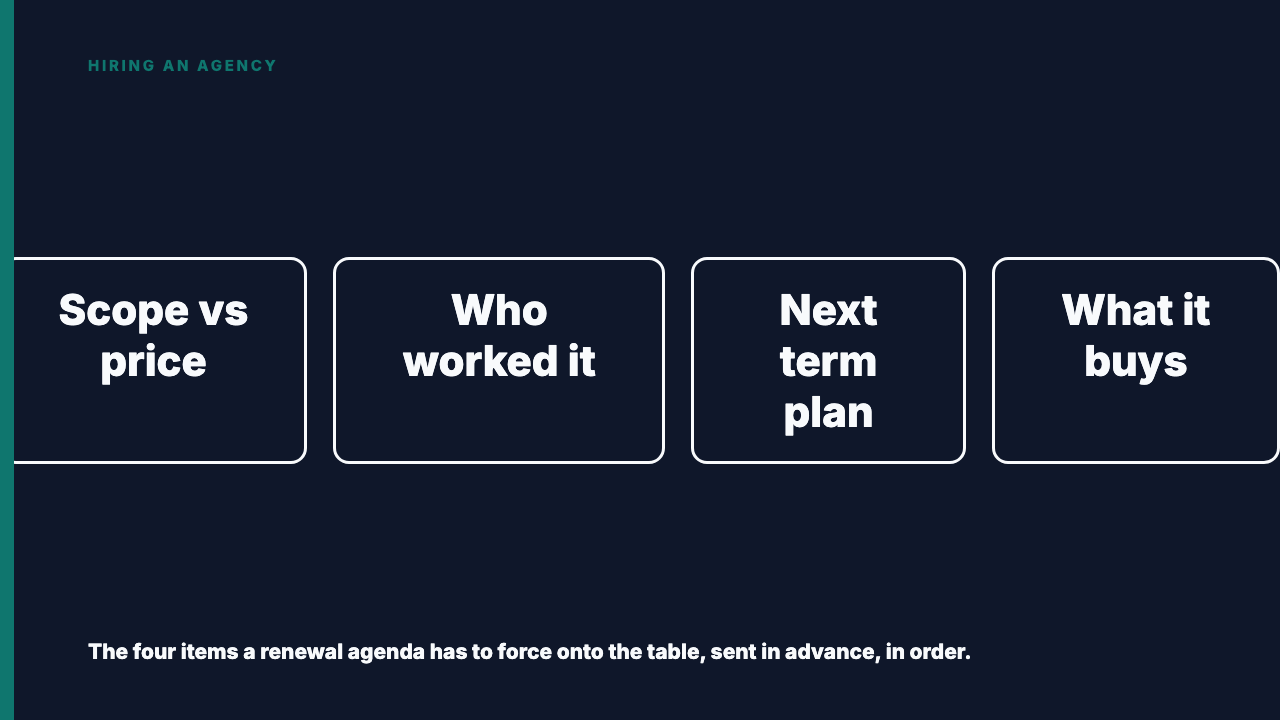
The four items the agenda has to force onto the table
Send these in advance, in this order.
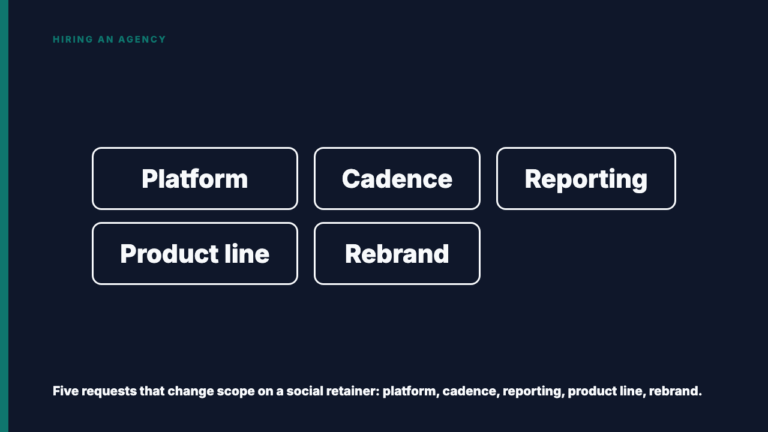
- What changed in scope with no matching price change. Name each one: a platform added in month four, a cadence that went from three posts a week to daily, a monthly reporting call the original scope of work never priced. Bring your own list.
- Who actually worked the account, by name, against the team named at kickoff. Ask how much strategy time came from the senior person who pitched. This is why the team that pitched you isn’t the team that runs your account is worth reading first.
- What the agency will do differently next term. A changed content mix, a channel it wants to retire, a workflow being rebuilt. If the answer is “continue and optimize,” it has stopped thinking about your account.
- What the increase buys beyond keeping today’s service unchanged. More senior strategy time, a named resource with a defined role, expanded reporting, nameable in one sentence.
A hypothetical case: the account that grew without the contract growing
Picture a hypothetical home services company whose twelve month retainer covered three platforms. A fourth got added mid year for a campaign, with no change order. A fifth followed on request, and a monthly reporting call the scope never priced became a fixture. Neither side revisited the contract.
Neither behaved badly. But the renewal review names the drift as drift, and the argument becomes repricing a scope that genuinely grew. Illustrative, not a reported case.
What a legitimate price increase actually buys
A defensible increase attaches to a specific, named change. A senior strategist moving from four hours a month to ten. A paid social specialist joining the account. Reporting that shifts from a monthly deck to a maintained live dashboard. An increase justified only by rising costs, with nothing changing in what you receive, is a different transaction. It renegotiates the agency’s margin, not your scope. That is not automatically unreasonable, but name it accurately in the room. If the fee structure itself is being reshaped, have how retainer, percentage of spend, and performance fees actually differ in front of you.
When to say yes, because underpaying an agency is its own risk
An agency underpaid relative to what your account consumes tends to correct for it quietly. The work gets staffed with more junior people. Strategy hours drift toward whoever is paying for them. The people who know your brand best get pulled onto better funded accounts elsewhere in the agency, which is the continuity problem behind what happens when your agency account manager quits. None of that is certain, but it is a real risk and you carry it. The test for a fair increase is whether it tracks the scope that already grew, not a number someone heard about what agencies charge elsewhere.
What it means if the agency won’t engage with the agenda
Some agencies decline the structured review. It comes as a deflection, that renewal fits on the regular call. Or a take-it-or-leave-it letter with a number, a date, and no room around it. Or a refusal to say who worked the account, dressed as internal policy. Read that separately from the price, which may be perfectly fair. The refusal tells you how this agency behaves when a client asks it to account for itself, and you will meet that behavior again the first time something goes wrong. Before weighing it, check your notice and termination terms, the moment to revisit what to check in the contract before you renew it.
Know what else is out there before you sit down
Partner in Social lists 80 vetted agencies you can filter by specialism and location, so browse vetted agencies before the meeting. If you run an agency and want buyers doing this homework to find you, list your agency free.
FAQ
How far before the contract ends should the renewal conversation start?
About a quarter out, roughly 90 days. That leaves time to reconstruct what changed in scope and staffing, check your notice period, and request the review before the agency sends its proposal.
What if the agency proposes a rate increase with no explanation?
Ask what it buys. An agency that cannot name what the extra money adds to deliverables, staffing, or reporting has told you something worth noting.
Should I always push back on a renewal price increase?
No. Refusing every increase risks under-resourcing a relationship your marketing depends on, and an agency losing money on your account has quiet ways to balance it. The right answer depends on whether scope actually grew.
What if my agency won’t say who worked on my account this year?
The refusal is itself information. Reread what your contract entitles you to ask about staffing, and put the question in writing against that clause.