How Many People Are Actually Working on Your Account
Two agency proposals are in front of you. Both promise a dedicated team. Both list four names and four titles. Neither tells you how many other clients those four people are also working on this month.
The word “dedicated” is doing no work
In a proposal, “dedicated” means assigned. It does not mean exclusive. A strategist assigned to three retainers is your dedicated strategist. A strategist assigned to twelve is also, accurately and without deception, your dedicated strategist. The document reads identically. The experience does not.
You will not see it at kickoff. It surfaces around month three, indirectly. Requests that came back in two days take five. Content starts feeling templated, like it could belong to any brand in your category. The monthly call turns rehearsed, questions answered with the slide already prepared. Then you conclude the account manager has gone complacent or the strategist was never sharp. Usually the person is as capable as they were in the pitch and has been given more accounts since. Capacity failures look like character failures from outside, which is why they go unaddressed. It is also why the team that pitches you is not always the team that runs your account is only half the problem.
What a staffing ratio actually measures
A staffing ratio is a plain count: how many other active accounts is this specific person concurrently assigned to. Not the department. This individual, this role, right now.
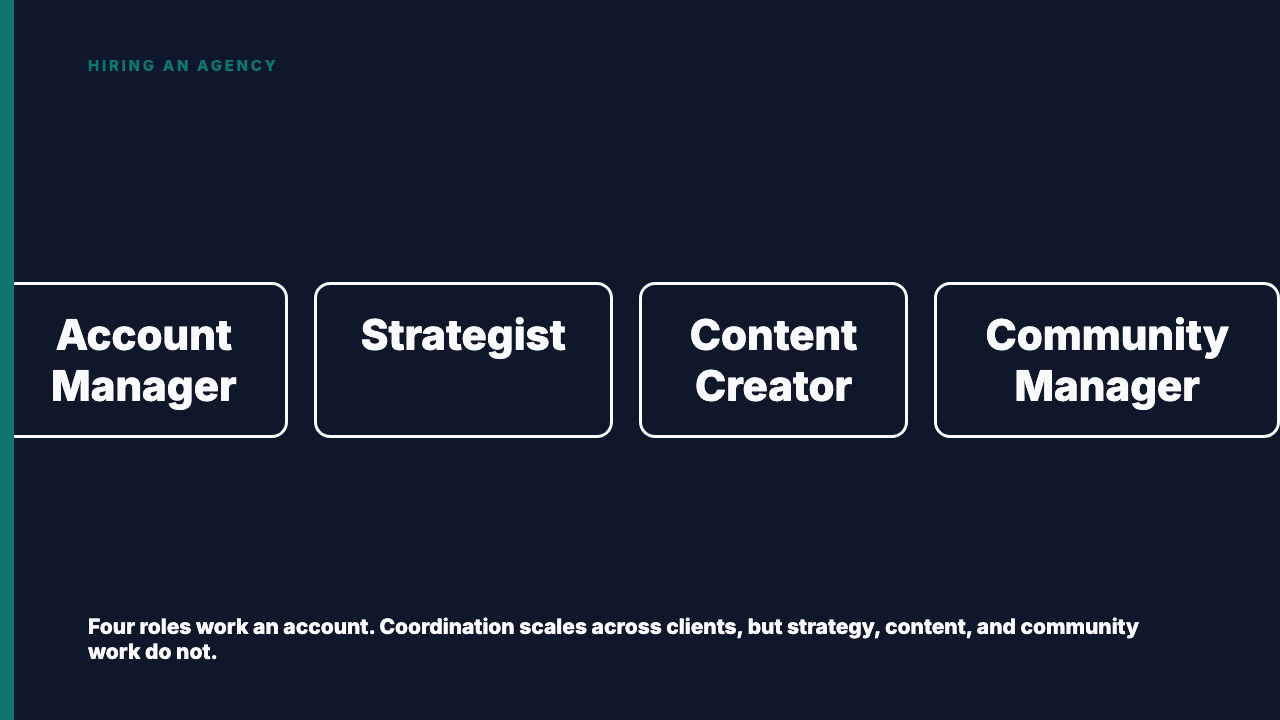
Ask it per role, because the roles do different kinds of work. An account team usually splits into an account manager who owns the relationship and keeps the calendar moving, a strategist or lead who decides what the work should be, a content creator or designer who produces it, and a community manager handling inbound conversation. Coordination is repeatable across clients, so a good account manager carries more of it without quality dropping. A strategist cannot. Strategy means holding your business in their head, your seasonality, why the thing that worked in March stopped working in June. That is original thought per account, and it does not compress. A team size number hides all of it. “Your team of four” could mean four people substantially on your account, or four people at a fifth of their time each.
Why proposals almost never state this number
Picture two hypothetical proposals listing the same four roles at a similar retainer, both described as dedicated. At A, the strategist carries a short list and half a day a week is genuinely yours. At B, the strategist is spread wider and you get what remains after the largest accounts. Nothing in either document distinguishes them.
Be fair about why. A senior strategist’s salary is not covered by one mid-sized retainer, and utilization across a book of clients is what makes agency pricing possible. A ratio existing is not a red flag. It is the model. The problem is narrower: buyers are never told the number, so they cannot judge whether it is reasonable for the work they are buying.
The questions to ask, and what they are actually testing
Ask these during evaluation, as the staffing drill down inside the fuller list of questions to ask a social media agency.
- “How many other active retainers is [the named person] currently staffed on?” Tests whether they will produce a number at all. Name the individual, because the abstract version invites an abstract answer.
- “What is the maximum number of accounts someone in this role is assigned here?” Tests whether a policy exists or the ratio is set ad hoc. An agency without a ceiling will discover one using your account.
- “If this person is reassigned, who absorbs their accounts, and does that change the ratio for everyone else?” Tests the system under strain, not at kickoff, when every agency looks well staffed.
- “Is the ratio different for a retainer at my budget tier than for your larger clients?” Tests whether smaller accounts run on leftover capacity.
A good answer and a bad answer, side by side
Both are invented. They are the two shapes this takes.
“She is on four other retainers, and our cap for that role is six. Past six, strategy calls turn into status updates. At five we stop adding to her load and push a start date instead.”
What makes it credible is not the number. It states a figure, explains the reasoning behind the ceiling, and says what happens as someone nears it.
“She is fully dedicated to your account. We do not disclose internal staffing allocations, but I can assure you our clients get the attention they deserve.”
Nothing was offered in place of the number. Not a range, not a policy, not a word about how load is managed. A flat refusal is more useful to you than a fuzzy answer. A vague number can be improvised. A refusal usually means no policy exists to disclose, and the ratio will be set by sales pressure rather than by rule.
Putting a ceiling in writing, not just in conversation
A staffing answer you liked in a pitch meeting has no standing once the contract is signed. The people who made it are rarely the ones running the account later, and the only thing anyone consults then is the document. So put it in the scope of work. A named point of contact, and a cap on the concurrent accounts that person carries, can be a term exactly the way deliverables and turnaround times are, with a line on what happens if it is breached, alongside what else belongs in the contract.
Where to start
If you are still building a shortlist, browse vetted agencies and take this question into every first call. If you run an agency and your staffing ceilings are something you would happily say out loud, list your agency free.
FAQ
Is there an industry-standard staffing ratio I should compare an agency against?
No. There is no published, verifiable benchmark for how many accounts a strategist or account manager should carry, and any figure quoted as an industry standard is worth doubting until traced to a source. The useful test was never comparison. It is whether the agency can state its own number and explain why it landed there.
Is it a red flag if an agency staffs one person across many accounts?
Not on its own. Utilization across multiple retainers is how agency economics work. The red flag is having no policy governing it, or refusing to state the number, because that means nobody has decided where the limit sits.