Who Covers Your Account When the Agency Team Is on Holiday?
Your account lead has just told you they will be away for three weeks, and you have no idea who is running your social channels meanwhile. You check your contract and the answer is not there.
The month your account lead disappears
Illustrative scenario, not a real case. Picture a homeware brand mid-launch. A batch of posts needs approval by Thursday, and a comment thread under a product announcement has turned sour. On Monday the account lead mentions, cheerfully, that they are off for three weeks. Who approves Thursday’s batch? Who decides how to reply? The calendar says what is scheduled, not who is accountable on a given Tuesday.
That is the quiet weakness of many scopes of work. They list what gets delivered, not who answers for it. Check whether yours names who owns the account when the lead is away.
This differs from the lead leaving for good, covered in what happens when your agency account manager quits. Out-of-hours availability is a separate question again. A planned absence is known in advance and entirely arrangeable.
Why agencies leave cover vague
An account lead usually looks after more than one client, so whoever covers them is covering their own accounts plus yours. Cover is rarely budgeted as time, so it gets done lightly. Read how many people are actually working on your account for questions that expose it.
Team shape matters. With a strategist, a community manager and a coordinator who all know the work, one absence is an inconvenience. If the lead is effectively the whole account, their absence is the account’s absence. That is where leave hurts most.
Vagueness is not necessarily bad faith, but nobody on the agency side is rewarded for raising it. It falls to you.
Good answer, bad answer
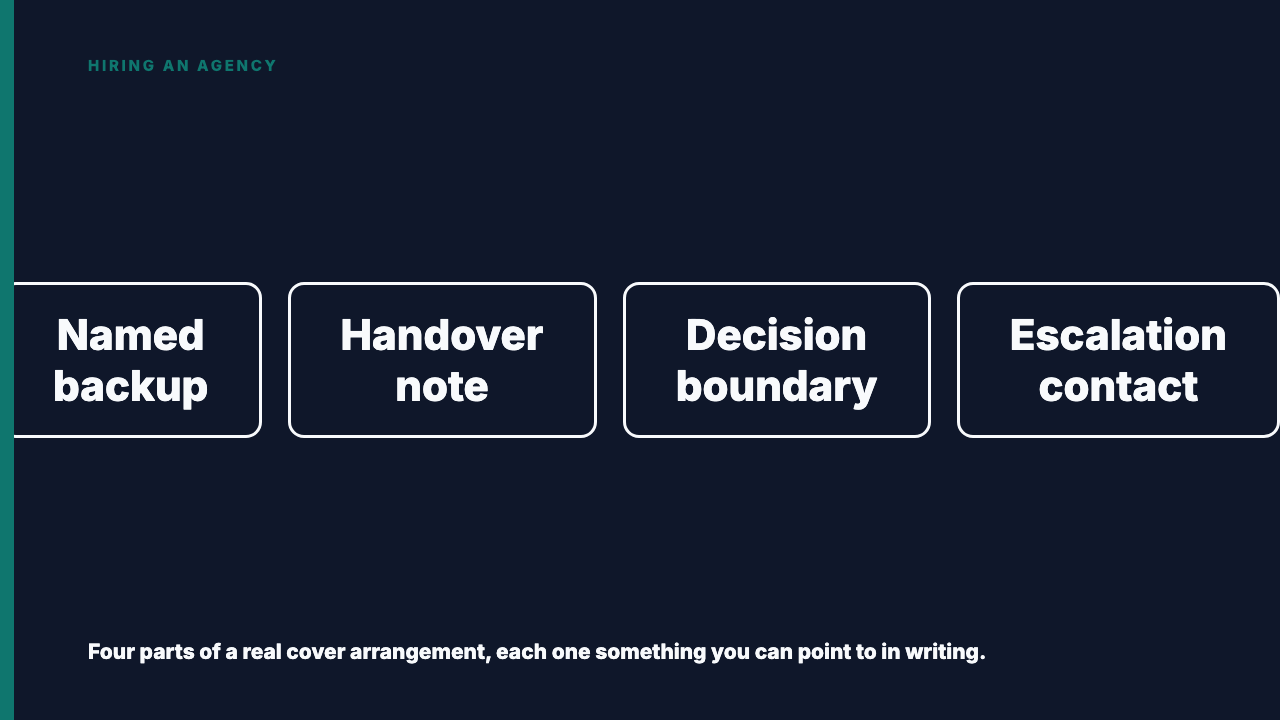
A real cover arrangement has four parts you could point to in a document: a named backup who already knows the account, a written handover note dated before the leave starts, a stated decision boundary for what the backup can approve alone, and a named person to escalate to.
The bad version sounds like this: “the team will keep an eye on things” (no name, so no accountability), “someone junior will check in” (no decision rights), or “you can always email the general inbox” (no owner, no response time). Each commits to nothing.
A junior coordinator checking in is fine for scheduling, monitoring and flagging problems. It is not fine for deciding how to answer a sensitive comment or whether to push a late approval live. Those need context.
| Question to ask | Passes versus push back |
|---|---|
| Who is the named backup? | Passes: a person, introduced to you. Push back: “the team”. |
| Is there a handover note? | Passes: yes, and you can see it first. Push back: “they will brief whoever covers”. |
| What can the backup approve alone? | Passes: a clear list. Push back: no answer, or “anything”. |
| Who do I escalate to? | Passes: a named senior contact. Push back: the general inbox. |
What a handover note should contain
Without a note the backup starts from the calendar and guesses. A usable note covers six things: live and upcoming posts, pending approvals and who owns each, open conversations with your team, anything sensitive in the comment queue, tone guidance learned the hard way, and where the lead can be reached for a true emergency.
Ask to see the note before the leave starts. A hypothetical excerpt of a good one:
Approvals: Thursday batch is with the founder, who replies fastest by phone. Comments: one open complaint on the launch post, do not reply publicly until customer care confirms the order details. Tone: no exclamation marks in complaint replies. Emergency: mobile only if a post must come down.
The weak version is a message saying “calendar is in the shared folder, everything is scheduled.” It says nothing about what might go wrong.
Put it in the onboarding conversation, not the crisis
The best moment to settle cover is kickoff, while the agency still wants the signature. Try: “Who covers the account lead? Who covers the community manager? How much notice will we get of planned leave? Is cover included in the retainer, or billed?” Get the reply to that last one in writing.
Ask for a notice period long enough for a note to be written and read. Propose blackout windows: no planned leave for the lead during agreed launch periods, or a backup briefed in advance if unavoidable.
Write it down, in a line in the scope of work or a short account operating note, and have your own counsel review contract wording. See reading a scope of work and your first 30 days with a social media agency.
If the absence has already been announced
If nothing was agreed, work in this order:
- Ask who the cover is, by name.
- Ask for the handover note, and read it.
- Agree a single point of contact.
- Agree what waits until the lead returns.
- Put a check-in at the midpoint. How often you should actually hear from your agency helps set the rhythm.
Hold anything sensitive or reputational rather than delegating it to a backup who does not know the account. Routine content is safe to let run. If the answers are evasive, treat that as information about how the agency manages staffing, and raise it with the agency’s senior contact.
What cover does not need to be
People take holiday, and a good agency should let them. The goal is continuity. The backup keeps the calendar moving and handles routine matters. The lead handles strategy on return.
If choosing an agency now, Browse vetted agencies and ask these questions before you sign. If you run an agency with a clear cover process, list your agency free.
FAQ
Should holiday cover be written into the agency contract?
Yes, in some form. A line in the scope of work or a short operating note naming the backup, the notice period and the decision boundary is enough, though exact wording depends on the agency and your own legal counsel.
How much notice of planned leave is reasonable?
My recommended starting point, not an industry standard, is enough time for a handover note to be written and read by you, and longer when the leave overlaps a launch.