The Price Increase Clause Your Agency Would Rather You Skim Past
You are three weeks from signing with a social media agency, looking at a retainer that finally fits your budget. That number is the one you negotiate hard. The clause a few pages later, governing renewal, is the one you skim. That is backwards, and it is why brands end up paying a renewal increase they never agreed to, only failed to catch in time.
The clause nobody reads on the way to signing
Every proposal has a few sentences that decide more than the headline retainer does: the renewal term length, whether the contract renews automatically, and the mechanism governing how the price can move. Buyers scrutinize the retainer because it is concrete, and skim the rest because it sounds procedural. But the first-year number is the least useful number in the document, precisely because it is locked. This matters most for anyone locking into an annual contract, where the exit gets heavier the longer you stay.
What an escalation clause actually says, in plain terms
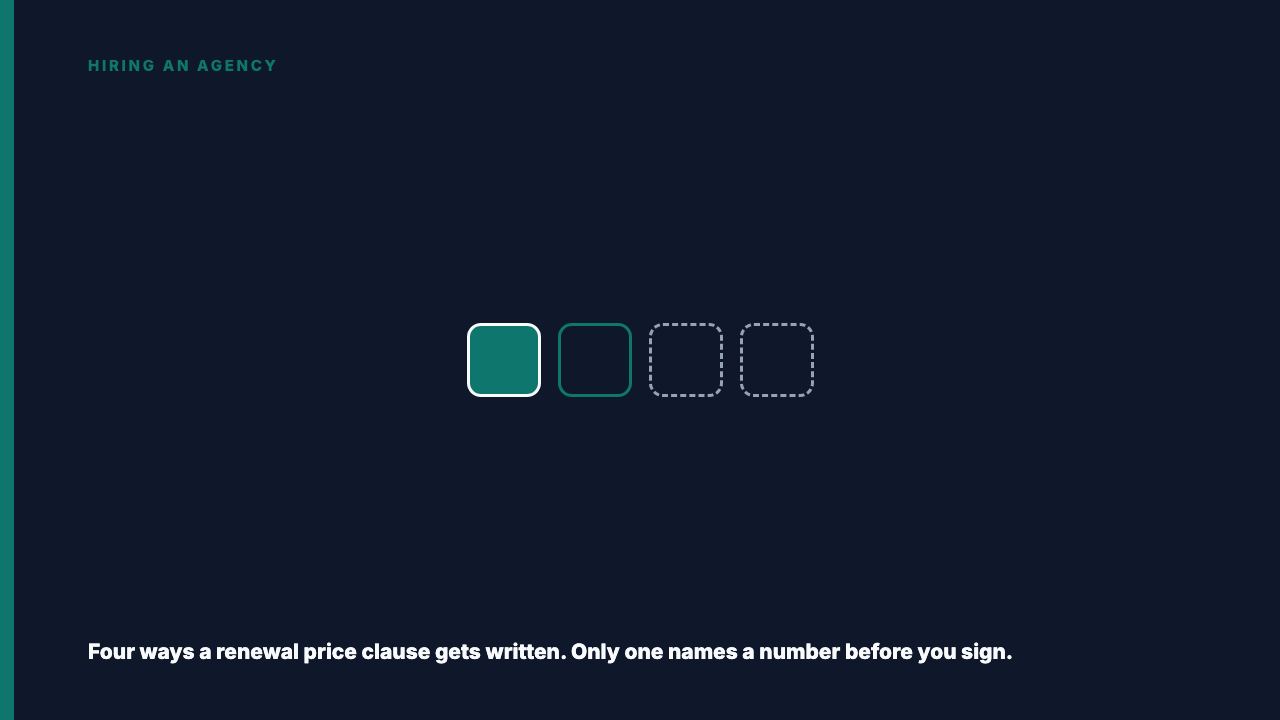
Strip the legal phrasing away and escalation language falls into one of four structures, none more common than the others.
- A fixed cap. A maximum percentage or dollar amount the retainer can rise by at renewal. You know the ceiling before you sign.
- An index-tied clause. Pegged to a published external figure, commonly described as a cost-of-living or inflation index. It moves, but according to something outside the agency’s discretion.
- Sole discretion with notice. The agency can raise the price by any amount, provided it gives notice. Notice is not a limit; you learn the number and get no say.
- Silence. Nothing is said about increases, which usually means the agency proposes any number at renewal and you negotiate from zero.
Reading the clause: a worked example
Here is a hypothetical clause, written for this piece and not lifted from any real contract: “This agreement renews automatically for successive twelve-month terms unless either party gives written notice of non-renewal at least sixty days prior. Agency reserves the right to adjust the monthly retainer at each renewal to reflect then-current market rates.”
Read closely, this commits the agency to little. The renewal term is capped at twelve months, and the notice period at sixty days, both clear. But the price sentence names no maximum, no index, no formula. “Then-current market rates” is a phrase the agency defines unilaterally, at the moment it benefits them most. A quick read sees a normal paragraph. A close read sees a price section committing to nothing.
Uncapped versus indexed versus fixed: what each one costs you later
A reasonable annual increase is a normal, fair commercial term. The problem is never that a clause allows increases, it is one that does not bound them.
| Structure | What it exposes you to | What it protects |
|---|---|---|
| Uncapped or sole-discretion | All future pricing risk sits with you. | Nothing. Notice is not a limit. |
| Fixed percentage cap | A bounded maximum that may outrun your own budget growth. | Predictability, a modelable worst case. |
| Index-tied | An increase that can still move more than you’d like in an unusual year. | Alignment with real, auditable costs. |
Why the renewal is the wrong time to negotiate this
At signing, the agency wants the deal and competitors are plausibly in the room, leverage that exists exactly once. By renewal, the balance has flipped. Two costs erode a buyer’s position: institutional knowledge, since the agency’s team already understands your brand voice and past performance while a replacement starts at zero, and the cost of running a search and onboarding that replacement. The cap belongs in the document you sign, not a conversation a year later with no leverage left.
The language to ask for before you sign
- A stated maximum percentage increase per renewal term, written as a number, not a phrase like “market rates.”
- If you prefer indexing to a flat cap, a named index either party can verify independently.
- A requirement that any proposed increase be disclosed in writing a set number of days before renewal, not applied automatically.
The right to decline the increase and exit at renewal without full termination penalties is a separate, complementary protection, covered elsewhere on this site.
What a defensive answer sounds like, and what a fair one sounds like
How an agency responds when you raise this, illustratively rather than as a quote, tells you something. A defensive answer deflects: “that’s just industry standard,” without naming a number, or resists a cap outright, treating the request as distrust. A fair answer names an actual figure or index unprompted and explains the reasoning.
Where to go from here
If you are still comparing options, browse vetted agencies, or list your agency free. See also how agency pricing is structured and what else to check in the contract.
If you are already past signing
None of this helps retroactively if you signed vague or uncapped renewal language, but it is not too late. Raise it ahead of the renewal conversation, not once a number lands. Ask that the clause be amended going forward, even without reopening the contract. If the proposed increase is unreasonable, treat that as grounds to invoke whatever renewal or termination rights the contract gives you.
FAQ
Is any annual price increase clause a red flag?
No. A reasonable, bounded annual increase is a normal, fair commercial term, and agencies with rising costs of their own have a legitimate reason to build one in. The concern is never the increase itself, it is a clause that is uncapped, vague, or left entirely to one party’s discretion.
What is a fair cap to ask for?
There is no universal number here, and any figure offered as typical would be invented. Compare the proposed cap against your own expected budget growth, not what a vendor calls standard, and insist the contract state an actual number, not open language like “market rates.”
Does an index-linked clause protect me better than a flat cap?
Neither is better in every case. An index ties the increase to something external and auditable, but it can still move more than expected in an unusual year. A flat cap is predictable but arbitrary, since it ignores real cost changes. Choose based on whether you value predictability or cost alignment.
What if the agency refuses to cap the increase?
Treat it as one data point among several gathered while vetting the agency, not an automatic disqualifier. An agency that resists naming a number once you’ve explained why is telling you something worth weighing against everything else you learned during vetting.