Decide Who Can Actually Approve Agency Work Before You Sign
When a scheduled post sits in review for a week, the instinct is to blame the agency. Usually the real cause is closer to home: nobody on the client side was ever given the authority to say yes, so the post waits on a decision nobody was assigned to make.
The agency did not cause the delay you are about to blame it for
Picture a brand that just hired a social agency. The marketing manager expects to sign off since she runs the relationship. The founder expects to see anything customer-facing before it goes live. Legal has been told to glance at anything mentioning a promotion. Nobody decided which of the three has the final word. A post goes into review Monday, the manager approves it, the founder has questions Wednesday, and legal flags an already-cleared phrase Thursday. A week later it still is not live, and everyone blames the agency.
An agency’s turnaround is really two numbers stacked together: how fast it can produce work, and how fast the client can decide on it. The agency controls the first and has almost no control over the second, so a complaint about a slow agency is often a complaint about a bottleneck it did not create.
What “final approver” actually means
A final approver is the one person whose “yes” is sufficient to publish, regardless of who else has opinions about it. Not the loudest opinion, not the most senior one, the one everyone agreed in advance gets to end the review.
This role is easy to confuse with the relationship owner, the person who takes the weekly call and manages the back and forth. That person is essential, but coordination is not authority.
Because any one person can be unreachable, the role needs a named backup with identical authority, not a scaled-down version. A backup who can only approve “small things” is a second bottleneck.
Assign the role before you write it into anything else
- Look for the person closest to the consequences of a bad post, not the biggest title. Ownership of the downside qualifies someone, not seniority.
- Run a simple test: could this person say yes to a scheduled post at 6pm on a Friday, on their own judgment, without checking anyone else? If not, the role is still unfilled.
- Rule out committees. A group can be consulted, but it cannot approve, because it has no single moment at which it says yes. Requiring several people to agree in real time recreates the bottleneck this exercise removes.
Put a turnaround number on it
A name alone does not solve the problem. Without a stated response time, “final approver” quietly becomes “whoever replies eventually.” A turnaround window is a specific commitment, such as a response within eight business hours, not a vague promise to reply “as soon as possible.” The number should reflect reality: how your approval process shapes the work determines whether that promise is realistic, so account for any internal review steps before the approver even sees a draft.
The window only works if you have also decided what happens when it is missed. Does the agency publish on its own judgment, treating silence as approval, or does the post wait, and for how long? There is no single right answer, but there has to be one, decided calmly in advance, and added to what to have ready before you sign.
The bad version of this, and what it costs
Picture a hypothetical brand that skipped this step. A post goes out for review and three stakeholders respond in separate email threads, each with a different note: shorten the copy, change the call to action, swap the image. The agency incorporates all three, satisfies none of them, and the posting window closes.
The deeper cost is to incentives: without a named approver, an agency defaults to appeasing whoever complains loudest, and over months that trains a capable agency to avoid friction rather than produce good content.
Where this decision fits before you ever talk to an agency
Naming a final approver is one piece of a broader exercise: mapping who inside your organization plays which role before you evaluate agencies. Do it alongside naming the internal owner of the agency relationship, a role easy to conflate with this one but not the same. One coordinates, the other decides.
A brand that has not settled this internally should not expect an agency to settle it for them. Agencies that run a real onboarding process ask for a name directly, and stall until they get one.
A simple way to write it down
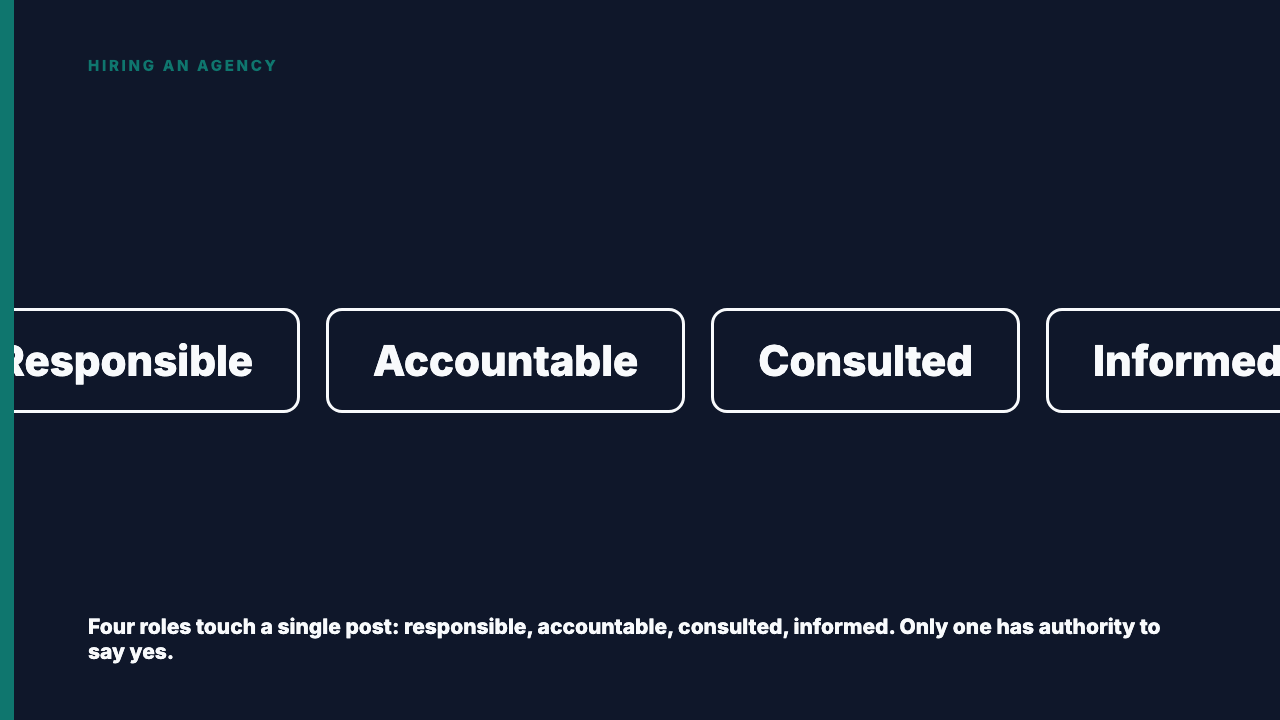
A basic RACI structure, responsible, accountable, consulted, informed, separates who does the work from who has authority to approve it, and maps cleanly onto a single social post.
| Role | Who | On a single post |
|---|---|---|
| Responsible | The agency’s content team | Drafts the post, incorporates feedback |
| Accountable | The named final approver | Gives the yes to publish |
| Consulted | Legal, founder, other stakeholders | Can raise concerns before the deadline |
| Informed | Wider team, leadership | Sees the post once scheduled or live |
Writing this down is not bureaucracy. A verbal understanding of authority holds up fine until the first real disagreement, then it dissolves. A one-page note naming the approver, the backup, and the turnaround window survives.
See how vetted agencies actually run onboarding
Before you finalize who holds this role, it helps to see how established agencies structure onboarding. Browse vetted agencies to compare how different shops describe their process, or if you run an agency, list your agency free.
FAQ
Does the final approver have to be the most senior person on our team?
No. The right candidate is whoever owns the consequences of a bad post and can make a fast call, sometimes a marketing manager rather than the founder or CEO. Seniority without availability defeats the purpose.
What if two departments both think they should have final say?
That has to be resolved internally before kickoff, not discovered during it. It is a readiness decision the brand owns, related to the failure mode of two departments contesting one agency budget.
Should this be written into the contract or just agreed verbally?
Written, even if only informally as part of the onboarding documentation. A verbal agreement about who approves what is the first thing disputed once there is friction.
What happens if our named approver is slow anyway?
Then the problem was never solved, only named. The turnaround window and the backup approver exist to prevent one person’s unavailability from stalling every post.
Sources
- Asana, “What is a RACI chart?”, fetched 2026-09-22.