A Monthly Report Is Not the Same as Access to Your Own Numbers
The proposal on your desk promises “detailed monthly reporting,” and it is tempting to read that line as the transparency question answered. It is not. A report is something the agency writes. Access is something you hold. A contract that names only the first leaves you reading the agency’s account of your own accounts.
What “detailed monthly reporting” actually buys you
A monthly deck has real value, but every deck is authored, and the author controls three choices: which metrics appear, which date window is shown, and what each number is compared against. None of those requires bad faith to tilt the picture. The deck is one part of the rhythm covered in how often you should hear from your agency.
Hypothetically, a deck opens with the strongest two-week stretch of the month, because that is where the story is. The brand’s marketing lead cannot look at the other two weeks without emailing someone and waiting. Nothing dishonest happened. The lead just cannot check.
This post is about arranging access, not about interpreting what the numbers mean.
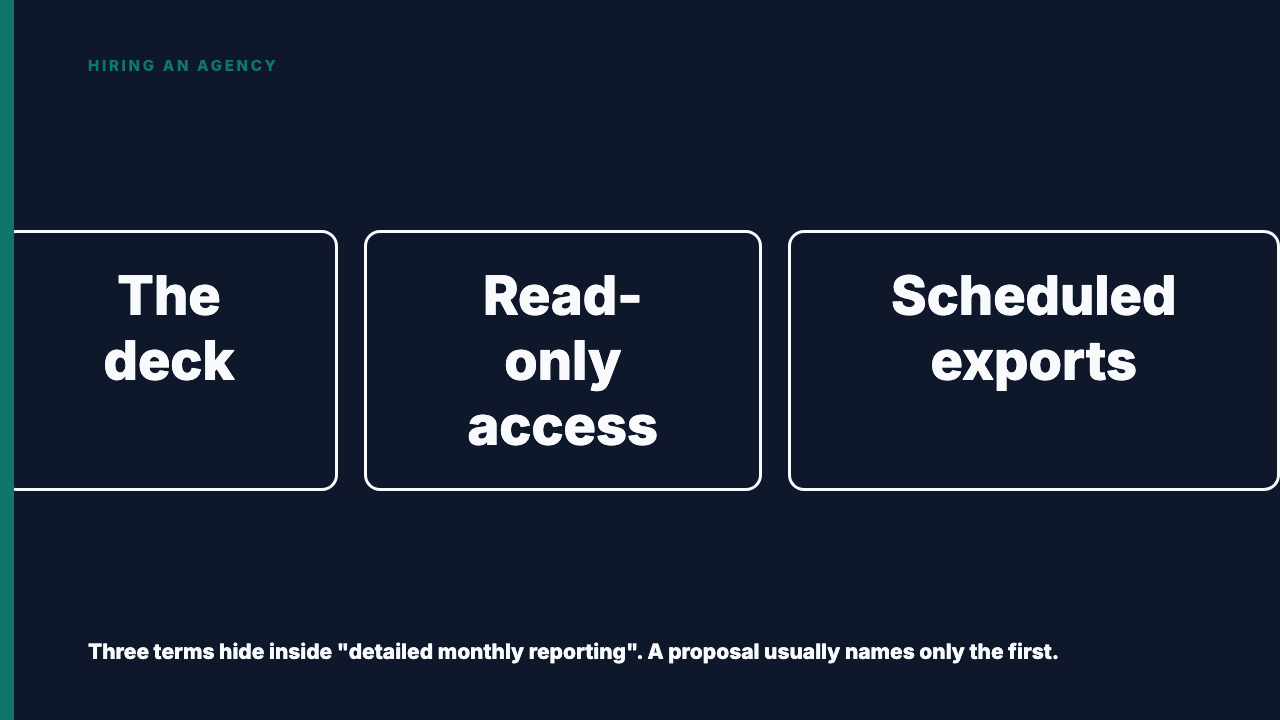
Three different things hiding in one phrase
A proposal usually names only the deck. Pull the three apart before you sign.
| Term | What you receive | Who controls the content | What it lets you do | What to write in the contract |
|---|---|---|---|---|
| The deck | A monthly document | The agency, including timing | Read the agency’s account of the period | Delivery date, data source, date window, metric definitions |
| Standing read-only access | A viewing role on the platform’s own records | Nobody at the agency. You see what the platform holds | Check any figure, any date range, any time | Read-only role on every account in scope, granted within a stated number of business days |
| Scheduled exports | A recurring file pull for the period | The agency runs it, the contract fixes fields and schedule | Hold records in your own hands during the term | Which accounts, how often, what format, no request needed |
An agency-built dashboard belongs in the first row, not the second. It is a livelier deck. It is still the agency’s selection of the data unless it sits alongside direct platform access.
How read access works on the platforms
The screens differ, but the pattern holds. The brand keeps admin on the page, the ad account and the analytics property, and grants the agency a role scoped to what its work needs. Google Analytics, for example, manages access by role at account and property level, and its role table includes a Viewer role described as able to see settings and data, with the editing roles above it. Google Ads lets an account owner choose an access level when inviting someone, and change or remove it later. The social platforms’ business tools use partner setups under other names.
Role names change over time, so do not name one in the contract. Ask for “read-only or the closest equivalent lowest-permission role that shows performance data.”
Check one dependency first. None of this works if the agency created the account and holds the only admin login. That is the subject of who holds admin on the accounts and, for paid work, who owns the ad account. Then the agency gets what its job needs, such as publishing and ad management, and you get a viewing role on the same assets. These are separate grants.
The clauses that make it real
- Standing access at kickoff. Acceptable: “Agency will ensure Brand holds read-only access, or the closest lowest-permission role that shows performance data, to every account in scope within five business days of kickoff.” Weak: access “as needed” or “upon request,” which turns a right into a favour.
- No removal or downgrade. The agency may not remove, downgrade or let lapse your read access during the term. Your own admin grants it, so this mostly guards against the agency reshuffling who sits on the account.
- A traceable report. Each report names its data source, date window, and the definition of every metric, so it can be checked against the platform. Which metrics matter belongs with the KPI language that belongs in the contract.
- A response window. Questions about a gap between deck and platform get an answer within a stated number of business days, so checking never depends on goodwill.
- Agency tools in addition. If the agency runs its own reporting tool, you get a login or scheduled exports from it, on top of platform access.
- A narrow ask. Say what you are not requesting: no admin rights, no publishing rights, no shared passwords. Narrow requests are harder to refuse.
What agencies say when you ask, and what a fair limit looks like
A hypothetical exchange, covering three likely objections:
Agency: “Client access is a security risk.”
You: “I am asking for a read-only role, not logins. That is the low-risk version.”
Agency: “Our dashboard is easier to read.”
You: “Good, keep it as a supplement. I still want the platform view.”
Agency: “Clients misread raw numbers.”
You: “Then book a walkthrough call. That is a reason to explain, not to withhold.”
There is a fair limit. Some data may live in a tool licensed to the agency, and it may keep that out of your view, provided scheduled exports are offered in its place. That differs from refusing any platform-level view. A flat refusal tells you information will move when the agency decides, the pattern described in how an agency sells is how it manages.
The test to run on the proposal in front of you
Find the reporting line and ask which of the three terms it names. If it names only the deck, send back a redline adding the read-only access and scheduled export clauses before you discuss price.
An agency confident in its numbers usually has no reason to resist a viewing role. Resistance is a fact about the agency worth weighing, not a dealbreaker on its own.
Next step
Browse vetted agencies in a directory of 80 agencies published, and bring the three-term test to your first calls. Agency owners can list your agency free.
FAQ
Is a monthly report from my agency enough transparency?
No, it is one of three things. It shows what the agency chose to include. Enough transparency means the deck plus your own read-only view of the accounts.
What level of access should I ask an agency to give me?
Read-only, or the closest lowest-permission role that shows performance data, on every account in scope. Skip admin and publishing rights. Role names vary by platform, so describe the level, not the label.
Sources
- Access and data-restriction management, Analytics Help, fetched 2026-09-20.
- Manage access to your Google Ads account, Google Ads Help, fetched 2026-09-20.