Don’t Just Ask an Agency About Turnover, Check It Yourself
You asked about staff turnover, got a percentage, and did not believe it. It is built from choices the agency made privately, so there is nothing in it to check.
The one number the agency fully controls
Four private decisions sit behind any turnover rate: the period measured, headcount at its start, whether contractors and freelancers are in the denominator, and whether an internal move counts as a leaver. Undisclosed, the figure cannot be tested from outside, and the follow-up is self-reported too.
Still ask. The checkable version has a shape: period, opening headcount, leavers, one line on contractors. The gap between that and what you find yourself is information. None of this yields a rate, only a direction and better questions.
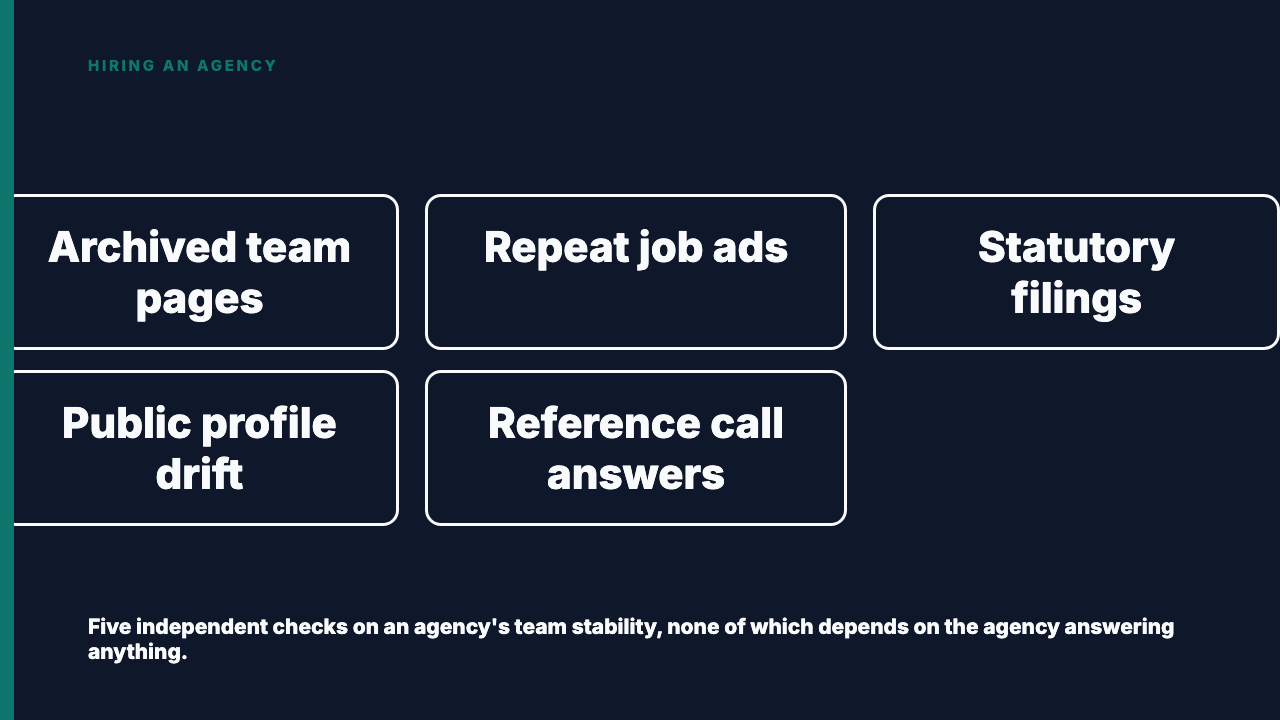
Read the team page as a time series, not a page
An agency’s team page is public, and so are its older versions, which the Wayback Machine retrieves by date. Pull it at six month intervals across two years, list the named people, then count how many of the oldest survive.
Hypothetically: the oldest names a founder, a head of strategy and two account managers, the newest only the founder, so one of four persisted. Senior names persisting while junior roles rotate is healthy; a page that stops naming anyone is not. Archive coverage is irregular, so a gap proves nothing, and a three person agency always looks volatile.
The same job advertised three times in a year
Growth hiring adds a discipline, a level, or a role that did not exist last year. Replacement hiring reposts the same title at the same level. Both show on the careers page, its archived versions, and its own hiring posts.
Agencies also hire ahead of a won account, so ask which client or service line the role supports and whether the answer is specific. At a small agency, the same role twice a year is unremarkable. Three or four times in twelve months is a revolving door. Baseline first: how many people are actually working on your account.
What public filings will and will not tell you
The UK register is free to search by company or officer name, and officer lists carry appointment and resignation dates beside the filing history.
| What you want | Public record | Not in it |
|---|---|---|
| Leadership change | Officer appointment and resignation dates | Why they left, or anyone below director |
| Company scale | Annual accounts, filed yearly by every UK company | Months out of date by then |
| Rough employee numbers | An average employee number, if the accounts carry one | Employee versus contractor split |
Jurisdiction decides: UK officer history is public, while a US LLC, partnership or sole trader may disclose almost nothing. Filings stop at director level, not the strategist who would run your account, and they lag by months. A resignation you find is a pitch question, who owns that work now, not an accusation.
Counting named people, carefully
Count the people publicly listing the agency as their current employer, note the tenure each claims, and compare both against the pitch. Three things break it: stale profiles, contractors listing the agency as employer, and agencies counting those contractors as staff. Hence the team that pitches you is rarely the team that runs your account.
A gap is a question, not a verdict: how many full time employees, against contracted specialists, would serve your account? Reading public profiles is due diligence. Messaging employees privately to ask whether they are leaving is not, and it poisons the relationship.
Ask references about the people, not the results
This is the only check giving first-hand evidence about departures, so do not spend the call on results. Ask how many day-to-day contacts they had, whether handovers were announced or discovered when someone stopped replying, how long each replacement took to be useful, and whether the strategist who set the direction lasted. See how to run an agency reference call.
Three answers should change your decision: a handover noticed as a new name on an email, a replacement re-briefed on things already agreed, and a reference who lost count of contacts. Reassuring is one or two names across a long engagement, with an overlap at handover.
Turn what you found into a contract term
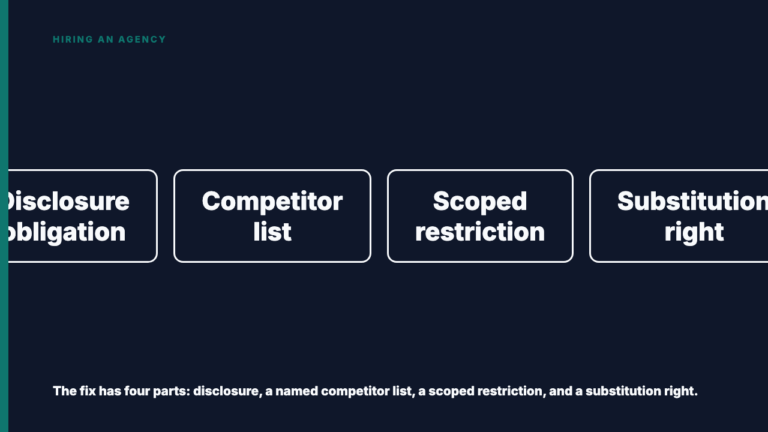
Four terms convert a finding into protection: named individuals in the scope of work, notice before a named person is replaced, a right to meet and object to the replacement, and a stated ramp to productivity. A named-person clause with no consequence is theatre; the reasonable version ties it to a review point or a fee adjustment.
Watch the reaction. A stable agency signs a named-person notice clause without much argument, and resistance is more informative than any figure it quoted. None of this predicts a resignation; it tells you whether the agency can absorb one, which is where what actually happens when your account manager quits picks up.
Where to start
Partner in Social lists 80 agencies filterable by specialism and location, so browse vetted agencies to build a shortlist. If you run an agency, you can list your agency free.
FAQ
Is an agency’s staff turnover rate public anywhere?
No. Some jurisdictions publish company-level and director-level records, officer appointments, resignations and annual accounts, but individual staff churn is filed nowhere. The rest you assemble yourself.
Is it fair to hold repeated job postings against an agency?
Not on their own. What earns a question is the same title at the same level coming back repeatedly, since growth hiring adds a discipline or a level instead. Ask which client or service line the role supports.
Should I tell the agency I checked?
Yes, as a question rather than a finding. Say what you saw and ask what changed: your team page named a head of strategy two years ago and does not now. An agency that cannot explain its own record has answered you.
What if the agency is three people and every check looks volatile?
Small teams look unstable on any count, because one departure is a large share of the team. At that size use the reference call and the contract terms, not the counting.
Does any of this predict whether my account manager will quit?
No. What these checks estimate is whether the agency has absorbed departures before without the client feeling it, which is the more useful question.
Sources
- Companies House, search the register. Fetched 2026-09-08.
- GOV.UK, appoint directors. Fetched 2026-09-08.
- GOV.UK, filing Companies House accounts. Fetched 2026-09-08.
- Internet Archive Wayback Machine. Fetched 2026-09-08.
- Wayback Machine APIs. Fetched 2026-09-08.