Hiring an Agency Mid-Crisis: What to Skip, and What Not To
A complaint about your brand is spreading faster than your team can answer it, and someone has just said you need an agency by tomorrow. The question is not whether you cut corners. It is which corners you cut, and whether you choose them or find out later which one mattered.
The vetting process was never one thing
Agency diligence is not one gate. It is five checks that share a calendar block, each insuring against a different failure.
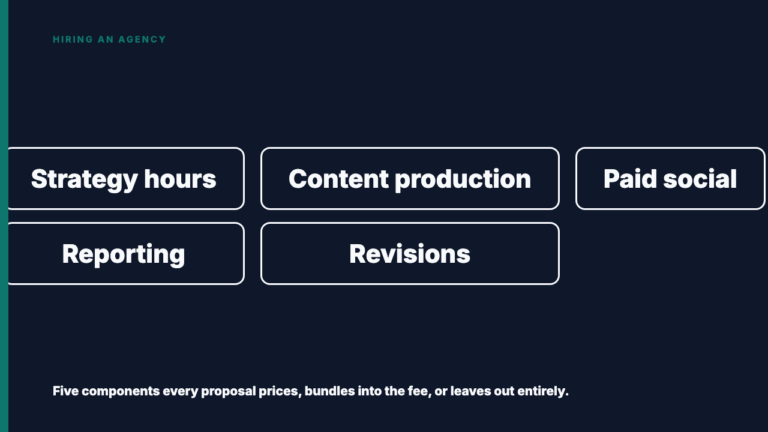
Reference checks protect against the gap between the pitch and what past clients actually lived through. Portfolio and specialty review protects against hiring a capable generalist for a specialist problem. A competitive shortlist protects against paying above market and against anchoring on whoever you thought of first. A paid pilot protects against committing budget to a team you have watched present but never produce. Contract negotiation protects against what surfaces at the end: ownership of the accounts and the creative, notice periods, kill fees, work in progress. So you are not deciding whether to vet, but which of those risks to leave open for a few weeks.
What a crisis timeline actually removes
A brand in an active public crisis works in hours to a few days, not the weeks a normal search takes. Silence is read as an answer long before a hiring process could finish.
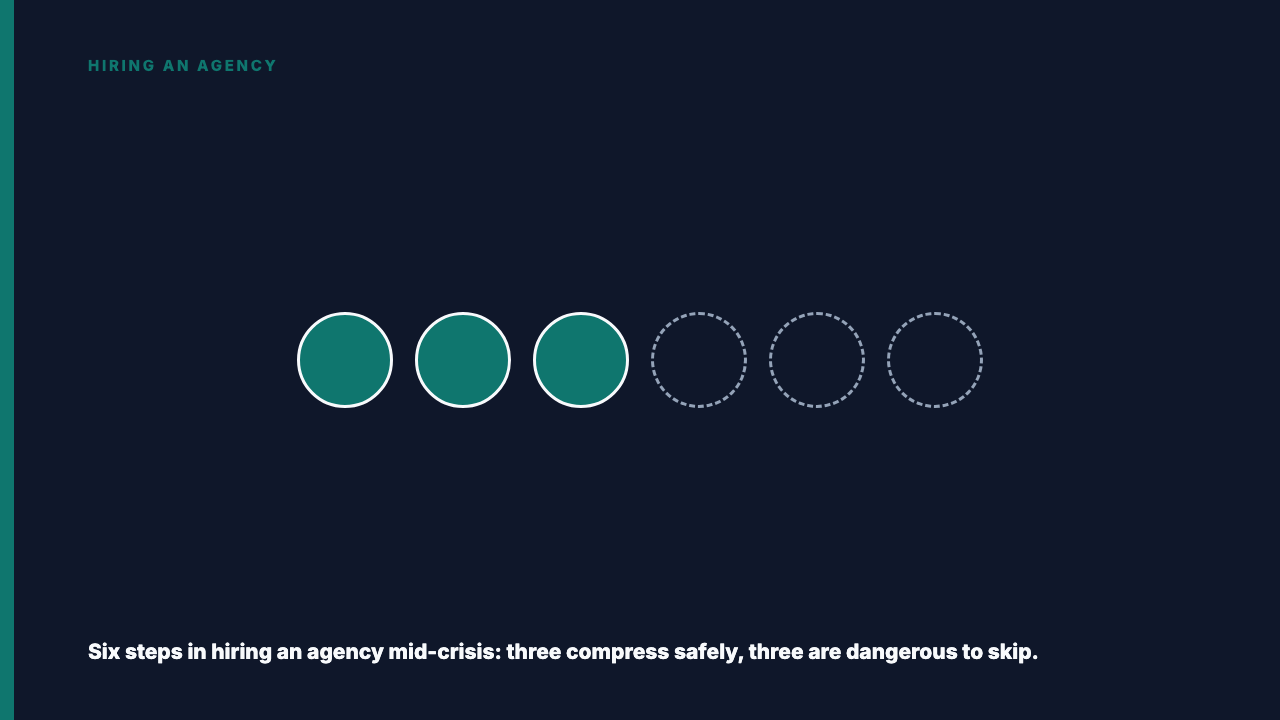
Compression forces steps that normally run in sequence to run in parallel, which is where the damage happens. You are choosing between four diligence steps done badly, which feel like diligence and work as theatre, and two done properly.
Steps that are survivable to compress
- Cut the shortlist to one. A competitive pitch during a live crisis consumes the resource it exists to protect. Three agencies means three briefings, three sets of follow-ups, three decks, and days gone. If you already know one strong candidate, start there.
- Swap the request for proposal for a short paid trial. An RFP predicts performance. A tightly scoped paid engagement, two weeks, one named deliverable, real access on day one, lets you watch it. The trial is the evaluation. Our case for a paid pilot instead of a full retainer assumes a calmer timeline, so compress the term, not the terms.
- Defer clauses that do not bite in the first month. Reporting cadence, renewal notice windows, rate escalators. None affect weeks one to three, and all negotiate better when you are not negotiating at midnight. Put them in an amendment with a date on it rather than pretending you agreed them.
Steps that are dangerous to skip, even now
- One reference call about crisis work specifically. General competence does not imply crisis competence. An agency can be excellent at a steady content calendar and come apart when the approval window is twenty minutes and the comments are hostile. Ask a past client about an event, not a feeling: a time something went wrong publicly on their watch, who called whom, how fast the first response came. That is a different question from the capability reference, and the one you cannot recover later. See what to ask on an agency reference call.
- A written approval chain, agreed before anything publishes. Name who signs off on public copy, who covers when that person is asleep, the turnaround you are promising them, and what the agency does if the window passes with no answer. One page, emailed, acknowledged. The failing version is the one worked out after the first draft is already in an inbox at 11pm.
- An explicit exit, in writing. Crisis hires end early more often than planned ones, having been made on partial information. Agree how either side stops: notice period, what is owed for work in progress, whether a cancelled deliverable carries a kill fee, how account access comes back. An undefined exit is worse under pressure, not less risky.
A hypothetical: two corners cut, one held
Picture a regional home services company, entirely hypothetical, whose refund policy becomes a viral complaint video on a Friday. By Saturday its marketing lead has one agency name and no time to find others.
She skips the competitive pitch, and returns three redlines on the contract instead of twelve. She does not skip a Sunday call to one of the agency’s past clients about a time something went sideways in public and who did what. And before any post goes live, one page saying she approves all public copy, her CEO approves anything touching the refund policy, and the agency waits rather than guesses if neither replies inside ninety minutes. Both took under three hours, and neither could have been added afterwards.
Turn the emergency hire into a real decision once the fire is out
The failure here is not the rushed hire. It is the rushed hire that becomes permanent because nobody revisited it. Set the date while you are still hiring: a specific point once things stabilise, with the skipped steps listed against it. The full reference checks. A proper scope of work rather than a paragraph agreed by text. The terms you deferred. Our what to have ready before you sign checklist works fine run late.
At that meeting you have three options, and naming them matters because the fourth, drift, is what usually happens. Convert the arrangement into a normal vetted relationship. Keep them while you run a proper search against the general criteria for choosing a social media agency. Or end it, because they were right for a fire and wrong for a year. All three are defensible. Letting convenience decide is not.
If you need a shortlist today
You still need somewhere to find that one strong candidate. Browse vetted agencies by specialty and location to build a starting point in an afternoon. If you run an agency that handles this work, list your agency free.
FAQ
Is it ever fine to skip reference checks entirely when hiring under crisis pressure?
No, though you can cut them to one. The general capability reference is compressible, because a short paid engagement shows you most of it within days. The crisis-specific reference is not, because nothing you see in the first fortnight tells you how this team behaved the last time a client of theirs was in public trouble.
Should the agency you hire during a crisis become your permanent agency?
Not by default, and not because they were bad. You chose under a clock on incomplete information, so the decision was deferred rather than made. Sometimes the work reveals an excellent partner. Get there by running the steps you skipped, not by discovering later that you are on a retainer nobody formally agreed to.
Sources
- Agency Reference Calls: What to Ask, and Which to Refuse, Partner in Social, fetched 6 September 2026.
- Buy a Paid Pilot Before You Buy a Twelve Month Retainer, Partner in Social, fetched 6 September 2026.