The KPI Language That Belongs in Your Agency Contract
You pushed back on the rate card for three weeks. Then you reached the section headed “Objectives,” read “grow engagement and build brand awareness,” and signed. Four months on you are arguing about the work with no document to argue from.
Why the price gets negotiated line by line and the KPIs get one paragraph
Deliverables are falsifiable by design: twelve posts a month either exist at month end or they do not. “Improve engagement” is a different sentence, because no result proves it false. Engagement fell, but the mix shifted to video: success. A sentence no outcome can contradict is not a commitment.
Whoever defines success grades their own work, and in most signed SOWs that is the agency, because it drafted the document and you never wrote a rival definition into it.
Leading indicators the agency controls versus lagging outcomes it doesn’t
The leading versus lagging split is old management vocabulary, and it does real work here. Posting cadence, response time to comments and direct messages, approval turnaround and creative volume are leading: the agency produces them directly. Follower growth, reach, share of voice and sales attributed to social are lagging, moved by paid budget, algorithm changes, seasonality and competitor activity. The agency contributes, it does not determine.
So a leading indicator can carry a hard commitment with a remedy attached: a missed cadence is a plain breach. A lagging outcome can carry a reporting requirement and a direction of travel, nothing more. Guaranteeing a number nobody fully controls is not enforceable, it is sales language.
Picture two hypothetical brands. The first makes fixed follower growth its one hard KPI, then a ranking change compresses organic reach across the category and the clause cannot be enforced. The second commits hard to response time and cadence, reporting reach as unpenalised context.
What a falsifiable KPI clause actually contains
A checkable clause needs four components:
- The exact metric and its source system. Not “response time” but “response time to direct messages, measured from the platform’s native inbox, not a third party dashboard.”
- The measurement window: weekly, monthly, rolling ninety days.
- The specific number or range committed to.
- Who pulls the number, and how a disagreement about it gets resolved.
Written badly:
Agency will strive to improve engagement month over month.
And written well, with placeholder figures:
Agency will respond to all direct messages and comments within 24 business hours, measured weekly from platform native reporting, with any week below 90 percent compliance requiring a written explanation within 5 business days.
The second is checkable by an outsider. A metric with no named source is unfalsifiable even when precise: engagement rate is computed per post, per follower and per impression across agency reporting, so two sides can pull different figures and both be right.
So give the fourth component a real answer. Name who runs the report and which export it comes from, reserve your right to pull the same figure from platform native reporting rather than accept a dashboard screenshot, and name what governs when the two disagree: the native number, with the gap explained in writing before the invoice is approved.
Metrics that look like outcomes but are really outputs in disguise
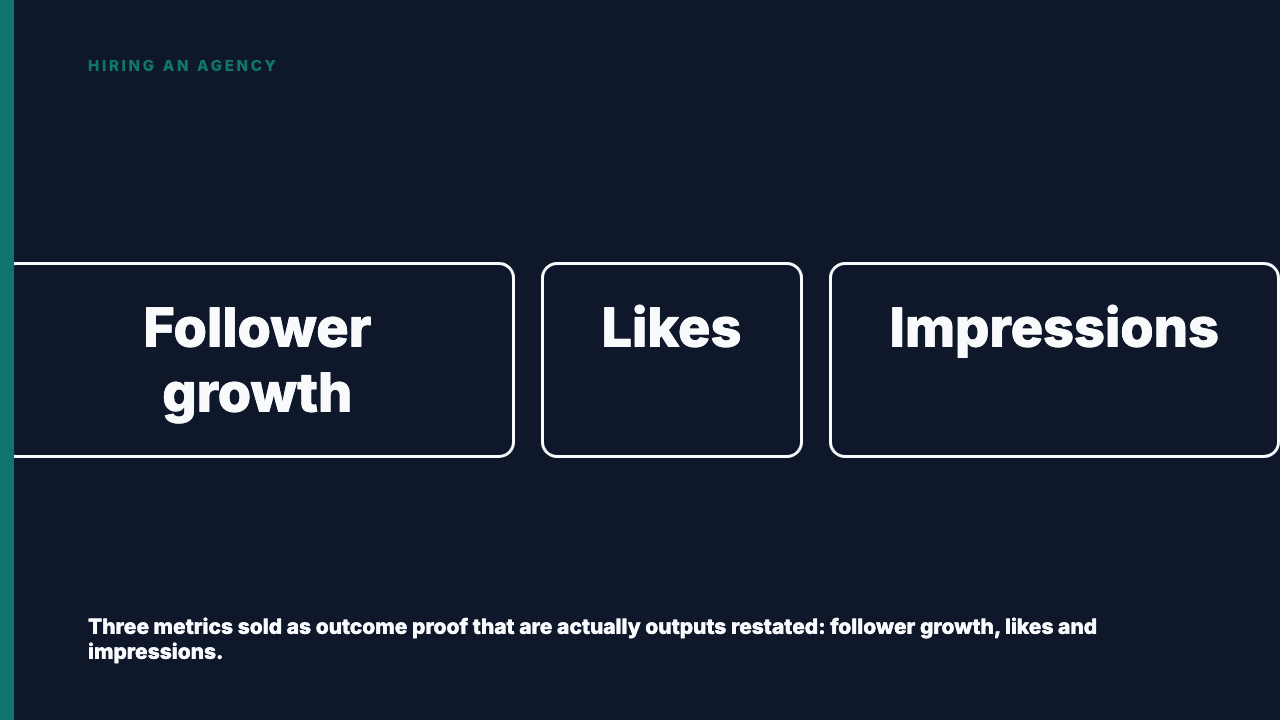
Three metrics get sold as outcome proof when they are outputs restated:
- Follower count growth. An account acquired subscribers, not buyers.
- Likes. Content was shown to people already served it.
- Impressions. Content existed and was distributed, the deliverables list restated.
A brand can hit all three and see no change in leads, bookings or revenue. So ask of any proposed metric: if this goes up, what changes for my business? If the answer is “nothing directly, it is a proxy,” it belongs in reporting, not the KPI clause.
What happens when a KPI is missed
A KPI with no stated consequence is a preference. The ladder runs: a written explanation and remediation plan, a scheduled strategy review, a fee holdback for the affected period, and at the top a termination trigger.
Match the rung to the tier. A missed lagging outcome should almost never trigger termination alone, since it may reflect conditions the agency could not steer. A repeated leading indicator miss is the agency not doing agreed work, a legitimate trigger, though notice periods and kill fees still apply when a KPI forces the exit. Read it beside the termination clause and what to check in a social media agency contract.
Where the KPI clause has to live in the document
KPI numbers that live only in a kickoff deck or a proposal PDF are a sales artifact: standard contracting practice is that the signed document governs, so a commitment outside the SOW is an expectation, not a term. Ask by email before signature: is this exact language going into the SOW word for word? Keep the reply, and see how to read an agency scope of work before you sign it and run a paid pilot before a twelve month retainer.
Start with a shortlist worth writing a contract for
KPI language only pays off if the agency can meet it. You can browse vetted agencies, or list your agency free if you run one.
FAQ
Can you put follower growth or engagement rate in the KPI clause at all?
Yes, but as tracked and reported metrics, not penalty bearing commitments. Reporting obliges the agency to show the figure, say how it was calculated and explain the movement. Guaranteeing obliges it to control what it cannot.
What’s a reasonable measurement window for a KPI clause?
Match the window to the metric type rather than hunting for an industry standard. Response time and cadence can be checked weekly or monthly, since the work either happened or did not. Lagging outcomes need a quarter at minimum, since short windows amplify noise.
Should a missed KPI let us cancel the contract immediately?
Not on its own, and the answer lives in your termination clause. A single missed lagging outcome is not a termination event, since market conditions can produce it with no failure by the agency. A pattern of missed leading indicators, contracted work not done, is a legitimate trigger, subject to the notice period and kill fees that clause sets.
Who should pull the numbers to check whether a KPI was hit?
Name the party and the report in the clause, usually the agency pulling a specified export on a fixed date. Then reserve your right to verify the same metric from platform native tools, not solely from the agency’s own dashboard export.