‘Make It Pop’ Is Not Feedback: Notes That Change the Draft
The same post is back for the third time. Round one asked for something punchier. Round two, from a different person on your team, asked for more detail. Round three says it still does not feel right. Before you decide the agency is not listening, check the notes you sent.
Why round three feels like the agency is not listening
Picture the agency’s side. They have a draft, a note that names a feeling (“make it pop”) or a fix (“use a bigger logo”), and no description of the target. So they guess. Each wrong guess costs a revision round, and each round makes the next note more irritable and less precise.
Agencies often describe this pattern as scope creep, and sometimes they are right: a new request disguised as a revision is real. But the cause is frequently the note itself, and both sides can be partly right. This post is only about wording. Who signs off is covered in your approval process, and what the contract allows is covered in what unlimited revisions actually means.
Describe the problem, not the fix
Say what is not working for the audience or the goal, and let the agency choose the solution. These pairs are illustrative and hypothetical, not from any real account.
- Weak: “Make it pop.” Strong: “The first line reads like every other post in the feed and does not say what changed this week.”
- Weak: “Make the logo bigger.” Strong: “Someone scrolling will not know whose post this is within the first second.”
- Weak: “Can it feel more premium?” Strong: “The stock-style background and the crowded caption both read as cheap to me, because our customers pay for restraint.”
- Weak: “Use a different photo.” Strong: “The photo does not show the product in use, so the post asks people to take our word for it.”
A prescribed fix backfires because the agency executes it literally, it may not solve the real problem you never stated, and you now own the result. Prescribing is right for a factual correction, legal wording, or a product detail that is simply wrong. Everything else deserves a problem statement first.
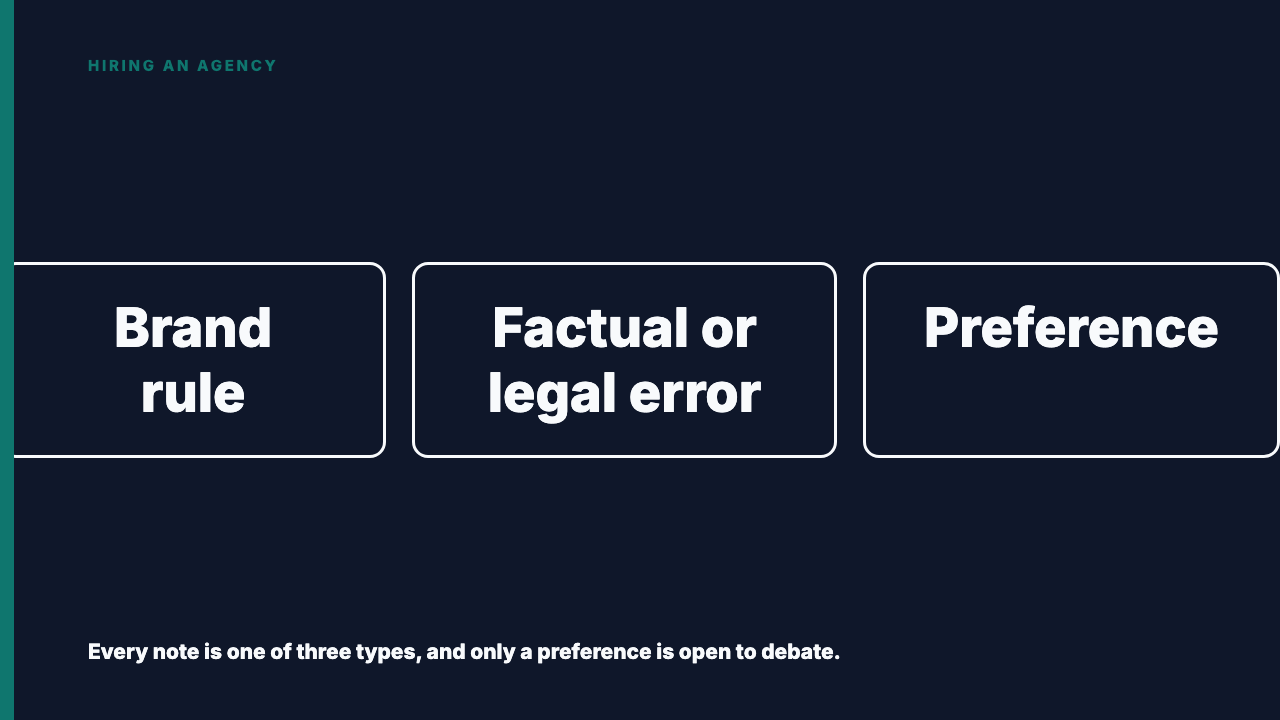
Sort every note into brand rule, factual error, or preference
Mixing note types is what makes agencies stop trusting the process. A brand violation must be fixed. A factual or legal error must be fixed. A preference is a request, and the agency may push back with reasons tied to your goal.
| Type of note | Example | How to label it | If the agency disagrees |
|---|---|---|---|
| Brand rule | The headline font is not the one in the written guidelines. | “Brand rule: see typography section.” | They fix it, or show where the guideline allows it. |
| Factual or legal error | The offer end date is wrong. | “Factual: correct date is in the attached sheet.” | They fix it. Not negotiable. |
| Preference | The tone feels a little too casual to me. | “Preference: tied to reaching procurement buyers.” | They may argue, with reasons. You decide. |
Prefix each note with its tier. If you cannot point to a written guideline, a fact, or a stated goal, it is a preference, and you should say so. That honesty buys credibility for the day you flag a real violation. If one keeps coming back, see recourse when an agency goes off-brand.
One voice, one consolidated list
The bad version: three stakeholders email the agency separately. One wants the caption shorter, one wants more detail, one wants a different image. The account manager merges them into a compromise nobody asked for.
The good version: a single named person collects every note, resolves conflicts internally, and sends one consolidated list in one message. Tell the agency who that person is, and that notes from anyone else are input, not instruction.
Hypothetically, if two colleagues disagree about caption length and your owner settles it in an afternoon, the agency revises once. If both notes reach the agency, they produce a middle version both dislike, and a full extra round is spent on something you could have settled in your own building.
Give notes the agency can act on without a call
Before pressing send, check each note:
- Does it name where in the draft it applies?
- Does it state the problem rather than a fix?
- Is it tagged brand rule, factual error, or preference?
- Does it refer to the goal or audience in the creative brief?
- Is it ranked must-fix or nice-to-have?
Limit a round to the few issues that matter most. A long, undifferentiated list tells the agency nobody has decided what matters. Also say what is working: praise is information, and an unpraised opening line may be rewritten along with everything else.
When the notes are fine and the agency still is not landing it
If you have given specific, tiered, single-voice notes and the same problem returns two rounds running, the agency is either not hearing the problem or lacks the skill to solve it. That moves the issue to their side.
A cheap check: ask the agency to restate the problem in its own words before revising. If it matches yours, the gap is execution. If not, you found the cause in five minutes. If the request is truly new work, read what counts as a change order.
Next step
Browse vetted agencies to compare options, or if you run an agency, list your agency free.
FAQ
How many rounds of feedback is normal with a social media agency?
There is no honest universal number. The scope of work defines what is included, and clearer notes mean fewer of those rounds get used.
Should I tell the agency exactly what to change?
Describe the problem and let them choose the fix. Prescribe only for factual, legal, or product-detail errors.
What if my team disagrees about the draft?
Resolve it internally first. One named person sends one consolidated list.
Can an agency push back on my notes?
Yes on preferences, with reasons tied to the goal. Not on brand violations or factual errors.
How do I give negative feedback without damaging the relationship?
Specific problem statements about the work are easier to receive than verdicts, and saying what is working helps.
Sources
- What unlimited revisions really means in a contract, fetched 2026-10-10, HTTP 200