Who Owns the Brand Voice Document When the Agency Leaves
In week two of onboarding, your new agency offers to draft the brand voice guide. It sounds like a favour. But that document will shape every caption while you work together, and the day you leave it either goes with you or stays behind. Decide who writes it and who owns it now, while you still have leverage.
The week-two offer, and why it is not a neutral favour
The offer is usually sincere, and often useful. The agency cannot write a caption without a voice reference, and drafting one beats waiting on a busy brand team.
The quiet problem is what happens afterwards. A guide written by the agency, in the agency’s template and file format, tends to be treated as agency work product unless the contract says otherwise. In my experience onboarding documents often arrive in whatever tool the agency already uses, so check for that pattern. Who owns work an agency creates depends on the written agreement, and silence can leave it ambiguous. Have counsel confirm how that works in your jurisdiction.
Here is when it bites. Month fourteen, you give notice and ask for the voice guide. You get a slide deck in the agency’s workspace that nobody on your side has ever edited, with the agency’s methodology slides tangled through your voice rules.
Three ways this goes: agency drafts, brand drafts, or you split it
| Option | Who does the work | Brand time | Failure mode |
|---|---|---|---|
| Agency writes from scratch | Agency strategist, brand reviews | Lowest | Drifts toward the agency’s house style |
| Brand drafts, agency edits | Brand writes, agency sharpens | Highest | Vague or aspirational, full of words that decide nothing |
| Agency interviews, brand signs off each section | Shared | Moderate | A polished document nobody argued with |
My recommendation is firm. The brand writes the first draft, or at least marks up a rough one. Deciding what the brand will and will not say is the brand’s job. The agency then sharpens it and turns it into something a freelancer could use. If you truly have no time, the interview route works, provided you sign off section by section and push back on a few of them. A guide with no edits from you is a warning sign.
A weak guide and a strong one, side by side
Picture an invented chain of neighbourhood bakeries. This is hypothetical, but both versions are easy to find in real life.
The weak guide says the brand is friendly, bold and professional. That is the whole page. No sample captions, no list of things the brand never says. A new agency learns nothing it could not have guessed, so the first month becomes submit, reject, guess again.
The strong guide keeps the same three adjectives and pins them down. It shows a caption that passes and one that fails, with the reason. It lists words the brand avoids, says how complaints are handled (reply once in public, then move to private message), when humour is welcome and when the account goes quiet, and names one person who can approve exceptions.
The test: could a competent stranger write a caption on day one that the brand would approve without a rewrite? If not, the guide is a mood board, not a handover asset.
What to write into the contract or the SOW
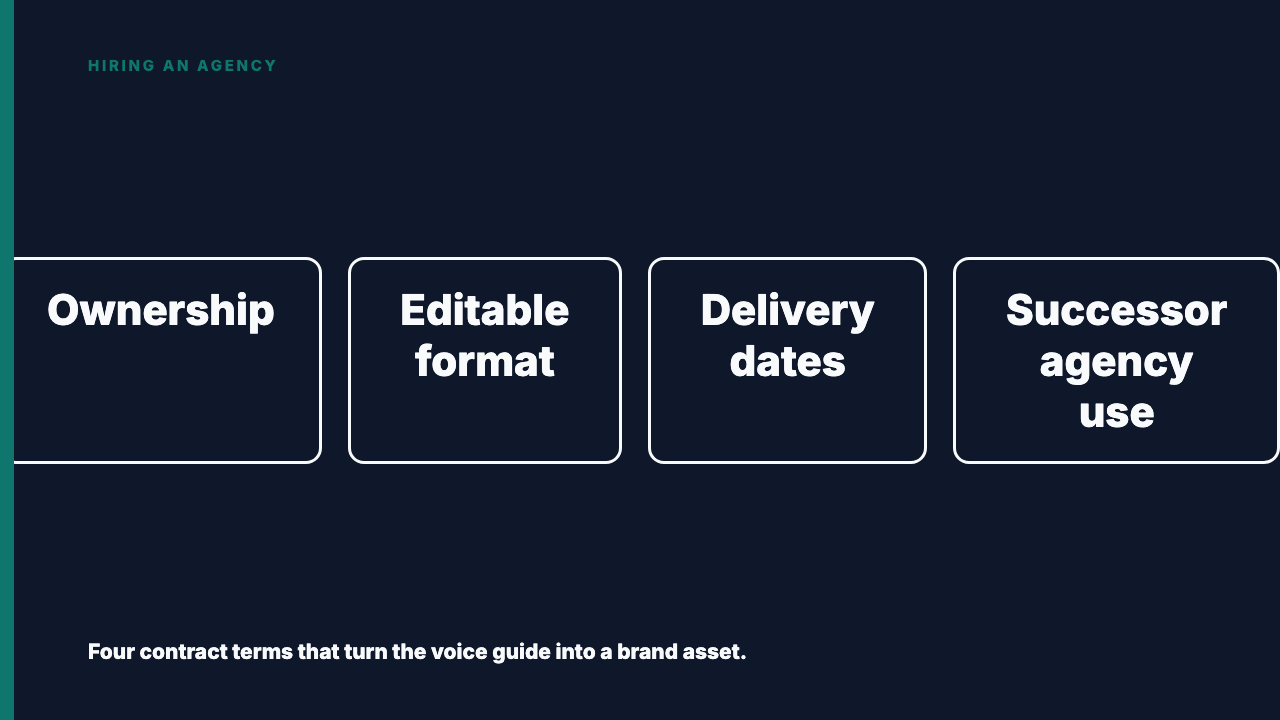
Four terms turn the guide into a brand asset. Put them in the statement of work or master services agreement.
- Ownership of the document and all versions. Acceptable: the brand owns it and the agency keeps no claim over the brand’s voice. Unacceptable: silence, or a licence to use it “for the duration of the engagement”.
- An editable format. Acceptable: a file the brand can open and change without agency software. Unacceptable: a locked PDF or slides that live only in the agency’s tools.
- Delivery at defined points. Acceptable: final at sign-off, current version on request or at notice. Unacceptable: “available on request” with no deadline.
- Use by a successor agency. Acceptable: the brand may share it with any new agency without further permission. Unacceptable: the old agency must consent first.
One carve-out is fair: the agency keeps its own generic templates and methods, but not the brand-specific content. Ask counsel to confirm the wording for your jurisdiction. This is a checklist, not legal advice.
Keeping it alive: who edits it after week two
A guide frozen in week two is wrong by month six. Hold the master copy in your own storage and give the agency edit access, not the reverse. Name an internal owner and set a review rhythm, as with a named internal owner for the agency relationship.
When approved posts keep contradicting the guide, either the guide is out of date or the agency is ignoring it. You need to know which. And if nobody cites the guide in feedback rounds, it is decoration. Good feedback says “this breaks the rule on humour”, not “make it pop”.
Why this shortens the next agency’s first month
Imagine two handovers. In one, the brand gives the incoming agency a current, editable guide with annotated approved and rejected examples. The new team sounds right within days. In the other, the incoming agency reverse-engineers the voice from old posts, including the off-brand ones that slipped through. Expect weeks of rework and extra approval rounds. I will not put a number on it, but it lands in the month you can least afford friction.
The guide is one item on the exit checklist. See what a clean handover looks like and the overlap period when switching agencies. For the creative itself, read who owns the creative the agency produces.
Ask your incumbent today: where is the master copy, and could I edit it this afternoon?
What to say when the agency pushes back
- “It is our methodology.” Reasonable. Reply: “Keep your methods and templates. We need only the brand-specific rules and examples to be ours.”
- “It took our strategists real time.” Reasonable. Reply: “That time is covered by the fee, and the content describes our brand.” If they want to charge separately, that is a price conversation.
- “We cannot hand over our template.” Fine, if the content can be lifted into a plain editable document. Reply: “We do not need the template, just our content in a format we can open.”
- “We keep it in our system for safety.” A signal. An agency that will not give you an editable copy is showing you how it will behave at exit. Note it in the vetting file.
Next steps
Ask every agency on your shortlist how it handles voice guide ownership before you sign. Browse vetted agencies to build that shortlist, and if you run an agency happy to hand over clean documents, list your agency free.
FAQ
Should the agency or the brand write the voice guide?
The brand should draft or mark up the first version and let the agency refine it, because deciding what the brand will and will not say is the brand’s job. A time-poor brand can use an agency-led interview if it signs off section by section.
Does the agency own the voice guide it writes for me?
It depends on the contract wording and your jurisdiction, and silence can leave it ambiguous. The fix is an explicit clause assigning the brand-specific content to the brand, reviewed by your counsel.