What ‘Unlimited Revisions’ Actually Means in an Agency Contract
In the deliverables table of the proposal on your screen sits the phrase “unlimited revisions.” It reads like protection. You usually discover its real boundary in month three, in a message from your account manager that starts with “just so we’re aligned on process.”
The phrase is a sales line, not a contract term
“Unlimited” does one job in a proposal: it removes an objection next to a competitor offering three rounds. It says there is no stated cap. It does not say there is no boundary, because any agency staffing an account against a fixed monthly fee has one. The retainer bought a fixed number of a designer’s hours.
Notice where the phrase sits: in the pitch deck, almost never in the scope of work with a definition attached, so when the disagreement arrives there is no document to consult, only your reading against the agency’s. That is why how to read a scope of work before you sign it matters: the scope is where this clause belongs.
The four ways agencies commonly bound it
Agencies rarely enforce a secret number. They apply one or more of a small set of practical limits, typical mechanisms rather than measured proportions.
- Rounds per asset. The number of pieces you can revise is uncapped, but a single piece has a ceiling. Sending back every post in the month once is fine. Sending the same carousel back six times is where the limit appears.
- Brief changes versus preference changes. The most common distinction, and the least often written down. If the work missed the brief, fixing it is free and genuinely unlimited. If it hit the brief and you have changed your mind, that is usually new work, billable or capped.
- Time windows. Requests inside the review window, often a set number of days after delivery, are covered. One landing after you approved the asset, or after it published, is usually a separate job.
- Scope boundaries. The clause covers the deliverables you bought, not new concepts, formats or extra assets framed as revisions. “Can we also see this as a Reel” is a new deliverable wearing the word revision.
A scenario: two brands read the same clause differently
Picture two hypothetical buyers, a home services company and a specialty food brand, signing under identical wording: unlimited revisions on all monthly content deliverables. Neither is real; the point is what one sentence can mean.
The home services buyer reads it as unlimited creative direction: if the concept does not land, they will keep asking until it does. The food brand’s agency reads it as unlimited execution changes inside an approved concept, so tweaks to copy, crops and captions are fair game forever, but starting over is a new concept. The two readings collide at a predictable moment, round three or four on one asset, when the feedback stops being “the logo is too small” and becomes “the whole idea is wrong.”
What the acceptable version of the clause looks like
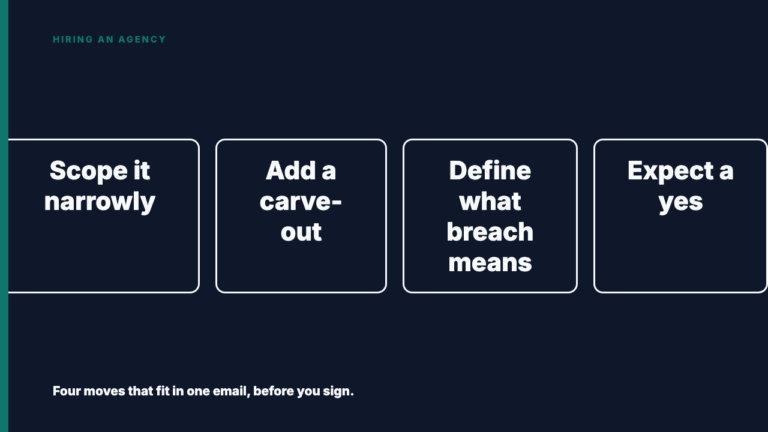
An enforceable clause is short and answers four things. First, what counts as a revision: something like “a change to a delivered asset that brings it into line with the approved brief; a request that changes the approved brief, concept or format is a new request.” That sentence prevents most disputes.
Second, whether there is a per asset or per round cap. A generous stated cap beats an unstated one: “up to four rounds per asset, additional rounds quoted separately” is something you can plan against. Third, turnaround, in business days from receipt of consolidated feedback, because unlimited rounds with no commitment on speed is a queue rather than a benefit. Fourth, what happens outside the definition: whether it becomes a change order, how it is billed, and what it does to the publishing date, which belongs with the rest of what to check in a social media agency contract.
What the vague version looks like, and why agencies leave it vague
The vague version is what you already have: two words in a table, no definition, no cap, no turnaround, no consequence. That suits the agency, and not for cynical reasons. Vagueness lets a good account manager absorb a fourth round for a client having a hard month, and leaves grounds to push back when one account starts consuming the hours of three.
So vagueness alone is not dishonesty. The warning sign is what happens when you ask. An agency that names a boundary, even one you do not love, is telling you how it runs accounts. One that deflects with “we’re not the kind of agency that counts rounds” is keeping the right to decide later, once you have signed.
Questions to ask before you sign
- Give me an example of a request you would decline under this clause. Anyone who has run accounts has one ready. A blank stare means you will be the test case.
- How many rounds does a typical asset take before it is final? You are not asking for a cap, only for what normal looks like there, so you can tell later whether you are inside it.
- What happens if we want to change something after it has gone live? Ask separately about a live post, a paid asset in flight, and one approved but unpublished. The answers often differ.
- Will you put that answer in the scope of work? An answer on a call is worth nothing in month seven, when the person who gave it has left. See the fuller set of questions to ask a social media agency.
Before you sign with anyone
The fastest way to judge one agency’s answer is to have another beside it. Browse vetted agencies and put the same four questions to each. If you run an agency that already defines its revisions clause properly, list your agency free.
FAQ
Does “unlimited revisions” ever actually mean no limit at all?
Rarely, for a structural reason rather than a dishonest one: an uncapped promise against a fixed fee is near impossible to staff profitably. Expect one of the four common boundaries instead. The clause is a problem only when the agency will not name its version of it.
What is a reasonable number of revision rounds per asset?
No industry standard number is worth quoting, and anyone stating one confidently is describing their own habits. Ask the agency for its typical number, listen for whether it sounds like experience or improvisation, then get it into the scope of work. A number you negotiated beats the word unlimited, because you can hold someone to it.