Who Responds When a Post Blows Up at 11pm: You or Your Agency?
Your scope of work lists posting cadence, content volume, reporting frequency, and a monthly call. It almost certainly says nothing about 11pm on a Friday, when a comment thread under a post you approved on Tuesday turns hostile and pulls in people who never bought anything from you.
The clause your scope of work almost certainly does not have
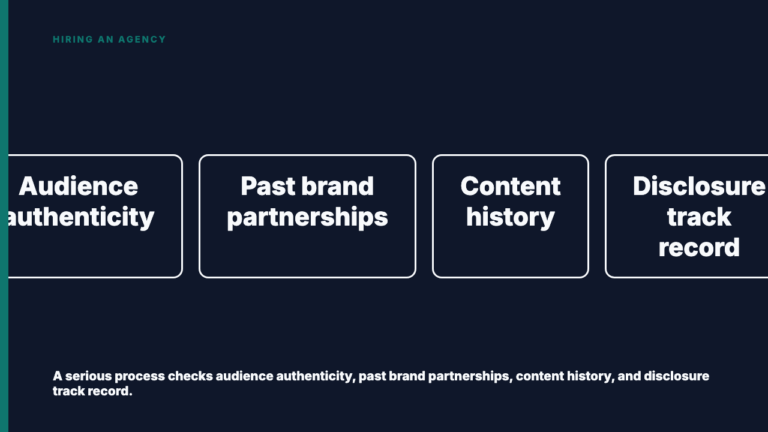
Business hours deliverables and after-hours incident response are two different commitments. A contract can define the first down to posts per month and the day the report lands, and say nothing about the second. Silence is not an implied yes. When you read the scope of work before you sign it, look for what it commits the agency to when there is nothing to produce, only a decision to make under pressure. That term belongs beside termination and account ownership in what to check in a social media agency contract.
It is 9pm on a Friday, a reply under your latest post has been screenshotted, and the screenshot is outperforming the post. Who is watching, who decides whether to respond, and who may publish? The community manager logged off at six, and no sequence was ever agreed, so the first hour goes to inventing one.
Three questions the protocol has to answer
- Who is notified first, and how? There is a real difference between monitoring that pushes an alert to a named person’s phone when comment volume spikes, and monitoring someone reviews on Monday. If you are expected to spot it and ping the agency, say so, because it makes you the monitor.
- Who has posting authority in the moment? Can the agency reply, hide, edit, or unpublish without your sign-off? If yes, write the limits: a holding acknowledgment yes, a statement on the underlying issue no. If no, name the approver and their backup. At 11pm a job title is not reachable, a person with a phone is.
- What is the response time commitment? Not “we will get on it quickly”. A number, in writing, for acknowledging your alert, another for a first public response, and a stated consequence when either is missed.
What a real escalation protocol looks like on paper
Here is an illustrative clause. Every number in it, and in the table below, is invented and drawn from no standard. Yours should come out of a negotiation about what your agency can staff.
Escalation and after-hours response, illustrative only. Each party designates a primary on-call contact and a named alternate, with mobile numbers exchanged and refreshed after any staffing change. First contact for a Tier 2 or Tier 3 event is a phone call. If the primary does not answer within fifteen minutes, the caller proceeds to the alternate.
| Tier | Trigger | Who acts | Response window, invented |
|---|---|---|---|
| 1 | An isolated negative comment | Agency handles under standing guidelines. No call. | Normal business hours. No after-hours clock. |
| 2 | Accelerating or coordinated volume on one thread | Call the on-call contact. Agency may use pre-approved holding language, nothing further without the approver. | Call answered within 30 minutes, holding acknowledgment live within 2 hours. |
| 3 | Factual error in live content, or legal or safety implications | Call primary and alternate. Agency may unpublish immediately, then draft for the approver. | Call answered within 15 minutes, first public response within 4 hours. |
The channel is the detail people skip: a Slack message at 11pm sits unread until morning, so first contact is a phone call, to a number you have dialled once as a test. And the fallback, because contacts change jobs, which is why this gets revisited alongside what happens if your account manager quits.
Why this has to be negotiated before anything is wrong, not during
Once an incident is live, every minute spent clarifying who owns what is a minute the response is not happening, and the delay often becomes the story. Raising this while the relationship is calm costs a conversation. Raising it mid-crisis costs trust on both sides, and asks an agency to accept obligations it never priced. It needs an owner, one more reason the internal role that has to own this cannot sit vacant.
What happens without a protocol, in practice
The bad version: a brand hears at 11pm through a friend’s text, not from anyone paid to be watching. The account manager replies at 7am, explains that nobody checks notifications after six local time, and that authorising a post was never their call. By then the public read is not that the brand was slow, it is that it did not care.
The good version is duller. Within minutes a named person at the agency has been alerted and has phoned the brand’s on-call contact. The tier named on that call settles who decides and who publishes, and an acknowledgment goes up from pre-approved language. Nobody argues about authority, because it was settled weeks earlier.
Questions to put to your agency this week
- Does your monitoring alert a person outside scheduled hours, or only while someone is logged in? A dashboard showing a spike is not an alert if nobody is watching it at 10pm.
- Who can post, edit, or delete without our approval, and how do we reach them after hours? Get a name and mobile number, then a second name and number. Dial one in daylight.
- What response time do you commit to in writing, and does it change by severity? If nobody will put a number in an email, that is your answer.
If you are still choosing an agency
Ask this in the pitch, not a year in. Browse vetted agencies by specialty and location, and if you run an agency with a protocol already in place, list your agency free.
FAQ
What response time should I expect from my agency during a reputational incident?
There is no benchmark to hold them to, and anyone quoting an industry standard number is quoting something they cannot source. Treat the response window as a term you negotiate, not a norm you inherit. Agree a number for acknowledging an alert, another for a first public response, and get both in writing.
Is this the same as hiring a crisis PR firm?
No. This is about the relationship you already have: who watches, who decides, and who publishes when something goes wrong outside business hours. A crisis communications specialist is a separate and larger decision, with different budgets and a scope well beyond a comment thread. The protocol with your existing agency governs the first hour.