Agency Reference Calls: What to Ask, and Which to Refuse
You are down to two agencies. The decks are equally polished, the retainers are close, and both firms handed you a reference list before you asked. Most buyers treat that list as the tiebreaker, but it is the one part of the pitch the agency controls completely.
A reference list is a marketing asset, not evidence
Any agency worth shortlisting can find two or three clients who will take a fifteen minute call and say kind things. That is a low bar. A supplied list answers one question, whether this agency has any happy clients at all, and you assumed the answer was yes when you invited them to pitch.
That is not dishonest, it is just selection. The agency offers the account where the chemistry was good and the scope held, not the one where the strategist quit in month four. When both finalists show you the same kind of client, the exercise cancels out and you are back to comparing decks.
Ask for the reference the agency would not choose
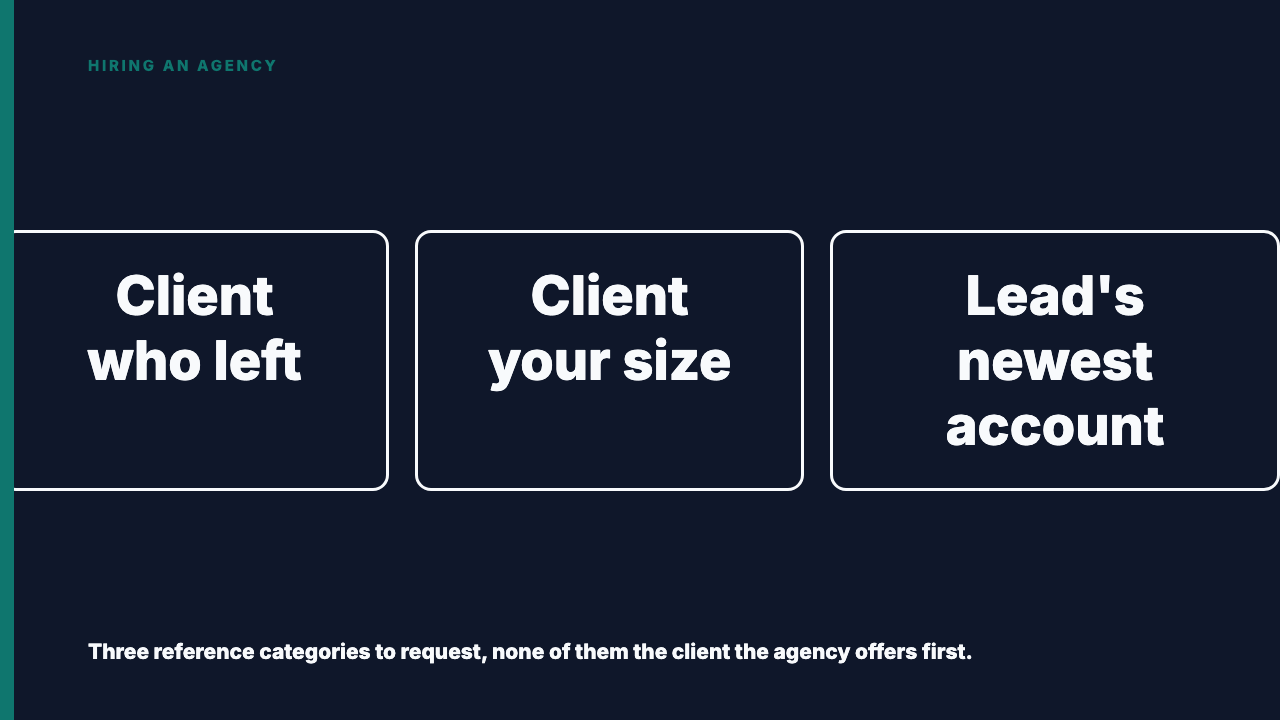
Request three references by category rather than by name. Each controls for a different failure mode.
- A client that left, ideally within the last year or two. A current client shows you what the relationship looks like while it is working. A departed client shows you what breaks, and how the agency behaved once things went badly.
- A client in your revenue range. Not your industry, your size. An agency whose other clients are ten times your revenue has approval chains, reporting cadences and staffing minimums built for a company with a marketing department, which on your account is overhead you cannot use. Revenue range tests whether the process fits a business shaped like yours.
- The account lead’s most recent client. Not the agency’s best work, the individual’s current work. Whoever is named as your day to day lead just came off another account, so ask for that client specifically. This is why the team that pitches you isn’t always the team that runs your account.
What a refusal tells you
Some agencies will say no. That is data, not a technicality. A client under an NDA that survives the engagement is credible, and so is one who ended on decent terms and then went dark. The evasive version sounds different. It is the firm that cannot name one departed client, or that tells you nobody has ever left. Churn is normal, and an agency claiming none is either very new or not being straight with you.
Either way, keep the thread. Ask them to describe the departure themselves: why the client left, what went wrong, what changed afterwards. You lose the independent account, but you learn how a vendor narrates its own failure while you watch. An honest version names a cause and a fix. A defensive version says the client was difficult.
The questions a coached reference cannot answer smoothly
The questions decide whether the call is worth anything. Ask these:
- What took the longest to fix once you flagged it?
- Did anyone on your account team leave or change mid engagement, and how was that handled?
- What happened the first time results were bad?
- Knowing what you know now, would you sign the same contract again, or change something in it?
They work because they are open, past tense and anchored to an event. A reference cannot answer them from general goodwill, they have to retrieve a memory, and the retrieval is what you are listening for. Compare “were you happy with the agency,” which is closed and answered well by default. Nobody who agreed to be a reference says no to that, so the answer is a script you wrote yourself.
Running the call
Here is an illustration, invented to show the shape of the move. It is not a transcript, and no real agency or client sits behind it. You ask what took the longest to fix once they flagged it, and the answer is smooth and empty.
“Honestly, nothing major. There was some back and forth early on but they were always responsive.”
Do not move on. Ask for one instance: what was the last thing you flagged, and what happened after you sent it?
“Reporting, probably. We wanted the monthly deck to split organic from paid because our finance lead kept asking, and it took two months and three reminders. Fine since then.”
That arrived only because the follow up asked for an episode rather than an assessment. A reasonable request from a satisfied client still took two months and three reminders.
A strong answer and a weak answer sound different
A strong reference is specific and volunteers a complaint alongside the praise. They name the friction and the fix: onboarding ran two weeks past the promised start, the agency added a second coordinator once we said something, and the delay never repeated. It is credible because they gave you the bad half without being pushed.
A weak reference speaks in superlatives with nothing underneath. Great team, super creative, easy to work with. Ask for an example and they reach for the case study rather than the relationship. That redirect is the signal.
Using this as the tiebreaker
Weight the calls unevenly on purpose. The departed client conversation and the account lead’s current workload should outweigh the polish of the case deck, because they describe what happens after you sign, while the deck describes what the agency looked like while selling. Polish measures how good a firm is at pitching, which is not what you are buying. Pair what you heard with the questions that disqualify an agency outright, which interrogate the agency directly rather than the people who hired it.
Building the shortlist in the first place
If you are still building the shortlist, browse vetted agencies by specialism and location, and read our guide on how to choose a social media agency. If you run an agency, you can list your agency free.
FAQ
Is it reasonable to ask an agency for a client who fired them?
Yes, framed as standard due diligence rather than an accusation, and say you ask every finalist for one. An agency confident in why a relationship ended will either provide the contact or explain clearly why it cannot. The only bad response treats a normal question as an insult.
What if the agency says the departed client is under NDA or unreachable?
Treat it as plausible without treating it as sufficient. Ask them to describe the departure in their own words, then weigh that against everything else you have on both finalists. The question is not dropped, it is just answered by a more interested party.