In-House, Agency, or Hybrid: How to Actually Decide
Someone has asked whether you should hire a social media agency. Stop there. That question hides an earlier one: whether the work you need is agency shaped at all.
Why company size and budget are the wrong starting point
This decision comes before you shortlist anyone, not after three proposals are on the table.
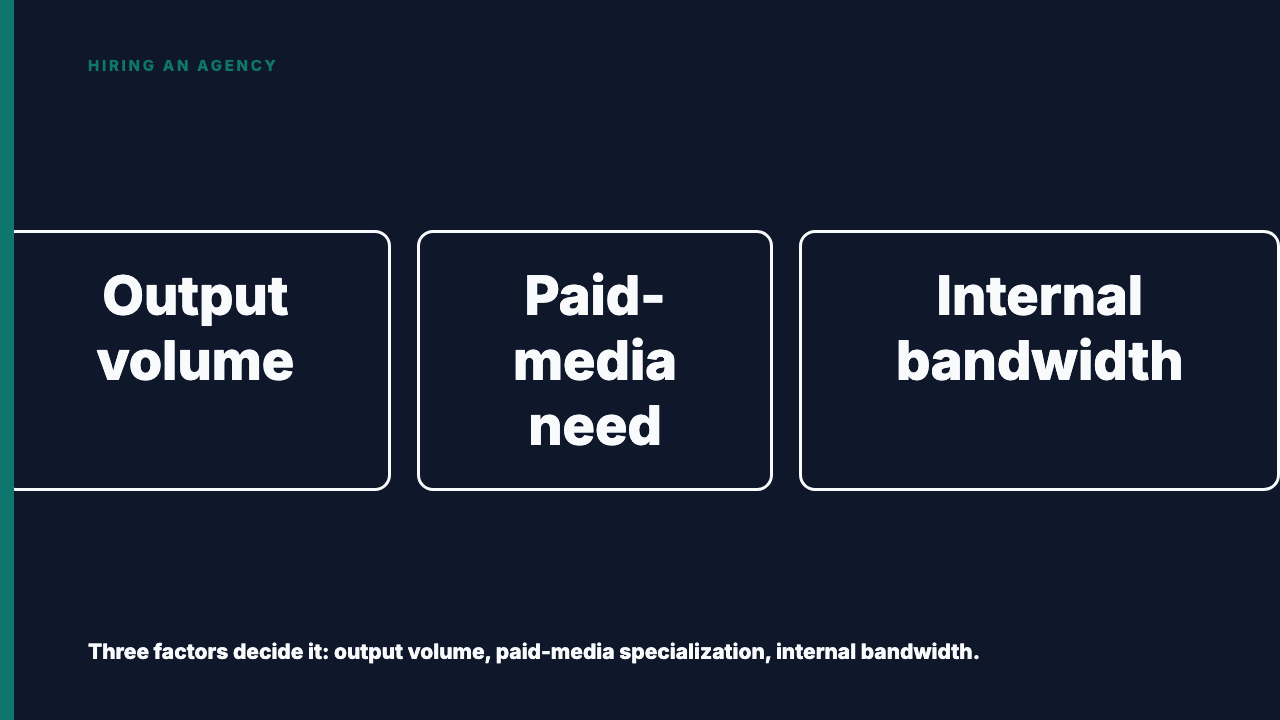
Three things decide it: how much output you need to sustain, whether you need paid media specialization, and whether anyone internally has the bandwidth to manage a vendor. Company size and revenue correlate with those three, but they are proxies, and proxies fail.
Picture two companies with the same headcount and marketing budget. One lives on paid social, rotating creative against cold audiences every month. The other posts three times a week to an existing community, no ad spend. Same size, opposite answers.
Output volume: how much you actually need to publish and produce
A brand posting twice a week on one or two platforms is one person’s job, and a capable generalist sustains it without heroics.
A brand needing daily posting across five platforms, plus a refreshed batch of paid creative every few weeks as the set fatigues, is not. Hire one person for it and either they burn out, or one platform quietly goes stale and nobody notices for two quarters.
Volume means sustained cadence, not a launch push. Ask what month seven looks like, when it is boring.
Paid-media specialization: the skill an in-house generalist rarely has
Paid buying and organic content are two jobs that touch the same platforms. Organic is content and community work. Paid is operational: structuring the account so results are readable, testing creative on a cadence, pacing budget across the month, and noticing fast when a platform changes its policies or its delivery behavior. That last item makes it a maintained skill, not a learned one.
Hold it in one hire and you have a single point of failure. When they leave, the skill goes with them and the account is unreadable to whoever remains. An agency spreads that specialism across many client accounts, and one person on one account cannot manufacture that volume of reps.
Internal bandwidth: what managing a vendor actually costs you
An agency changes the shape of your workload, it does not remove it. Someone on your side does all of this, on a repeating cadence:
- Write or review the creative brief, so the agency knows what is launching and what it cannot say.
- Turn approvals around on a deadline. A post sitting in your inbox for five days does not run.
- Show up to the recurring status call with internal context the agency does not have.
- Read the reporting against what the scope promised, and raise the gap.
If nobody internally can own that list, the relationship degrades regardless of how good the agency is.
When the right answer is neither, not yet
Sometimes you are not ready to hire anyone. You have not defined the audience, so any brief is a guess an agency fills with its own assumption. You have not tested whether social does anything for this business. Or you cannot fund one small paid test, so a specialist would arrive with nothing to spend.
Waiting is a real decision, not stalling, as long as you write down what has to become true before you revisit it.
Combining the three factors into a decision
| Output volume | Paid-media need | Internal owner | Points toward |
|---|---|---|---|
| High, daily, several platforms | Yes, paid is core | Thin, nobody owns briefs | Agency |
| Low, one or two platforms | No, or an occasional boost | Yes, someone wants the job | In-house generalist |
| High | Yes, a genuine gap | Yes, a strong owner exists | Hybrid |
| Undefined, still guessing | No budget to test | Not applicable yet | Neither, not yet |
These are illustrative starting points, not a formula. Real situations mix the factors, and row two flips the moment a paid budget appears.
The hybrid model, and where it breaks
Hybrid means a specific split of ownership, written down. Two patterns cover most cases. The agency runs paid media end to end, including the creative built for testing, while in-house owns organic content and community. Or the agency owns strategy and creative while in-house owns publishing and every reply.
Hybrid fails one way. Nobody wrote the boundary down, so both sides assumed the other had a function, or both did it twice. It surfaces late, when a launch post never went up and two parties describe the same arrangement differently. Name an owner for every function on one page before kickoff.
What to do with this once you’ve decided
If you landed on agency or hybrid, the next question is how to pick one. That is covered in how to choose a social media agency, followed by the questions to ask before you sign. When you are ready to shortlist, browse vetted agencies, or list your agency free if you run one.
FAQ
Is it cheaper to hire an agency or build an in-house team?
A straight comparison misleads unless the scopes match. One in-house generalist and a full-service retainer are not doing the same job, so you would be comparing a salary to a team’s output. Decide the scope first, then price it both ways. For how agency fees are structured, see how agency pricing actually breaks down.
Can one agency cover both sides of a hybrid model?
Yes, because a hybrid is defined by who owns which function, not by how many vendors are in the room. The boundary still has to be written down. Two vendors with a clear split works. One vendor with a fuzzy split does not.
How do I know if I actually have enough internal bandwidth to manage an agency?
Go back to the four tasks above: briefs, approvals on a deadline, the recurring call, and reading reporting against scope. Then ask whether anyone already performs the equivalent role for another vendor you use. If nobody does, that is your answer.
Should a small business ever hire a social media agency?
Yes, when there is a real paid-specialization gap, or a volume need one generalist cannot sustain. No, when the real gap is that the business has not decided what it should be posting or to whom.
Sources
- How to Choose a Social Media Agency: Specialties, Proof, and Fit, fetched 2026-08-30.
- Social Media Agency Pricing: The Four Budget Bands Explained, fetched 2026-08-30.
- Questions to Ask a Social Media Agency (With the Answers That Disqualify), fetched 2026-08-30.