Who Answers Customer Support Questions in Your Agency’s DMs?
Your agency runs your inbox, and customers are using it to ask for refunds, chase orders and dispute charges. Nobody wrote down who answers them, so some sit for days and others get an answer the company never approved.
The DM your agency should never have been left holding
Here is an illustrative scenario, not a real case. A customer DMs about an order that is a week late. The community manager replies with an apology and “we will refund you.” Two weeks later finance sees the order falls outside your refund policy and declines, and the customer holds a screenshot of the promise.
The cause is structural. You hired the agency for content and community, and the moment it started running the inbox it became your first support desk by default. It has no order system access, no refund authority and often only a partial picture of your policies.
So the thesis: this is a contract and process gap, not an agency competence problem, and it belongs on the buyer’s side to fix. A promise made on your behalf may be treated as binding on you in some circumstances, which varies by jurisdiction, so take advice from counsel.
Why the scope of work almost never covers it
In my experience, community management scopes often say something like “respond to inbound messages” and stop there. That phrase silently includes support traffic. Unless the scope carves support out, the agency is expected to answer refund requests and billing disputes too.
This differs from the community management coverage window, which is about hours, and from a separate crisis escalation protocol, which covers viral incidents. This is routine, everyday support volume.
The bad version of a scope says nothing about support and names no escalation contact. The good version has a named category list of what the agency answers, what it routes, and a named person on the brand side who receives what is routed.
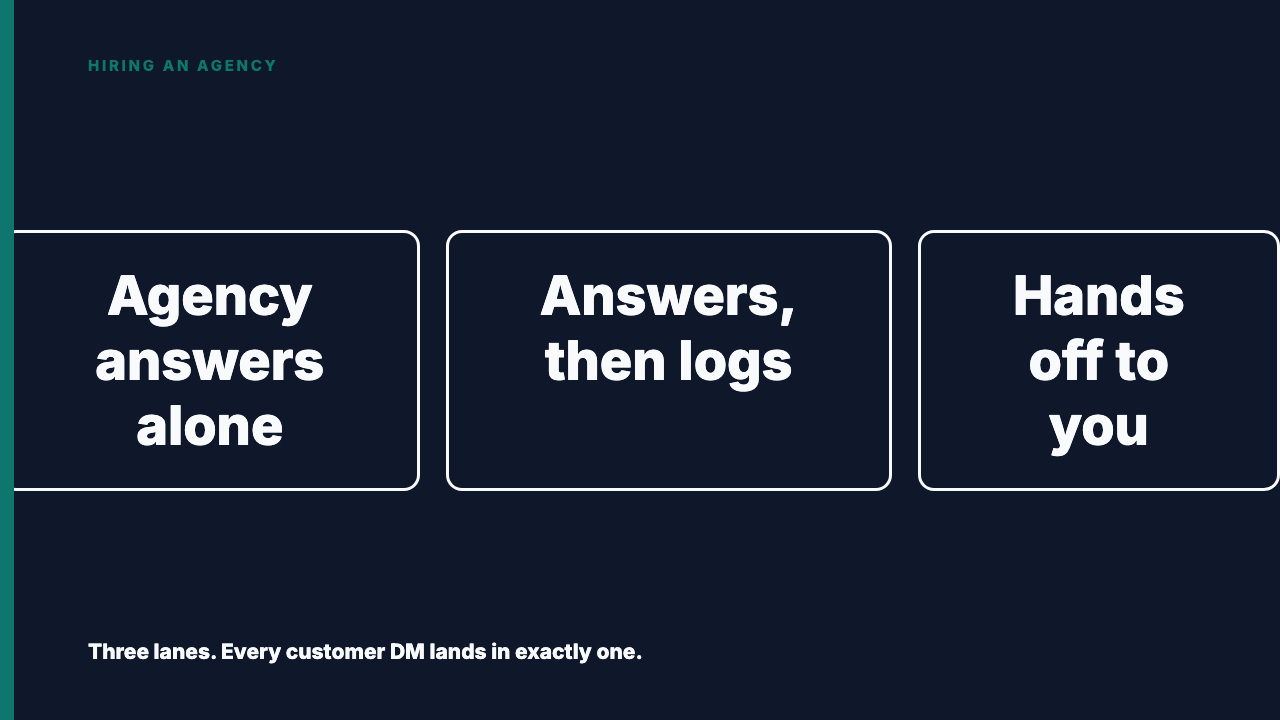
The three lane triage rule
This is a suggested starting structure, not an industry standard. Adapt the categories, but keep the principle: every message lands in one lane.
| Lane | What the agency does | Typical messages |
|---|---|---|
| One: agency answers alone | Replies and closes the thread without involving you. | Product questions answerable from the supplied FAQ, store hours, where to buy, sizing or feature questions, general compliments. |
| Two: agency answers, then logs | Sends an immediate acknowledgement (“we have your message, our team will contact you within X”) and records the case. | Anything touching a policy, a complaint about tone or experience, a repeat contact. |
| Three: hand off, agency never resolves | Acknowledges, logs and passes it to your support team at once. | Refunds, order status that needs a system lookup, billing disputes, account or personal data requests, safety or health claims, legal threats, anything involving a named employee. |
In lane two the agency may acknowledge and record. It may not interpret policy or offer a remedy.
Words the agency is not allowed to use
The agency can acknowledge and route. It cannot commit the company.
- Acceptable holding reply: “Thanks for flagging this, I have passed it to our support team and they will reply to you here or by email within one business day.”
- Unacceptable: “We will refund you.”
- Unacceptable: “That is covered by our warranty.”
- Unacceptable: “It will arrive on Friday.”
Name the commitments the agency must never make: refunds, replacements, discounts, delivery dates, warranty coverage and policy exceptions. A written list protects you more than telling the agency to “be careful,” because a new community manager can check a draft reply against it on day one.
How fast, and how the handoff is logged
The response time SLA needs two clocks, and only one is enforceable against the agency.
- Clock one, on the agency: time from message received to handoff logged. You can hold the agency to this.
- Clock two, on your team: time from handoff to first human reply. The agency cannot enforce this.
A usable handoff record holds the customer handle, the message, the time received, the category, what the agency already said, and who on your side received it. Keep it in a shared log you own, not an email thread in the agency’s inbox. A bad log is screenshots in a chat with no timestamps and no owner. A good log has one row per case, a status column, a named owner and a closed date.
Ask the agency for a monthly count of lane three handoffs from its own log. Treat it as the agency’s own figure, not something to compare against an outside benchmark.
Your side of the bargain
The rule fails if you do not staff the other end. Name an owner who receives handoffs, and a backup, as part of an internal owner for the agency relationship. Give the agency a maintained FAQ, current policy summaries and a short list of who to page for what.
Do not give the agency order-system or payment access to solve this. The answer is a role, not the keys, with limited rights.
Audit your inbox this week
- Pull the recent DM threads that look like support requests and sort each into the three lanes by hand.
- Read what the agency said in each, and note how long the customer waited.
- Flag any commitment your company would not have honoured, and any thread with no reply and no handoff. Either one means a contract amendment: add the lane table, the prohibited promises and the two clocks.
If support volume was never in scope, handling it is legitimately a change order. See how scope creep and change orders work.
If you are comparing agencies, Browse vetted agencies. If you run an agency, you can list your agency free.
FAQ
Should a social media agency handle customer support at all?
Partly. It can answer simple, documented questions and acknowledge everything else, but resolution that needs order data or authority stays with your support team.
What if we do not have a support team?
Name one person as the receiving owner anyway, and treat lane three volume as a signal that you need a support process or a separate support contract. Do not silently expand the agency’s role.
Sources
- Community management coverage window, fetched 2026-09-29
- Crisis escalation protocol, fetched 2026-09-29
- Agency account access permission levels, fetched 2026-09-29
- Internal owner for the agency relationship, fetched 2026-09-29
- Scope creep and change orders, fetched 2026-09-29