How Often You Should Actually Hear From Your Social Media Agency
Three months into a retainer, most brands cannot tell whether the contact they get is normal. Either the agency has gone quiet, or the calendar has filled with standing calls nobody can justify.
Why cadence gets misjudged in both directions
Silence and an overbuilt meeting schedule look like opposite service styles. Usually they are the same problem in different clothes: nobody on the agency side is actively managing the decisions on your account.
When an agency goes quiet, the work has not stopped. Posts still go out, ads still run. What has stopped is anyone asking whether something now needs your input.
The heavy schedule fails the same test from the other side. Three standing calls a week often means the agency is filling time it cannot otherwise justify, or substituting live meetings for reporting it never built. Neither pattern disqualifies an agency by itself. The test is whether contact tracks pending decisions.
What cadence is actually for
A status touchpoint tells you what happened: what published, what the numbers did. Nothing changes based on when you receive it. A decision touchpoint is different. Something cannot proceed until you approve or choose, so it carries a real clock set by the decision, not your calendar.
Picture a restaurant group running paid social on two platforms. Ten days in, one is spending steadily and returning almost nothing while the other performs above its recent range. Budget should shift this week. Wait for the monthly report and three weeks of spend go into the weaker placement. A fixed cadence agreement only governs status touchpoints. Decision touchpoints get triggered by the decision, not the calendar.
How retainer size changes what’s reasonable to expect
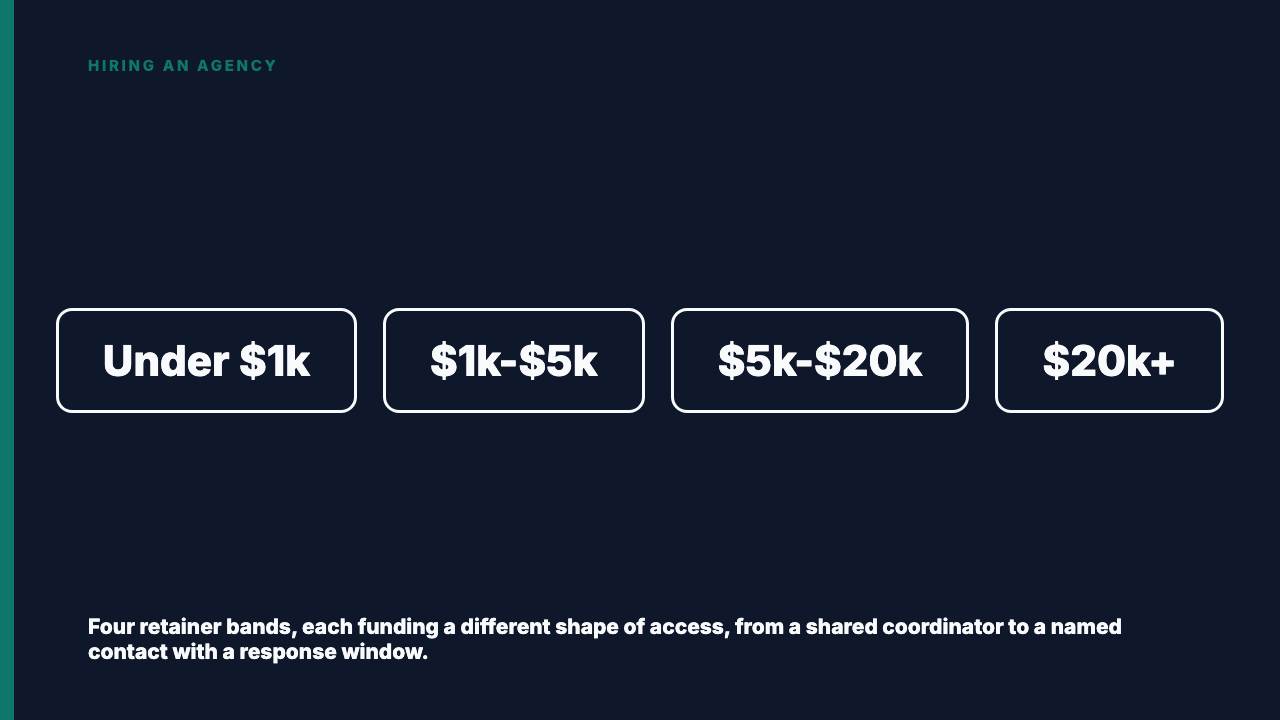
Access costs money, and pretending otherwise leaves brands feeling cheated. Each of the four retainer bands this site uses funds a different staffing shape.
| Band | What the fee plausibly funds | Reasonable expectation on access |
|---|---|---|
| Under $1k/mo | Account management shared across clients | A scheduled check-in and replies inside a working week. A dedicated manager reachable outside it is not realistic, because the fee funds a fraction of one person |
| $1k-$5k/mo | A coordinator carrying a portfolio of accounts | A regular touchpoint and one defined channel. Escalation may route through a stranger |
| $5k-$20k/mo | A small team with a strategist attached, not borrowed | A named account manager, and contact when a decision is live, not only on schedule |
| $20k+/mo | Dedicated time from identified people | A named contact responding inside a defined window on urgent items, plus a named backup. Ask for it in writing |
None of this is an industry standard, and you should not quote it as one. It is reasoning about what a fee can fund, not a benchmark. An agency at the top band that will not commit to a response window is failing something you already paid for.
The signals that should trigger contact regardless of the schedule
- A result falls well outside the account’s own recent pattern, in either direction. Not outside an external benchmark, outside what this account normally does.
- A platform policy or algorithm change is reported to affect your content or ad delivery specifically. General industry news is not a reason to call. A change touching your categories or formats is.
- Planned content carries brand or reputational risk. That decision belongs to you before it publishes, not in a post mortem.
- A request from your side falls outside the agreed scope. That needs a change order conversation before work starts, not an invoice surprise later.
What an overbuilt meeting schedule usually means
Take two hypothetical agencies on one account. Agency A sends a short written update each week and books a call only when a decision is pending. Agency B holds three standing weekly calls to relay what could have been three sentences in an email.
Agency B looks more attentive and is usually less attentive, because the meeting has become the deliverable. Ask after every call: could this have been a two paragraph message? If yes most weeks, the meeting is the product, not account management.
Quiet that is actually fine
The opposite mistake is real too. A mature account with a documented content calendar and no open strategic questions can run on a monthly touchpoint with nothing wrong at all.
The question is whether the quiet exists because nothing is pending or because nobody is looking. Ask what decisions are coming in the next six weeks. An agency that is watching names specifics: a fatiguing format, a reallocation due at quarter end. One that is not says everything is going well and offers a call.
Writing the cadence into the contract instead of assuming it
A cadence clause should name three things: the standing meeting frequency and who attends from the agency side, a maximum response time for urgent items, and a named backup for when the account manager is unavailable, as what happens when your account manager quits covers. Compare two versions of the second:
The agency will respond to time-sensitive requests within one business day. Time-sensitive means anything affecting live spend, publishing schedules, or reputational risk.
The agency is responsive to client needs and maintains open lines of communication.
The first is checkable, and it defines what counts as urgent. The second cannot be breached, which is the same as saying it cannot be relied on. Put it in the signed scope of work, not a verbal understanding from the pitch, as part of how to read a scope of work before you sign it and the questions that disqualify an answer.
Where to start if you are shopping
If enough of these tests have failed and you are shopping, browse vetted agencies and raise the clause in the first conversation, not at renewal. If you run an agency and communication discipline is your differentiator, list your agency free.
FAQ
Is a monthly report enough contact with a social media agency?
It depends on how many decisions are pending between reports, not on a rule. A stable account with no open questions runs fine on a monthly touchpoint. One in a ramp period or running meaningful paid spend generates decisions weekly, and a monthly rhythm strands them.
How many calls a month should I have with my agency?
There is no correct universal number, and an agency quoting one as an industry standard is describing its own process. Ask what your retainer can fund in dedicated attention, and whether decisions get made on time. One call that resolves three real decisions beats eight that recite status.
Sources
- Social Media Agency Pricing: The Four Budget Bands Explained. Fetched 2026-09-05.